Eighty-eight years ago, on November 9-10, over 1,400 synagogues across Nazi Germany were attacked and set alight in what became known as Kristallnacht. Today, Jewish communities around the world are once again facing attacks on their synagogues and places of worship.
One year ago, a terrorist chose Yom Kippur, our holiest day, to attack my synagogue in Manchester. I was shot trying to keep the doors closed. One of my fellow worshippers, Melvin Cravitz, died from multiple stab wounds, and another, Adrian Daulby, was killed by a bullet fired by police responding to the attack.
Two months ago, I walked back through the doors of Heaton Park Synagogue for Yom Kippur. I couldn’t pretend it would be easy, but I knew that, as a community, we would face it together. We always do. An attack on our community can intensify antisemitism, but it can also strengthen Jewish identity and bring people closer together.
I have thought about that morning of the Yom Kippur shooting every day since, and I have come to a difficult conclusion: antisemitism will never be defeated by higher fences. Just hours before Yom Kippur this year, as we were preparing for Kol Nidrei, two men were arrested in Manchester on suspicion of plotting to target our community again. Last month, our Home Secretary, the cabinet member responsible for internal security, announced an inquiry to establish how the attack happened, whether police and intelligence agencies missed opportunities to stop it, and what lessons can be learned to better protect Jewish communities.A year later, the physical wounds may have begun to heal, but the world around us does not feel safer.
We have seen in London arson attacks on synagogues and Jewish-run ambulances in and the stabbing of two Jews. There are more gates and more security than we have ever had. This year the Community Security Trust, a charity that protects the Jewish community and monitors antisemitism, reported that antisemitic assaults are up by 82%. Lord Mann's National Health Service review found Jewish patients avoiding treatment and Jewish staff considering leaving the service, saying that antisemitic “interactions between NHS staff and with patients, their relatives and members of the public” have become “normalized.”
Universities feel less safe too. We do not put the addresses of community events on posters. Our children go to schools that can look like fortresses.
The danger is that, over time, we become accustomed to living this way.
I know where hatred can lead because I have experienced its consequences in my own body. Antisemitism does not begin with someone deciding one day to attack a synagogue, or that an entire Jewish population should be wiped out. It begins with exclusion and isolation, with removing rights, jobs and citizenship, and with making life so unbearable that Jews are forced to leave.
On Simchat Torah this year, three years after Oct. 7, U.K.’s Green Party voted to make itself an explicitly anti-Zionist party. For many British Jews, seeing this on the anniversary of Oct. 7 made an already hostile environment feel even less safe.
Kristallnacht reminds us that the destruction of Jewish life does not begin with the destruction of synagogues. It begins much earlier, with hateful rhetoric, propaganda, exclusion and the normalization of antisemitism. The Holocaust did not begin with the concentration camps. That is why Holocaust education matters, and why we must challenge antisemitism long before it turns into violence.
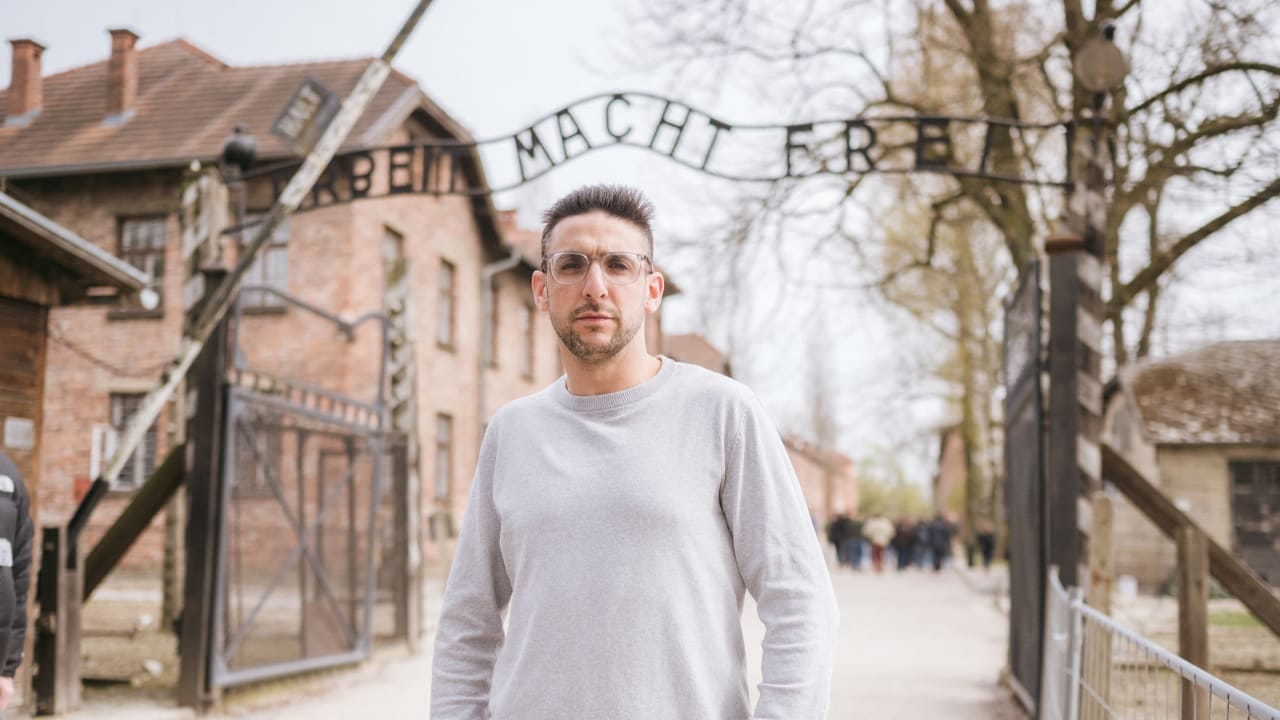
Earlier this year, I travelled to Poland to take part in the International March of the Living, walking from Auschwitz to Birkenau alongside Holocaust survivors and thousands of others. I was not alone in carrying more recent scars. I met survivors of the Bondi Beach attack in Sydney, and of the shooting outside the Jewish museum in Washington, D.C. The survivors I met are heroes who have not let their suffering define them. They have rebuilt their lives and are prouder than ever of who we are.
But there is another lesson I learned this year, and perhaps it is the more important one. The answer to antisemitism cannot just be security. We all have a responsibility and a platform to challenge it wherever we see it. I was privileged to address 130 members of an international law enforcement delegation at Birkenau, and I told them what I have come to believe: Combating antisemitism cannot be left to Jewish communities alone.
Despite everything, what gave me hope was the extraordinary amount of love and support I have encountered over the past year, especially from Holocaust survivors.
When I asked Ivor Perl, one of the Holocaust survivors I met this year, what got him through, he told me he’d had luck, but he’d also had hope. He hadn’t sought vengeance on the Nazis; he’d chosen to rebuild his life instead. He told me something else I’ve carried since: Question what is written, don’t always believe everything you read or hear, do your own research.
If fear makes us hide who we are, if security becomes the defining feature of our schools and synagogues, if we gradually retreat from public life, then hatred has achieved something even without another attack.
I refuse to give it that victory.
This Yom Kippur, I was back in synagogue, leading the same prayers our community was saying when the attack happened. It was a Yom Kippur like no other: tears and sadness, but also love and resilience. We were still there, still in the synagogue, singing and praying again.
I looked around the synagogue and saw the empty seats where Adrian and Melvin, murdered one year ago, had sat. The seats had been roped off as a mark of respect. But I also saw the other heroes from that day: Rabbi Daniel Walker, Andrew Franks, Alan Levy and other brave congregants.
At one point during Neilah, the closing prayer,I closed my eyes. As Chief Rabbi Sir Ephraim Mirvis led us magnificently, fulfilling the pledge he and Lady Mirvis had made at my hospital bed after the attack to be with us on this difficult but meaningful day, I felt an intense wave of emotion sweep through the room as the entire community sang together. At that moment, I realized: We have not been beaten.
For generations, people have tried to make Jews afraid to live as Jews. Kristallnacht was another attempt to do exactly that. So was the attack on our synagogue. This year, once again, we went to synagogue as proud Jews, knowing that whatever our enemies tried to do to us, they did not win.
They never will.
Yoni Finlay is a survivor of the terrorist attack on Heaton Park Synagogue in Manchester on Yom Kippur 2025