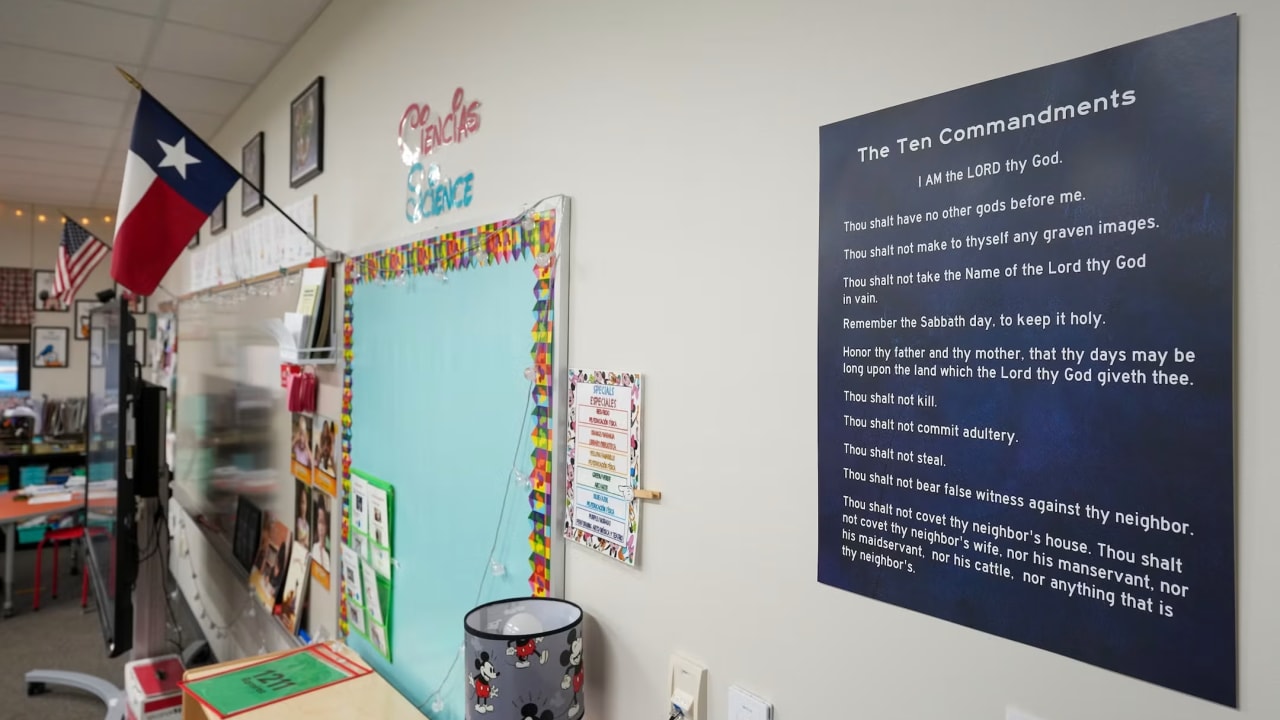
A Texas judge has ordered a Gulf Coast school district to display posters of the Ten Commandments in all classrooms, marking a victory for the state in a long series of legal battles over religious freedom in public education.
District Judge Jeth Jones ruled on Thursday that the Galveston Independent School District must comply within 10 days, while also scheduling a non-jury trial to resolve the case next June.
Texas Attorney General Ken Paxton, a Republican, had sued the school district last November after the school board voted against exhibiting the Protestant version of the Ten Commandments. Paxton’s petition argued that the board violated a June 2025 state law, SB10, which required the “conspicuous” display of Ten Commandments posters in all public school classrooms.
Two rabbis challenging the Texas law at the US Supreme Court
That law is at the center of multiple lawsuits across the state, including one effort led by two rabbis seeking to bring a case to the US Supreme Court. Along with non-Jewish clergy and parents, they are arguing that the mandatory inclusion of these texts in classrooms is unconstitutional and infringes upon religious freedom. Their case is separate from the Galveston case.
“These are religious documents,” Mara Nathan, the lead petitioner and senior rabbi at Temple Beth-El in San Antonio, told the Jewish Telegraphic Agency.

“They do not belong in a secular public school space,” she continued. “If people want to be in a school space where religious instruction is part of that, then they can choose to send their kids to parochial school.”
In their case, Nathan and more than two dozen parties are asking the US Supreme Court to weigh in on the controversial Ten Commandments law. Their petition, filed in August, asks the court to protect the religious freedom of students by ensuring that families, rather than politicians, are able to determine what role religion plays in their children’s lives.
Joining Nathan in the case is Joshua Fixler, associate rabbi at Congregation Emanu El in Houston, as well as Jewish, Christian, Hindu, Baha’i, Unitarian Universalist and nonreligious families statewide. The defendants include a long list of school districts, such as the Alamo Heights Independent School District and the Houston Independent School District, where Nathan and Fixler send their children, respectively.
Their decision to petition the Supreme Court is the culmination of a lengthy legal process that began after Gov. Greg Abbott, a Republican, signed the SB10 bill into law in June 2025.
'Uncomfortable and outraged'
“When I heard about this law, I was really uncomfortable and outraged,” Nathan said. “When I found out there was an opportunity to speak up and be part of litigation to oppose it, I was like, ‘Please sign me up.’”
Fixler echoed these sentiments, with hopes of protecting children from “seeing this Protestant Christian text every day in every classroom, and having it shape their understanding of what religious freedom should look like in America.”
The Jewish and Protestant versions of the commandments differ in wording, order, and emphasis, with the Jewish commandments beginning with God’s declaration that he brought the Israelites out of Egypt.
Nathan, Fixler and the other plaintiffs filed a federal lawsuit in July 2025 seeking to block the display at their children’s schools. The next month, they secured a brief victory in district court when they won a preliminary injunction to block the displays.
Last October, Paxton issued a formal legal advisory to all Texas school districts, reiterating their obligation to exhibit the display. He warned that Texas would vigorously enforce the law, while acknowledging temporary exceptions for 11 school districts that were party to the litigation at the time.
The attorney general described the commandments as “a cornerstone of America’s moral and legal heritage,” stressing a need for “these timeless principles” in schools “now more than ever.”
Appellate court ruled the law didn't violate the First Amendment
The pendulum swung in Paxton’s favor in April 2026, when the US Court of Appeals for the 5th District reversed the district court’s ruling. The judges, who sit on one of the most conservative federal appellate courts nationwide, determined that the law does not violate the First Amendment’s free exercise clause, which prohibits government from regulating religious beliefs.
They maintained that the SB 10 law “looks nothing like a historical religious establishment,” a bar that the judges said was set in a 2022 lawsuit. The Texas legislation, they wrote in the ruling, doesn’t “tell churches or synagogues or mosques what to believe or how to worship or whom to employ as priests, rabbis, or imams.”
“It punishes no one who rejects the Ten Commandments, no matter the reason,” they added.
Unwilling to concede defeat, Nathan and her colleagues in August asked the high court to review the case. Whether the Supreme Court will decide to take on the case is still uncertain, as four of its nine justices must agree to do so.
Fixler noted that the law requires posters of the commandments to be big enough to be read anywhere in the classroom and contain no other texts or context.
“I’m hearing from parents all over the state that their kids know that the state is elevating literally one religious tradition over all others,” he said, relating that although he prepared his kids for the displays, they “expressed a lot of anxiety” about needing “to see these words posted on the wall of their classroom.”
Fixler also expressed concern that the prominence of these posters could lead kids to ask “questions that some teachers aren’t going to want to answer,” such as, “What is adultery, and what does it mean to covet your neighbor’s wife?”
The families are represented by the American Civil Liberties Union of Texas, the national ACLU, Americans United for Separation of Church and State, and the Freedom From Religion Foundation, with pro bono counsel from the Simpson Thacher & Bartlett law firm.
In their Supreme Court petition, the families accused the appeals court of defying a 1980 Supreme Court decision, Stone v. Graham, which they said “struck down a nearly identical Kentucky statute almost 50 years ago.” While the Texas appellate court had claimed that precedents set in a later case had superseded the Stone ruling, the families argued that the core principles of the Stone judgment were untouched by that later suit.
The forced display of the Protestant Ten Commandments in public school classrooms is not unique to Texas, although the Lone Star State case has emerged as one of the most prominent battlefields for the issue in recent months.
Other states that have required public schools to exhibit the Ten Commandments include Arkansas, Louisiana and Alabama, while Tennessee and North Dakota allow optional displays.
'America is a Christian nation'
A group of complainants in Arkansas, including one Jewish family, is urging the US Court of Appeals for the Eighth Circuit to block school districts from implementing a state law on the subject. Meanwhile, in Tennessee, the ACLU and other groups have sent letters seeking records relating to school district plans to begin displaying the Ten Commandments.
In Galveston, the school board president told local media on Thursday that the school district would comply with the order, as demanded in the November lawsuit. Alongside the filing, Paxton had declared that “there is no valid legal basis” to prevent schools from complying with the law, claiming that their refusal was rooted in “the misconception that a ‘separation of church and state’ phrase appears in the Constitution.”
“It does not,” Paxton stated.
While Galveston is not a party to Fixler and Nathan’s Supreme Court petition, the plaintiffs cited the year-long saga as evidence. The situation in Galveston, the petition argues, demonstrates that “injuries” to families who oppose the Ten Commandments displays “are actual or imminent,” a requirement to hear a case in federal courts.
The attorney general accused Galveston’s school board of voting “to flout SB 10” in its refusal “to display the Ten Commandments in accordance with State law.” At the time, he alleged that Galveston decided to “blatantly ignore the legislature,” while emphasizing that “America is a Christian nation.”
Notably, Fixler and Nathan’s Supreme Court petition flags the Galveston case in its appendix, even though the district is not a party to the case. The petition argues that the situation in Galveston shows “injuries” to families “are actual or imminent.”
“I hope that the Supreme Court will take our case and rule in our favor,” Nathan said, affirming that any decision made here could set a precedent for similar cases nationwide.
“It would be really exciting to be written into history in a positive way, as part of a movement to really protect our religious freedom and separation between public school spaces and the private religious lives of people,” she added.