
Archaeologists have uncovered the full floor of Lithuania’s historic Great Synagogue, revealing treasures nearly erased by Nazi and Soviet occupations, and exposing rifts between Lithuanian Jews over how to preserve and interpret what survived.
Locals walking through the center of Vilnius now pass a hole in the ground, a portal to the rich Jewish past of a city once called the “Jerusalem of the North.”
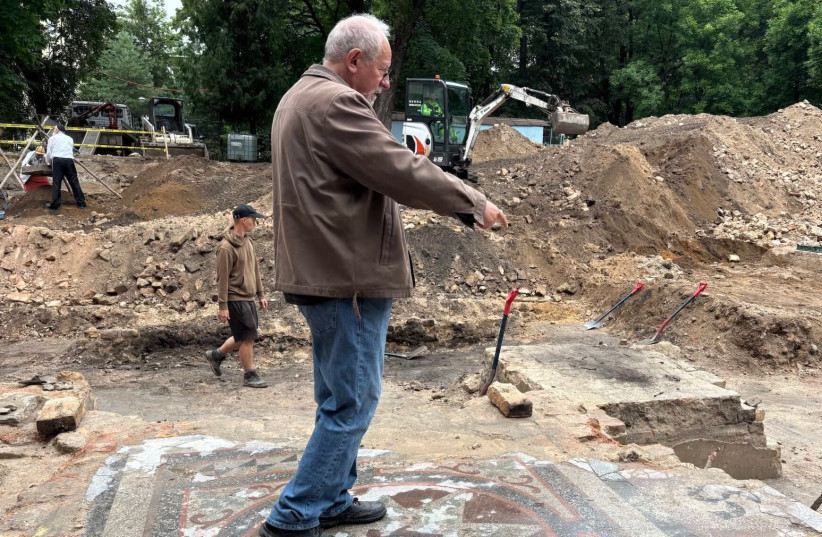
For the first time since 1940, they can see the polished, colorful floor and entire prayer platform of the Great Synagogue of Vilna, built in the 17th century, which became one the most important religious, cultural and intellectual hubs for Diaspora Jews.
In Lithuania’s small remaining Jewish community, who number less than 3,000, there is no debate that the site must be preserved. But discussions about how to protect the past, and what to build over it, have triggered pain over one of the last pillars of identity left standing for Lithuanian Jews.
The community’s main representative body plans to build a new Jewish community center over the excavation, where visitors could view the Great Synagogue floor through a glass layer or a basement-level exhibit. Above, the center would celebrate current-day Jewish life through cultural, social and educational events.
Some Orthodox Jews and their supporters oppose that project, saying the synagogue should be rebuilt as a house of worship or preserved as a purely archaeological exhibit. Other residents say the mission of a new building should be broadened beyond Lithuanian Jews, offering a center that promotes tolerance, human rights and understanding of Jewish history among all Lithuanians.

Lithuanian Jewry was decimated in Holocaust
On the eve of World War II, the massive Great Synagogue stood among more than 100 synagogues and Jewish prayer houses in Vilnius, where about 40% of people were Jewish.
Over 90% of Lithuanian Jews were killed in the Holocaust, and from 1944 until 1990, Vilnius was remade as the capital of the Soviet Lithuanian Republic. The synagogue was burned and largely destroyed by the Nazis, then razed by the Soviets to build a school in its place.
“This is the place that half the population would have identified their city with,” Jon Seligman, the archaeologist leading the excavation, told the Jewish Telegraphic Agency. “So this city at the moment is missing half its identity, and because it’s such a long time since it happened, they don’t even know they’re missing half their identity.”
The excavation is over a decade in the making. Seligman, an Israel-based archaeologist whose Jewish grandparents lived in Lithuania before World War II, first proposed unearthing the synagogue’s remains in 2013 after a visit to discover his family roots. His team of archaeologists have worked there since 2015, and last year, the former Soviet school building over the site was demolished.
In an accident of history, the synagogue’s main floor was constructed below ground and spared from total erasure.
“When the building was built in the 17th century, part of the restrictions that were placed on the Jewish community was that they were not allowed to build their synagogue higher than any of the churches in the surroundings,” said Seligman. “So to create the internal majesty, if you don’t want to have a low, two-story building, what you do is you drop the floor level one story below ground surface, and that’s what they did.”
The latest installment of Seligman’s project, completed in July, fully exposed this main hall and the bimah, or prayer platform, covered in red, white, green and black geometric designs. Archaeologists also found traces of the Shulhoyf, a busy complex that formed the heartbeat of Jewish life.
Vilnius was a major center of Jewish thought, famed for both its religious tradition and modern secular Jewish culture. It was home to the 18th-century Vilna Gaon, one of the most influential Jewish sages, and also the birthplace of the Jewish Labour Bund, a secular, socialist and anti-Zionist organization. Schools taught literature and the sciences in Yiddish and Hebrew, and Zionists shared ideas alongside anti-Zionists.
Before World War II, the Shulhoyf hosted 12 prayer houses, a bathhouse, kosher butcher stalls, the first public toilets in Vilnius, the prestigious Strashun Library and the first headquarters of the Yiddish Scientific Institute, or YIVO. That institute, now in New York City, continues to preserve the Yiddish language and cultural heritage of Eastern European Jews.
Faina Kukliansky, who has since 2013 chaired the umbrella organization known as the Lithuanian Jewish Community, spearheaded the initiative to construct a community center over the synagogue.
Kukliansky grew up as the child of Holocaust survivors in Lithuania under the Soviets. She said the new space will replace the community’s current headquarters, hosted in a nearby building that is more than a century old and struggles with heating and water system issues.
Kukliansky said the new center will honor both the past and the present of Lithuanian Jews, featuring a YIVO exhibition alongside concerts, social clubs and Jewish learning events. After the Holocaust and decades of Soviet restrictions on Jewish life, those who remain are mostly secular and distant from Jewish traditions. Kukliansky said the center’s construction over the remains of the Great Synagogue will inspire Jews to trace the threads of their heritage.
“It’s very meaningful that in the place where the synagogue rose, Jewish life will be intensive because our Jewish community center is there,” said Kukliansky.
But Kukliansky’s plans have met sharp opponents from other corners of Lithuania’s Jewish world. Among the most vocal is Rabbi Sholom Ber Krinsky, an emissary for the Chabad-Lubavitch Orthodox movement who was born in Boston and has lived in Vilnius since 1994.
Some Jews believe a community center wouldn't honor the sanctity of the site
Krinsky said that according to Jewish tradition, the Great Synagogue site should not be covered by a building for secular cultural activities, but remain a “living Jewish religious center that continues the learning and the prayer.”
“If a site was used as a synagogue, for centuries, in this case, the holiness retains its holiness, and it’s proper to respect that holiness,” said Krinsky. “A Jewish community center might be nice, but it certainly doesn’t represent the holiness of that site.”
Krinsky has for years demanded more money for Chabad projects, which he says would be used for religious services, Jewish education and social welfare programs. He accuses Kukliansky of monopolizing funds granted to Jews by the Lithuanian government as compensation for property stolen during the Holocaust. The Good Will Foundation, an international body created through the World Jewish Restitution Organization and the Lithuanian Jewish Community, has been authorized to distribute this restitution money.
Since legislation passed by the Lithuanian parliament in 2022, the Good Will Foundation has disbursed about $9 million to compensate individual Holocaust survivors and their heirs for private property claims. Given that most Jewish property was left without any heirs, another $40 million is being allocated to support Jewish communal life — including projects like the new community center.
Krinsky said these funds have not been sufficiently used to nourish religious life. Kukliansky countered that her organization supports the Choral Synagogue, the only synagogue still active in Lithuania, where Krinsky leads the small group of Jews who usually scrape together a minyan — the minimum of 10 people required for public prayers.
Compared with other Eastern European communities, Chabad’s footprint is small in Vilnius, where the Vilna Gaon led a tradition of opposing Hasidism that became central to the identity of many Lithuanian Jews.
Kukliansky also claims that Krinsky has refused to provide her with financial reports. His wife, Nechama Dina Krinsky, was indicted for tax fraud in 2023.
Kukliansky faces further criticism from Dovid Katz, an American-born, Vilnius-based scholar of Yiddish and the Holocaust. Katz advocated for rebuilding the Great Synagogue or preserving its remnants as a religious site, which he said would draw Orthodox pilgrims from around the world.
“A synagogue is a religious place, and religious leaders today, and everyday religious Jews, need to be consulted on what’s going to replace the Great Synagogue,” said Katz. “It is a place either for a replacement synagogue or for archeological remains.”
Still other critics say the Jewish representative body has split the site from a broader mission that would attract non-Jewish Lithuanians and Jews from around the world. Anna Avidan, who founded a nonprofit called Jerusalem of the North to celebrate Jewish history in Lithuania, led a conference in 2017 that invited historians, architects and students to discuss the future of a space commemorating the Great Synagogue.
Avidan said attendees proposed a cultural center that would host forums about tolerance, drawing international visitors and educating Lithuanians about the Jewish past of their country. She argued it would be “selfish” to build a center exclusively for the Lithuanian Jewish community, since such spaces are closed to the public, partly for security reasons. The proposals emerging from Avidan’s conference were shut down after Kukliansky’s opposition.
“We are still working on how to include Jewish history in Lithuanian history,” said Avidan. “Approaching the site as a site of Lithuanian history, that would promote this harmony and understanding.”
At the excavation site, Seligman’s team has dug up pieces of life in the synagogue, which seated about 500 people, with some 500 more squeezing in for High Holidays.
The latest artifacts to emerge from the ground include a Passover plate, a dish for gefilte fish, a plaque engraved with the Ten Commandments and several seating plaques with the names of people who donated to the synagogue, assuring their spots inside.
These name plaques left clues about families who vanished from Vilnius. One marked a seat for Gitel Klachek, identified as the “wife of the late Yechezkel, Shamash d’Mata,” the city sexton. Their wealthy, influential family owned several businesses around the Great Synagogue.
On the uncovered synagogue floor and the surrounding Jewish neighborhoods, there walked people who disputed religion, Jewish identity, Zionism and other ideas. “There would have been a large contingent who would have been ultra-Orthodox. There also would have been a large contingent who were completely secular,” said Seligman. “So the city was very, very much a very mixed community.”
The fights over the memory of these ghosts, and over Lithuania’s Jewish identity, echo the disagreements that animated the Jews who once thrived there.