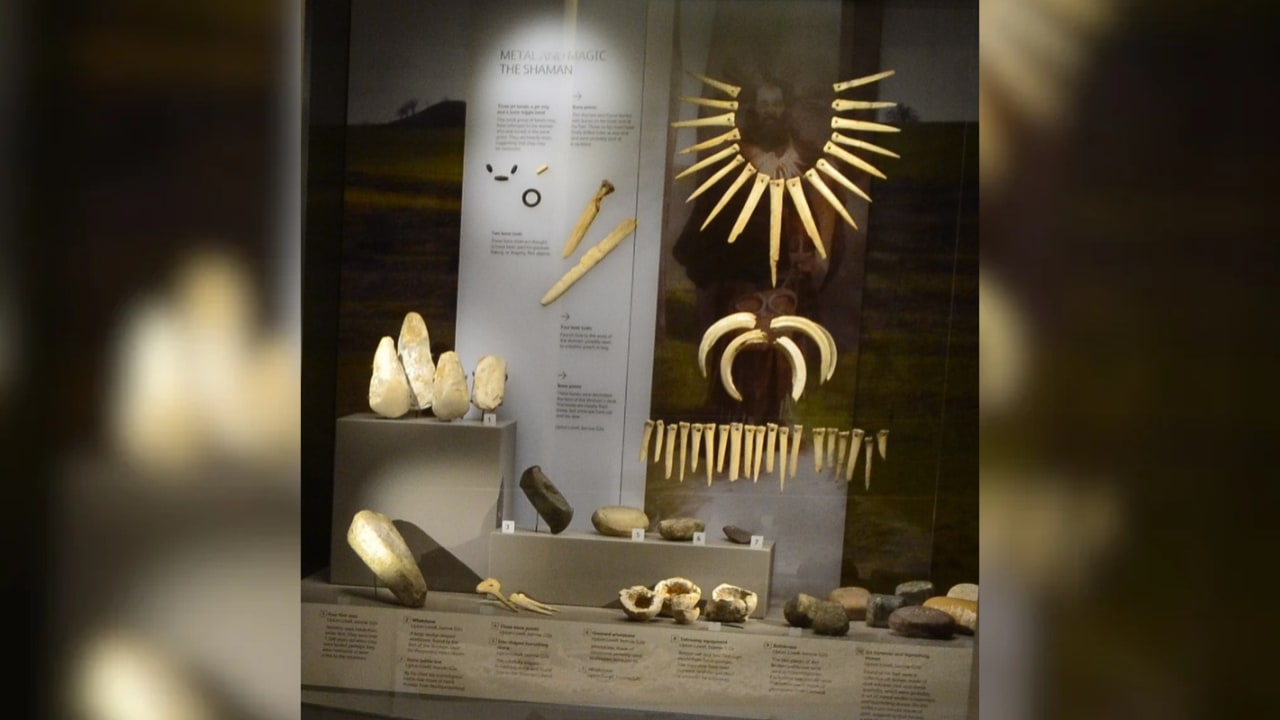
The Upton Lovell Shaman, a Bronze Age metalworker long assumed to have been a male individual, has been shown to be female, according to new research presented at London’s Francis Crick Institute We Go Way Back exhibition.
The exhibit, which opened on July 16, showcases the results of an analysis of DNA extracted from the skeleton’s skull, teeth and toes revealed to have XX sex chromosomes, typical in those who present as female.
“It completely tears up previous assumptions,” Wiltshire Museum Director David Dawson told The Guardian. “It’s a fantastic revelation of the position of women in society.”
“We’re so used to the assumption of men do everything, men are the leaders, men are the metalworkers. Here we have smoking gun evidence of a female metalworker. And metalworking was the space science of its day.”
Further analysis of the bones showed that she had most likely been over 45-years-old when she had died, and bore evidence of arthritis in her right wrist, consistent with a lifelong use of metalworking tools.
The complete details of the research carried out at by Ancient Genomics Laboratory at the Crick are slated to be published in a scientific journal “shortly,” Wiltshire Museum explained in a July statement.
“The field of ancient DNA has surged in technical capability over the last two decades, now giving us answers to questions that were previously inaccessible,” Pontus Skoglund, who is a senior group leader of the ancient genomics laboratory at the Crick, explained to The Guardian. “It feels really good to give this to archaeologists.”
Wiltshire Museum Curator Lisa Brown echoed the sentiment in the museum’s statement, adding that the “groundbreaking research, using cutting edge techniques, shows the importance of making museum collections available for scientific analysis.”
“We now have a whole new understanding of this burial, rewriting their story, breaking stereotypes, and putting women front and centre in our understanding of early Bronze Age society,” said Brown.
Shaman originally assumed to be male
The shaman’s remains, dating to approximately 4,000-years-ago, were originally excavated in 1803 by William Cunnington at a barrow at Upton Lovell, located less than 10 miles from Stonehenge.
At the time, Cunnington had assumed “from the largeness of the bones” that the burial “appeared to be a stout man,” according to the Wiltshire Museum.
Alongside her remains, archaeologists discovered several other artifacts, including a battle axe, stone gold-working tools and a cloak decorated with perforated animal bones.
“It shows the depth of understanding of her craft,” Dawson told The Guardian. “The people she left behind wanted her to take her tool kit into the afterlife.”
Remains reexcavated in 2000
In 2000, the barrow was reexcavated by Dr. Colin Shell, a Senior Fellow at the University of Cambridge, and Gill Swanton, a Wiltshire archaeologist. The shaman’s remains were removed from burial by Shell. He was also the first to notice that the stone tools bore traces of gold.
New research presented in 2022 by researchers from the University of Leicester identified the purpose of the tools as cups made from fossil sponges meant to mix adhesives and battle-axes repurposed to hammer out and smooth gold.
"The ability to transform other objects by the delicate and skilled process of covering them with gold sheet may have been seen as a magical or ritual process, a secret method known only to a few people," Susan Greaney, an archaeologist at the University of Exeter who wasn't involved in the study, told Live Science in a 2022 email. "This research shows how metalworking was closely related to magical, ritual and religious beliefs."