
When an Israeli company considers hiring employees abroad, the first figure usually brought to the table is salary. In practice, however, the amount appearing on the contract is merely the starting point: Mandatory payments, contributions, and taxes can significantly increase the cost to the employer, while simultaneously reducing the amount left in the employee's hands.
A new comparative study by Payoneer Workforce Management, Payoneer's global workforce management division, examined the cost of employing a mid-level marketing manager in six US cities, six European cities, and Tel Aviv. The findings place Tel Aviv in an unusual position: One of the most expensive cities for employers, but not necessarily the most lucrative for employees.
The issue becomes particularly significant for Israeli companies, especially tech firms, which manage a growing portion of their operations overseas. According to the Innovation Authority's employment report for 2025, Israeli tech companies employ about 440,000 workers abroad, compared to about 400,000 workers in the sector in Israel.
In such a reality, the decision on where to open a new position does not depend solely on the availability of skilled workers, proximity to customers, or the desire to enter a new market. It also requires understanding how much the employee actually costs the company, and how much of their salary ultimately remains in their bank account.
$75,000 in salary, $103,000 in cost
The study was conducted under two scenarios. In the first scenario, the employment cost was calculated based on a uniform annual salary of $75,000 in each of the cities. The goal was to neutralize local wage gaps and examine how tax systems and mandatory payments affect the total cost.
In the US, the cost to the employer ranged between $83,054 and $86,615 per year. In the European cities examined, it was higher, ranging from $86,063 to $109,753.
In Tel Aviv, the cost for an employee receiving a gross salary of $75,000 reached $103,161 per year. This represents an addition of $28,161, about 37.5% beyond the gross salary itself. However, a comparison based on a uniform salary does not necessarily reflect the prices at which employees are actually hired in practice.
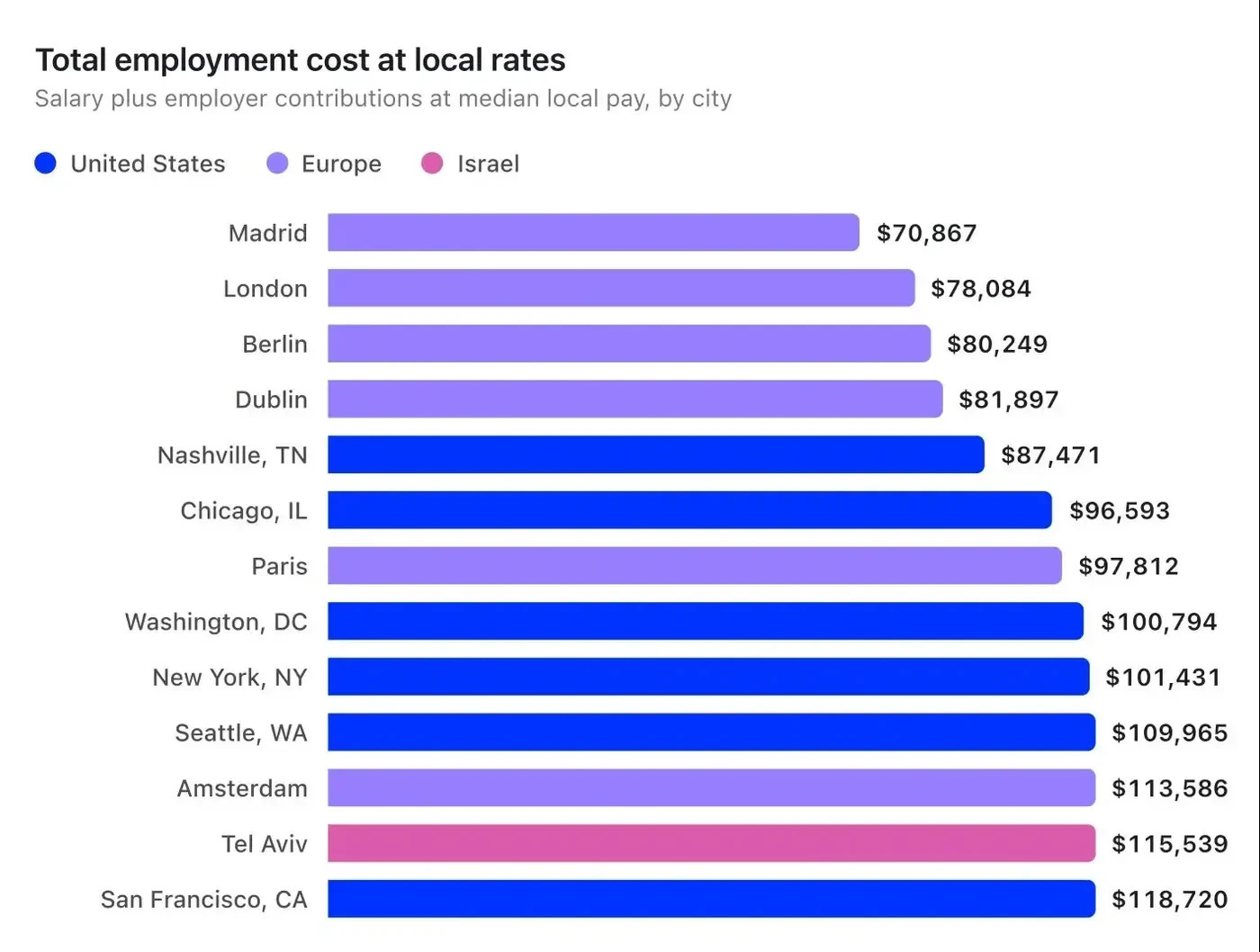
Therefore, an additional scenario was conducted, based on the accepted median salary in each city. The average median salary across the six American cities examined stood at $91,833 per year, about 38% more than the average in the six European cities, which totaled $66,375. These salary gaps make employment in the US more expensive than in most European cities, but Tel Aviv managed to deviate from this trend as well.
The annual gross salary of a marketing manager in Tel Aviv was estimated in the study at $84,000. After adding mandatory employer payments, the total cost of employment climbed to $115,539 per year.
This figure makes Tel Aviv the most expensive city among all the European cities examined, including Amsterdam, Paris, and London. In fact, only San Francisco was more expensive, with an annual employment cost of $118,720.
And net pay for the employee? Among the lowest on the list
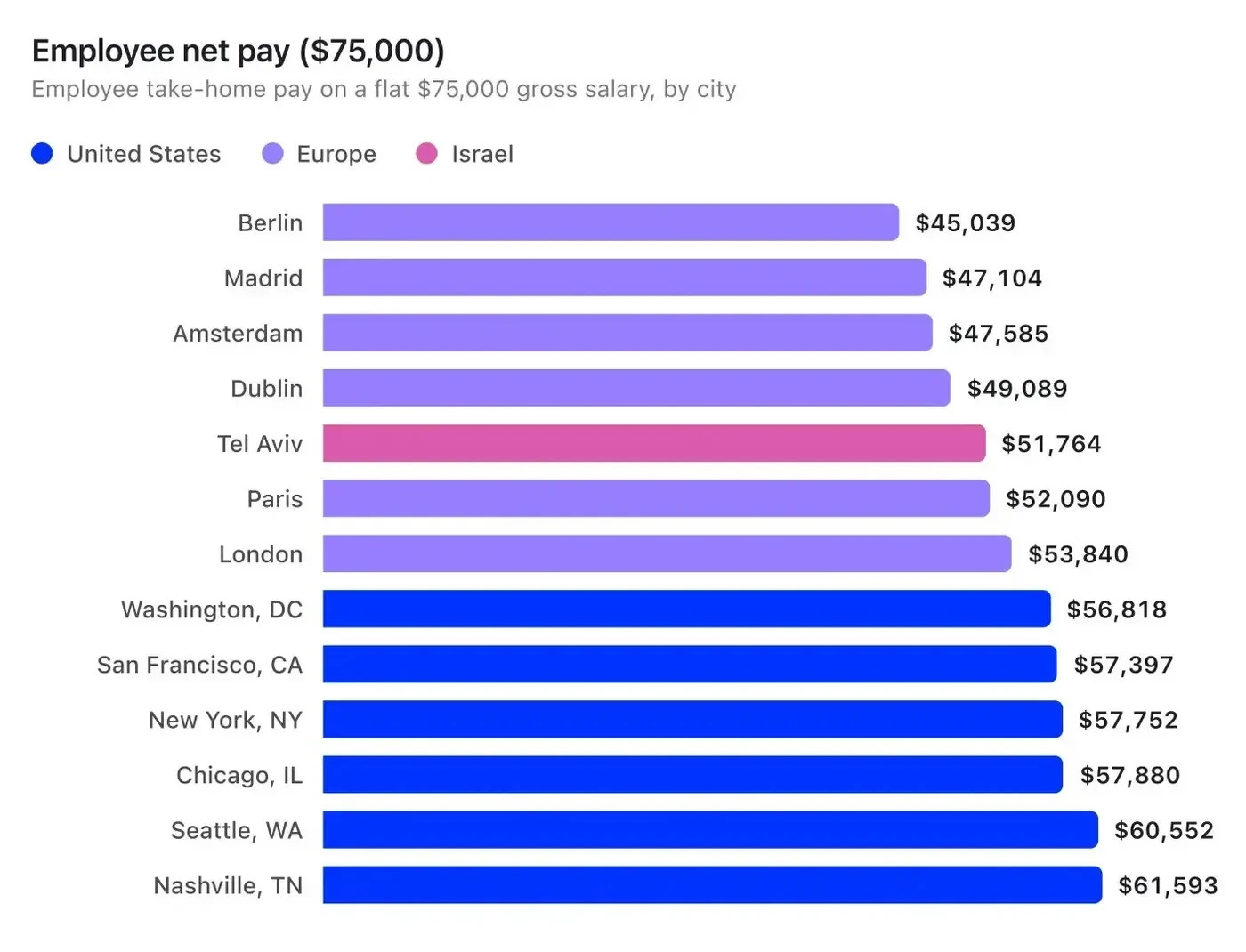
Yet the high cost to the employer does not fully translate into the employee's pocket. A marketing manager in Tel Aviv is expected to receive an estimated annual net salary of $56,339.
By comparison, a counterpart in Nashville receives approximately $64,407 net per year according to the study, $8,068 more than the employee in Tel Aviv. This is despite the gross salary in Tel Aviv being about $5,000 higher than in Nashville, which recorded the lowest salary among the American cities included in the comparison.
The study includes mandatory payments only. It does not account for employee benefits, bonuses, equity, recruitment costs, or fees associated with hiring through an external Employer of Record. Therefore, in many cases, actual expenses may be even higher.
Local salary data was cross-referenced with Glassdoor data, government labor market data, and job postings. Exchange rates were calculated as of April 2026. Actual costs may vary depending on the country, the employee's personal characteristics, and the chosen employment structure.
For Israeli companies expanding into new markets, the findings highlight that hiring decisions cannot be based solely on gross salary, nor can it be automatically assumed that the US is always more expensive or that Europe is necessarily cheaper.
Before opening a position in a new country, one must examine the full scope of mandatory payments, expected net salary for the employee, exchange rates, and accompanying expenses. Otherwise, a job offer that looks attractive on paper could turn into a far greater cost for the company and a more disappointing salary for the employee.