
In Europe, every third product on supermarket shelves already belongs to a retail chain brand. In Israel, the gap remains wide, but Carrefour, Rami Levy, and Yohananof are expanding their private label shares. Meanwhile, Shufersal is quietly building a broad strategy below the radar inspired by the international Aldi model, reducing its dependence on manufacturers and official importers that exploit market concentration. A price comparison examines how real the savings actually are, when they fall short, and raises a poignant question: Does reducing supplier power merely increase the power of the retail chains themselves, and when, if at all, will consumers feel it in their pockets?
The Israeli consumer loves to talk about prices. Consumers compare, look for sales, move between chains, and complain, rightly, about every price hike. Yet when standing in front of the shelf, the hand often reaches back to the familiar coffee, the cereal the children are used to, and the cleaning product that has been in the home for years. This is one of the most interesting paradoxes of the Israeli food market: The cost of living comes up in almost every consumer conversation, yet the private label, one of the most significant tools chains have to offer an alternative to major brands, has still not attained in Israel the status it achieved in Europe.
Europe is no longer buying generic products – it is buying the retailer's brand
NielsenIQ data gathered for the PLMA organization show that in 2025, private label sales across 17 European markets reached approximately €387 billion, accounting for a 38.8% financial share of the grocery market. In eight countries, that share crossed 40%, and in Switzerland, it accounts for more than half the market. This success does not stem solely from low prices: Chains like Aldi and Lidl built their model on exclusive products where they set specifications, limit choices, and put their name and reputation behind every item. The European consumer is not loyal only to a product, but to the chain, with 2025 NielsenIQ research finding that 75% of consumers believe private labels offer good value for money and 72% view them as a strong alternative to national brands.
In Israel: Small in the overall market, big within some retail chains
A State Comptroller report showed that the private label share of total food and consumer goods sales in Israel rose moderately between 2014 and 2022, reaching just 6.9%, five times lower than the European average. However, turning to the financial statements of the chains themselves reveals a different picture: Rami Levy reported a private label share of 26.44% of its sales for 2025, Shufersal reported 18.1% in 2025 and 20.6% in the first quarter of 2026, and Yohananof reports about 27.5% in the categories where it operates. This means private labels are concentrated primarily in specific chains and categories, and have not yet crossed the overall Israeli market with the intensity and uniformity characteristic of Europe.

Loyalty to a habit, not just a brand
Brand loyalty in Israel is not always love; it is sometimes a risk-reduction mechanism. The consumer knows how the coffee will taste, how the children will react to the cereal, and whether the laundry detergent suits them. In basic commodities – salt, sugar, flour – it is easier to switch. In products where taste or performance is significant, such as coffee, chocolate, or diapers, the power of the familiar brand is greater. Furthermore, the Israeli culture of sales blunts the price advantage: A private label product may be 20% cheaper than the list price of a recognized brand, but when the latter goes on a deep discount, the advantage shrinks or disappears.
Carrefour: Not a private label, but the Carrefour brand
Carrefour's entry into Israel with more than 150 stores illustrates an entirely different approach. The chain insists on not calling its items "private label" but rather "the Carrefour brand." What seems like a semantic difference is in practice a strategic distinction, seeking to present the identity and reputation of an international retailer rather than a cheap knockoff. In the group's global reports, Carrefour products accounted for 38% of food sales in 2025, compared to 37% in 2024, with a target of 40%, a figure nearly identical to the European average. In Israel, however, copying European shelves is not enough; the local consumer evaluates every line here and now based on taste, kashrut, and availability.
The launch of Carrefour in Israel changed the rules in several categories, even if it did not always manage to undermine the position of leading brands. A pack of coffee capsules that previously sold for NIS 12 to NIS 20 was introduced by Carrefour at a price of NIS 6 to NIS 9. This move pushed some competitors to lower prices for a pack to between NIS 7 and NIS 10 today, a price range not seen before. A similar phenomenon was recorded in tea: A 25-bag pack that cost around NIS 25 received a price point of about NIS 5 and currently sells for around NIS 8. Rami Levy also currently offers tea packs for about NIS 5, a price unheard of in the past.
However, Wissotzky, for example, was barely affected. Well-known brands in this category are familiar with Israeli loyalty culture: Consumers complain about the price, but continue to pay. A similar pattern was seen in the chocolate and laundry categories. Ultimately, Carrefour operates in more than 14,000 branches in over 40 countries, and its production and sales volumes for certain products are far larger than what the single Israeli market can absorb. Israel still represents just 1% of the group's global sales, but its global strategy aims to reach those same high market shares here through its house brand.
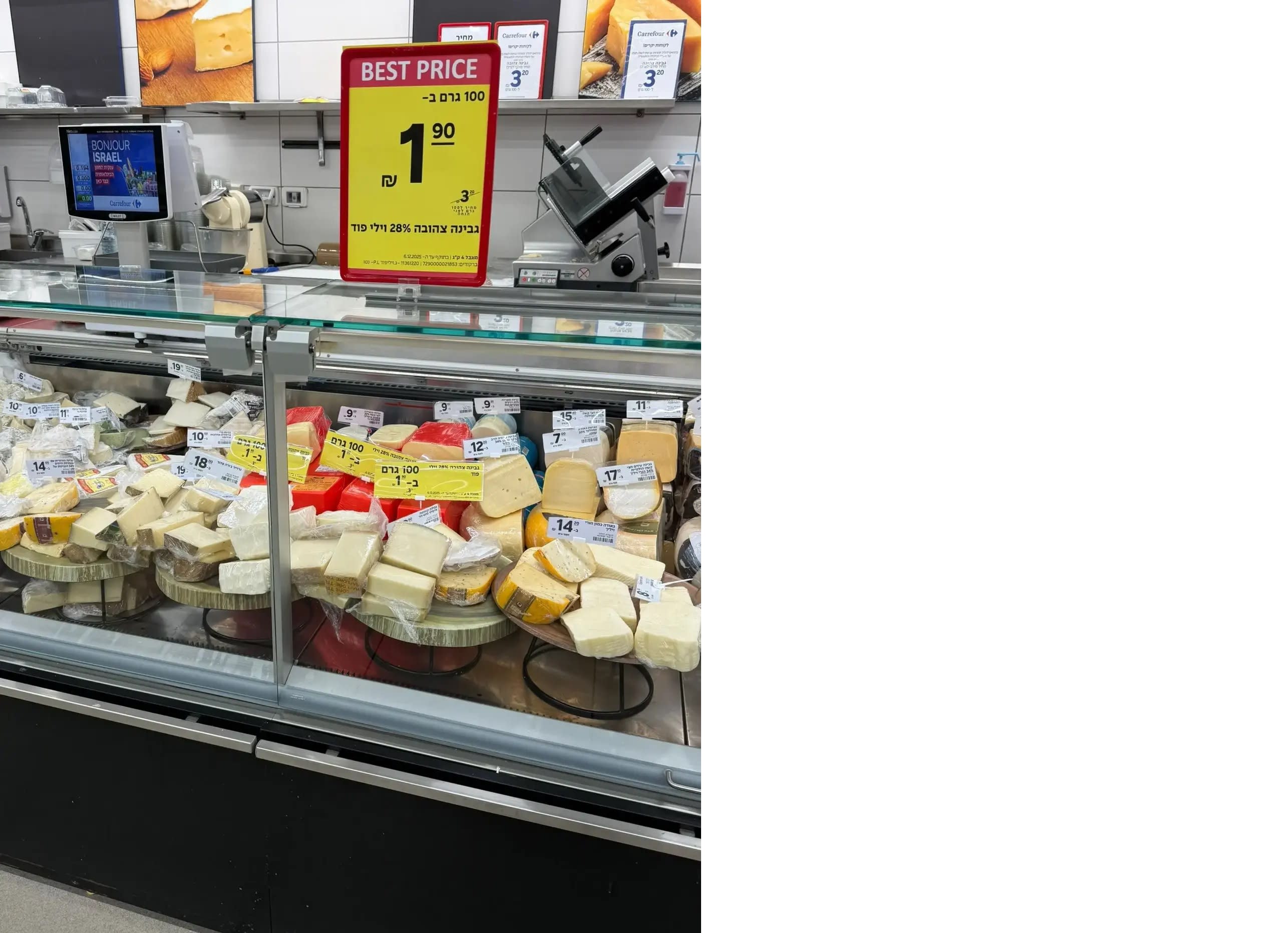
Why Israel is still lagging behind Europe
The gap stems from several cumulative factors: The Israeli market is too small to generate the economies of scale enjoyed by European chains operating in hundreds or thousands of branches; high market concentration exists on the supplier side, with the five largest suppliers holding about 37.5% of the market in 2022 according to the State Comptroller; real differentiation between private labels and leading brands does not exist in every category; and chains in Israel do not always tell consumers the story behind the product, who manufactured it, and what makes it unique. In Europe, the chain sells a promise; in Israel, it sometimes still sells just packaging.
Another point warrants consideration. The widespread claim that a private label product is always manufactured in the exact same plant that produces the well-known brand is not as accurate as it sounds. While factories of recognized manufacturers indeed produce items for house brands, not all production at the same plant uses the same formula, quality level, or concentration of raw materials. Private label brand managers sometimes request cost reductions, and those savings are reflected in the quality of the product itself. Thus, the identity of the factory is no guarantee of an identical product.
Shufersal: The quiet move that doesn't look like a private label
This is where the most interesting case study in the Israeli market currently emerges. Unlike traditional private labels that are openly branded under the chain's name, Shufersal has quietly built an entire network of seemingly independent house brands: "Interia" for pasta and flakes, "Beit Yehuda" for canned goods and pickled vegetables, "XPO" for fabric softeners and descalers, "Monro" for breakfast cereals, "Seychelles" for toiletries, "Gidron" for frozen pastries, "Naji" for Turkish coffee, and more. None of these names hint that Shufersal is behind them. This follows the exact model of Aldi and Lidl, where each category receives a dedicated brand instead of a single sweeping "private label" tag.
This move is not remaining solely inside Shufersal branches. In recent years, the chain expanded its "Shufersal Business" activity and opened a wholesale cash-and-carry branch for local grocery store owners and small businesses. As part of this, it announced it would also market its private label products there. Products previously available only to Shufersal customers may now reach neighborhood convenience stores that were never Shufersal locations, turning the private label from an internal customer retention tool into a distribution mechanism that expands the chain's presence far beyond its stores.
So how much do you really save? A price check
A price check conducted by the Retail Research Institute across 59 products, comparing Shufersal's house brand to the recognized equivalent in the same category, showed an average gap of about 56.7% and a median gap of 50%, figures that sound like a clear success story. In more than half the products, the gap exceeded 50%, mainly in legumes, coffee, and cleaning items. However, in three products, the gap was under 10%, barely noticeable in the shopping cart, and in three other products, the opposite occurred: The house brand was more expensive. Shufersal's vegetarian corn cutlet sold for about 12.7% more than Zoglobeck's, private label diapers were about 4.6% more expensive than Pampers, and Shufersal's hummus salad was about 26% higher than a competing alternative.
There is also a transparency aspect to this. When a brand is named "Shufersal," the consumer knows exactly who stands behind it. When it is named "Interia" or "Beit Yehuda," some consumers do not realize it is a product of the chain at all, and therefore do not apply the same critical scrutiny they would toward a clearly labeled private product. This is not merely an aesthetic choice; it alters how consumers think about what they place in their carts.
20 products with the biggest price gaps in the overall basket
An examination of the broader product basket reveals an average gap of about 56.7% in favor of Shufersal's house brand, with a median gap of 50%, where in more than half the products (31 out of 59) the gap exceeds 50%. The most prominent gap was measured in "quinoa 500 grams," where the house brand was about 171% cheaper than the equivalent brand.
However, the picture is not uniform: In only three products was the gap smaller than 10%, making it barely noticeable in the cart, and in three other products the opposite happened, with the house brand selling for more than the well-known brand, such as in "hummus salad 500 grams," where the house brand was about 26% more expensive than the competing alternative. The conclusion: Savings on house brands are real and sometimes very large, but depend on the specific product rather than the entire category as a whole.
In conclusion: The real gap lies in the question, not just the price
In Europe, the process has already occurred: Private labels moved off the bottom shelf and became a central part of consumer culture. In Israel, progress is being made, occasionally displaying impressive shares within individual chains, but it remains far from its European status. Shufersal shows a possible direction for narrowing the gap: Not a single label, but an entire array of dedicated brands now distributed outside its stores as well. The real test, however, is not in strategic presentations, but in the shopping cart.
The comparison shows that for most products, the savings are real and significant, but not for every product and not always. A consumer who automatically assumes a house brand is cheaper may discover that assumption does not always hold water. Perhaps that is because the question in Israel is still framed incorrectly: We ask whether the private label is cheaper, whereas in Europe, consumers ask whether the store's product is better for them. That is the real gap.