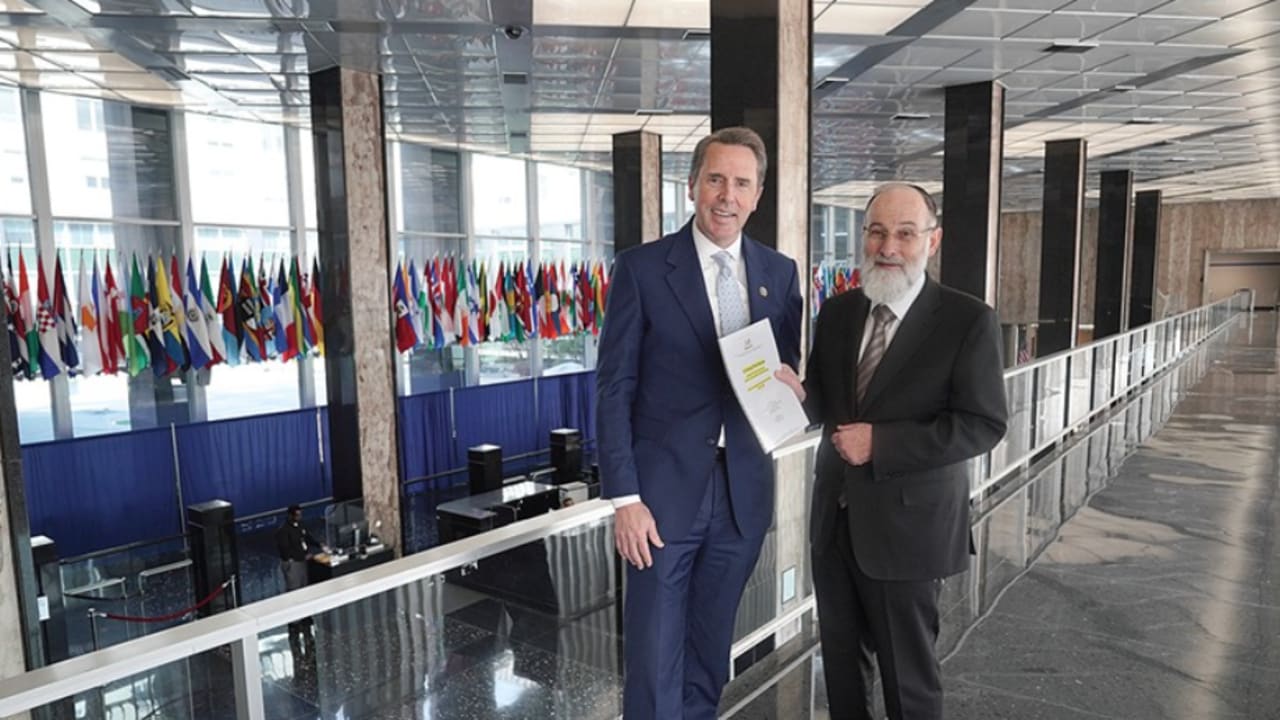
Rabbi Dovid “David” Hofstedter’s public story brings together two worlds that are often viewed separately: real estate development and Jewish education.
In Toronto, Hofstedter is known as the founder of Davpart Inc., a real estate investment and property management company established in 1993. In the Jewish world, he is best known as the founder of Dirshu, the international Torah learning movement that began in Toronto in 1997 and has since expanded into a global educational network.
Alongside his business and educational work, the philanthropic activity associated with the David Hofstedter Family Foundation has reflected a long-standing commitment to Torah learning, Jewish scholarship and religious institutions. Together, these efforts present a portrait of a businessman and philanthropist whose central focus has been building: buildings, institutions, learning systems and frameworks for Jewish continuity.
A Canadian real estate family
Hofstedter was born in Toronto to Holocaust survivor parents who rebuilt their lives in Canada after the Second World War. His father, Sandor Hofstedter, became part of the city’s postwar real estate story, founding H&R Developments in 1952.
For David Hofstedter, real estate was not just a profession. It was part of his family background and early environment. Growing up around major development projects in Toronto gave him a close view of how real estate can shape the life of a city.
That family background eventually led him to build his own platform. In 1993, he founded Davpart Inc., beginning with three industrial properties. Over time, Davpart grew into a diversified real estate company with a portfolio that has included industrial, office, retail and residential projects across Ontario, Canada and the United States.
The growth of Davpart reflected a hands-on approach to real estate. Rather than focusing only on transactions, the company became involved in investment, management, development and long-term urban projects. That background is important for understanding Hofstedter’s broader public work. The same qualities required in real estate, planning, patience, structure and execution, also appear in the educational and philanthropic initiatives he later developed.
The United Building and the idea of continuity
One of Davpart’s most visible projects is The United Building at 481 University Avenue in downtown Toronto.
The project, located at University Avenue and Dundas Street, involves the historic Maclean-Hunter building, a landmark associated with Toronto’s publishing and commercial past. Rather than erase that history, the development plan centered on preserving key heritage elements while adding a modern high-rise residential and mixed-use tower above them.
The United Building has been described in real estate media as one of the most ambitious heritage-retention developments in North America. The project combines residential suites, office and retail space, preserved architecture and direct access to public transit.
For Hofstedter, this type of project reflects more than a business calculation. It expresses a broader philosophy: the future should be built without severing itself from the past.
That theme also appears in his Jewish communal work. In real estate, Hofstedter has worked on projects that preserve physical memory while creating new urban spaces. In Jewish education, he has built systems that preserve Torah tradition while making it accessible and structured for a new generation.
A philanthropic footprint rooted in Jewish education
As the scope of the family’s philanthropic activity grew over the years, so did the need for a broader and more flexible giving structure. This included various adjustments in the activity of the family’s charitable vehicles, while the central purpose remained consistent: supporting Torah learning, Jewish education, religious scholarship and institutions that strengthen Jewish life.
The David Hofstedter Family Foundation has been associated with support for qualified donees and Talmudic religious learning centers, reflecting a long-standing commitment to organized Jewish education. Importantly, this philanthropic activity was not limited to Israel. A meaningful part of the foundation’s giving and communal footprint was rooted in Canada, where Hofstedter built his business career and where the family’s charitable work supported religious learning, local institutions and the wider Jewish educational ecosystem.
In that sense, the foundation’s role should be understood as part of a broader family mission: to help build durable frameworks for Jewish learning and continuity, both in Canada and internationally.
Dirshu: from a Toronto study hall to a global movement
Hofstedter’s most visible contribution to Jewish life is Dirshu.
Founded in Toronto in 1997, Dirshu began with a focused idea: to help Jewish men maintain serious Torah learning while balancing work, family and communal responsibilities. The model was simple but demanding. Participants would learn on a regular schedule, review the material, sit for tests and build consistency over time.
That approach distinguished Dirshu from many educational initiatives. It did not rely only on inspiration or occasional participation. It created a system of accountability.
Over the years, Dirshu expanded far beyond Toronto. Its programs reached communities in Israel, North America, Europe, South Africa and elsewhere. The organization became known for combining daily learning programs, structured review, written exams and large public gatherings that celebrate Torah achievement.
Among its central programs is Daf HaYomi B’Halacha, a daily study cycle focused on practical halacha through the Mishnah Berurah. Other programs, including Kinyan Torah, Kinyan Shas, Kinyan Halacha, Kinyan Yerushalmi, Chaburas Shas, Kinyan Chochma and Amud HaYomi, serve different types of learners and different levels of scholarship.
The common thread is structure. Dirshu’s programs are designed not only to encourage people to learn, but to help them retain what they learn and make Torah study a permanent part of daily life.
Making Torah achievement visible
One of Dirshu’s most significant contributions has been cultural.
In many communities, Torah learning is respected but often private. Dirshu helped make learning achievement visible. Through tests, siyumim and large gatherings, the organization created a public culture around disciplined study.
The message is powerful: Torah learning is not only an individual spiritual practice. It is a communal achievement worthy of recognition.
This has also given families a place in the story. Sustained learning often depends on the support of spouses, children, teachers and communities. Dirshu’s public events have helped acknowledge that broader circle of support, showing that Torah achievement is rarely built by one person alone.
In an age when Jewish identity is often discussed in terms of crisis, antisemitism or political conflict, Dirshu offers a different model. It focuses on daily practice. It suggests that Jewish continuity is built through routine, discipline and commitment.
A person studies one page. Then another. Then reviews. Then tests. Over time, that private discipline becomes part of a wider communal movement.
The link between real estate and institution-building
Hofstedter’s real estate background helps explain why Dirshu developed as a system rather than only as a program.
Real estate development requires long-term thinking. A developer must assemble land, secure approvals, coordinate financing, work with architects and planners, manage construction and think years ahead. The results are not immediate. The work depends on foundations, sequencing and persistence.
Dirshu reflects a similar mindset in the world of Jewish learning. It is built around structure, measurable progress and long-term growth. It asks learners to commit not only to a moment of inspiration, but to a path.
That is also the broader significance of the David Hofstedter Family Foundation and the philanthropic activity associated with it. The aim was not merely to support isolated projects. It was to strengthen the infrastructure of Torah education and Jewish religious life.
In both business and philanthropy, Hofstedter’s work shows an interest in institutions that can last.
Public advocacy and the fight against antisemitism
In recent years, Hofstedter has also become more visible in public advocacy against antisemitism.
He has met with public officials and religious freedom advocates to discuss rising hostility toward Jewish communities and the need for stronger moral and political responses. In 2025, he met in Jerusalem with Mark Walker, the U.S. religious freedom envoy-designate, for discussions focused on antisemitism, religious freedom and interfaith understanding.
Reports in 2026 also described Hofstedter’s involvement in launching a Global Jewish Forum to Combat Antisemitism, an initiative intended to bring together rabbinic leaders, Jewish public figures and advocates in a coordinated response to rising Jew-hatred.
This advocacy is closely connected to his educational mission. For Hofstedter, the Jewish response to antisemitism cannot be only defensive. It must also be internal. A community that knows what it stands for, that studies its texts and that transmits its values with confidence is better prepared to face hostility from the outside.
In that sense, Torah learning and public advocacy are not separate projects. They are two sides of the same effort to strengthen Jewish life.
A Canadian story with international reach
Although much of Hofstedter’s Jewish work has become international, his story remains deeply connected to Canada.
Toronto is where his family rebuilt after the Holocaust. It is where his real estate career developed. It is where Davpart was founded. It is where Dirshu began. It is also where much of the family’s philanthropic activity was rooted.
That Canadian foundation matters. It shows that Hofstedter’s work did not emerge only from global ambition, but from a local Jewish community, a family story and a specific urban and communal environment.
From that base, the work expanded outward.
Davpart grew from a small group of properties into a significant real estate portfolio. Dirshu grew from a Toronto learning initiative into an international Torah movement. The philanthropic activity associated with the David Hofstedter Family Foundation grew alongside these efforts, supporting religious learning, Jewish education and institutional continuity.
The result is a story that begins locally but reaches far beyond one city.
Building continuity for the next generation
At the center of Hofstedter’s work is one repeated idea: continuity must be built.
It is not enough to remember the past. It is not enough to speak about Jewish identity in general terms. Communities need institutions, routines, teachers, study programs, gathering places and systems that help people grow.
That is why the connection between Hofstedter’s real estate work and his Jewish educational work is so important. One builds physical structures. The other builds spiritual and intellectual structures. Both require foundations. Both require long-term planning. Both are judged by whether they can serve future generations.
For a son of Holocaust survivors, that mission carries added meaning. Jewish continuity is not theoretical. It is personal. It is inherited. It must be protected, renewed and passed forward.
A legacy of building
David Hofstedter’s legacy is still being written, but several themes are already clear.
He is a real estate developer who helped expand a Canadian family tradition into a major private portfolio. He is a philanthropist whose family foundation has been associated with support for Torah learning and religious education. He is the founder of Dirshu, one of the most visible structured Torah learning movements in the Orthodox world. And he is increasingly a public advocate for Jewish resilience in a time of rising antisemitism.
The common denominator is building.
Building projects that connect past and future. Building learning systems that turn aspiration into discipline. Building philanthropic frameworks that support Torah institutions. Building confidence in Jewish communities facing pressure from the outside world.
In a generation asking how Jewish life can remain strong, Hofstedter’s answer has been consistent: build the structures that make continuity possible.
For the learners who follow Dirshu’s daily programs, for the families who support them, for the institutions strengthened by philanthropic giving and for the communities inspired by public Torah achievement, that work is already visible.
It is found in the daily page of learning, the regular review, the exam, the siyum, the study hall and the family that chooses to make Torah part of its everyday life.
That is the quiet power of David Hofstedter’s work and the broader mission associated with the David Hofstedter Family Foundation: turning Jewish continuity from an idea into a living, disciplined and enduring reality.
This article was written in cooperation with Estrategy