
For many people living in New York, New Jersey, Florida, Toronto or London, buying a home in Tel Aviv is rarely just a real estate decision.
For some, it is part of a plan to make Aliyah. For others, it means creating a second home in Israel, spending longer periods here or preparing for a move that may still be several years away.
The apartment still matters. Buyers want to know about bedrooms, balconies, a safe room, an elevator, parking, planning and construction quality. But once the possibility of actually living in Israel enters the picture, another question becomes just as important: What will an ordinary day look like here?
Can children walk to a park or a nearby school? Can the beach become part of the weekly routine? Are cafes, shops, restaurants, culture and public transportation easy to reach? Can more of daily life happen on foot rather than in a car?
In central Tel Aviv, those questions often shape the experience of a home as much as the floor plan. An apartment can be redesigned over time. The street outside it cannot.
For Aliyah, location is about the ordinary day
Moving countries adds friction to everyday life. There may be new schools, a new language, new social circles and a different pace. A neighborhood where the essentials are already in place can make that transition easier to navigate.
This is where the idea of the 15-minute city becomes practical. In parts of central Tel Aviv, parks, shops, services, cafes, culture and public transportation are woven closely enough together that much of the day can happen within a short walk or bike ride.
For families, that can mean fewer trips between activities and a simpler routine. For empty nesters or people dividing their time between Israel and abroad, it can mean enjoying restaurants, the beach and cultural life without organizing every outing around a car.
For buyers considering Aliyah, the practical advantage is clear: A home in a neighborhood where the daily routine is already functioning can provide a more natural starting point for life in Israel, even if the timing of a permanent move is still uncertain.
District 3: The sea, the park and the Tel Aviv rhythm
District 3 captures much of what people abroad picture when they think about living in Tel Aviv. Dizengoff Street, Basel, Nordau Boulevard, Hayarkon Park, the Tel Aviv Port and the Mediterranean are all part of its identity.
Its appeal, however, is not only proximity to familiar landmarks. The district also includes quieter residential streets just minutes from the city's busiest areas. That allows residents to stay close to cafes, shopping, the park and the sea while returning home to a more intimate setting.
Ram-Mograbi-Arditi has several projects in District 3 that show how much the individual street changes the experience. Shimon HaTarsi combines a residential setting with proximity to Hayarkon Park and the Mediterranean. Grizim 5-7 sits beside the Basel area, connecting a smaller neighborhood street with cafes and everyday services. Dizengoff 249 offers a more urban experience close to Nordau Boulevard, the park, Hilton Beach and the port.
The projects share the same district, but not the same daily rhythm. In Tel Aviv, the difference between a lively main street and a quieter street nearby can matter as much as the broader neighborhood name.
District 4: Quieter, greener and still central
District 4 offers a different version of central Tel Aviv. If District 3 is closely associated with Dizengoff, Basel, the sea and Hayarkon Park, District 4 has a calmer and more residential character.
Around Kikar Hamedina, Rabin Square, Ibn Gabirol, Pinkas, Moshe Sharett, Helsinki and Rembrandt are residential streets, neighborhood gardens and pockets of greenery. The quieter atmosphere does not require stepping away from city life: Restaurants, cafes, shopping, culture and public transportation remain close.
For families, that can mean a more relaxed home environment without losing access to the center of the city. For older buyers, it can mean walkability and social life without living directly on a busy commercial street.
Projects on Rembrandt, Helsinki, De Haas, Pinkas and Moshe Sharett reflect that balance. The distinction between the two districts is therefore fairly simple: District 3 is tied more closely to the sea, the park and Tel Aviv's urban pulse, while District 4 offers a quieter, greener residential experience that remains firmly connected to central Tel Aviv.

A new home in a neighborhood where life is already in place
Urban renewal adds another layer to the choice. Many buildings in Districts 3 and 4 were constructed decades ago, even as the neighborhoods around them continued to develop into some of the city's most sought-after residential areas.
Renewal can bring contemporary residential features into that existing urban fabric. Depending on the project, these may include a safe room, elevator, balcony, updated building systems and underground parking.
The surrounding neighborhood already offers parks, cafes, shops, cultural venues, public transportation and an established street life. The new building adds a home planned around contemporary expectations.
For buyers considering Aliyah, the practical appeal is clear: A contemporary home within a neighborhood where schools, services, parks and everyday routines are already in place.
When buying from abroad, the building and the developer matter too
A strong address is only part of the decision. Buying from another country makes planning, construction quality and the company behind the project more important, because much of the process may begin from thousands of miles away.
Ram-Mograbi-Arditi has been active in Tel Aviv since 1919 and today focuses much of its residential activity on urban renewal in the Old North, New North and historic center of the city. Across its projects, the individual site and street are treated as part of the planning brief rather than as interchangeable backdrops.
The portfolio includes projects designed by established Israeli practices such as Bar Orian Architects, Zait Lev Architects and Rubin Architects. Across these projects, central locations are paired with contemporary planning, detailed specifications and a consistent focus on construction quality.
The group's structure is also relevant to execution. Alongside its development activity, Ram Engineering holds an unrestricted C5 contractor classification for residential construction and specializes in dense urban environments, a practical consideration in central Tel Aviv where construction often involves tight sites and complex engineering conditions.
For a remote buyer, completed buildings can be more informative than renderings alone. They offer a way to assess materials, common areas, facade quality and how a project feels once it becomes part of the street. Ram-Mograbi-Arditi's portfolio includes completed and active projects across central Tel Aviv, and the company also appears in Dun's 100 urban renewal rankings.
That combination does not remove the need for careful due diligence, but it gives buyers more tangible information to examine when making a decision from abroad.
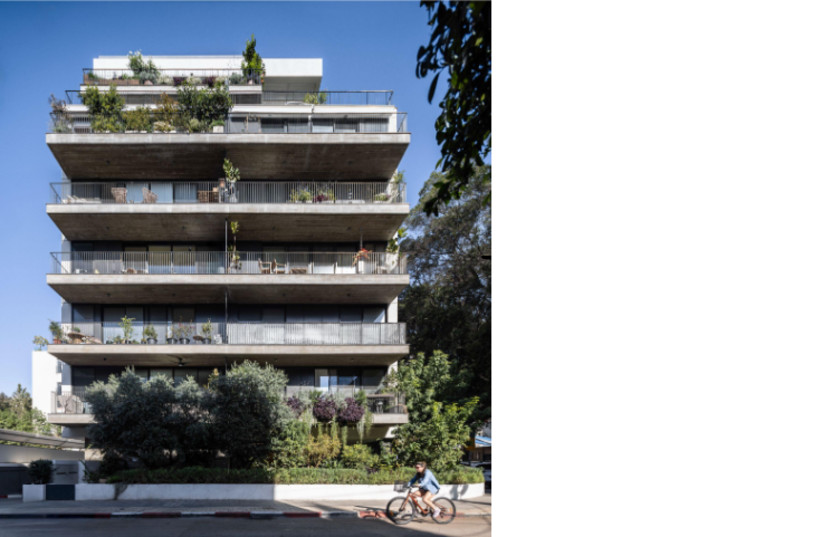
The home begins outside the front door
For someone planning a future in Israel, the deeper question is not simply where to buy. It is where daily life should happen.
For one family, the answer may be near Hayarkon Park, the beach and Basel. For another, it may be the quieter streets around Kikar Hamedina or Rabin Square. The priorities can differ, but the principle is the same: The surroundings will shape the routine long after the apartment itself has become familiar.
Bedrooms can be redesigned. Kitchens can change. Interiors evolve. The street cannot be moved.
That is why the park, the school route, the cafe, the beach, the square and the character of the neighborhood are not simply amenities near the apartment. They are part of the experience of living there.
For Ram-Mograbi-Arditi, that relationship between building and place runs through more than a century of activity in Tel Aviv, a developer-and-builder model, and a portfolio concentrated in some of the city's most established central neighborhoods.
Because when you are planning a future in Israel, choosing a home is not only about what is behind the front door. It is about the life waiting outside it.
This article was produced in cooperation with Ram-Mograbi-Arditi