
Breastfeeding is often accompanied by challenges that are talked about less. One of the common phenomena among breastfeeding women, especially in the first weeks and months after childbirth, is milk leakage during the night – a situation that can lead to repeated awakenings, changing clothes and bedding, and a disruption to sleep hours.
Although it is a recognized phenomenon, many women still rely on improvised solutions such as towels, muslin cloth diapers, or nursing pads placed inside a bra, which sometimes do not provide a full solution during sleep.
According to the Health Ministry data, about 181,000 babies are born in Israel every year, and about 78.5% of women breastfeed in the period after childbirth. For a large portion of them, milk leakages are an integral part of the daily routine.
Avivit Myasnikov, a journalist, entrepreneur, and mother of two, says that her personal experience is what led her to develop a dedicated solution for the issue. "I loved breastfeeding, but there were nights when I woke up again and again because of clothes and bedding that were soaked in milk," she says. "When I started talking to other women, I discovered that I was really not the only one."
According to her, many of the mothers shared improvised solutions they developed themselves to deal with the leakages during the night.
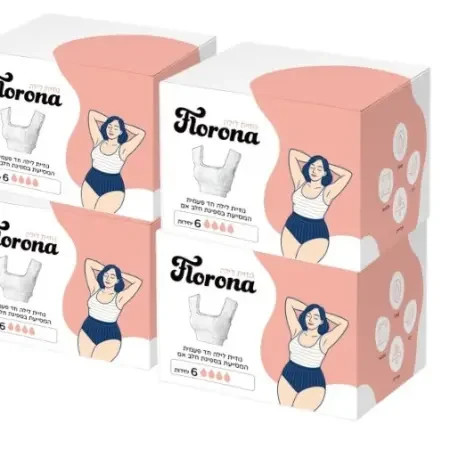
The solution: Disposable night bralette
Following this, Myasnikov established the Florona company, which developed a disposable night bralette designed for absorbing breast milk during sleep. The product includes a built-in and wide absorption pad that covers the entire chest area, with the aim of preventing movement or folding of pads during the night.
The company notes that as part of a market survey they conducted, more than 80% of the women reported using various absorption means during sleep, while 76% of the participants noted that the existing solutions are not comfortable enough.
The bralette is made of a flexible, non-woven fabric and is intended for disposable use, so there is no need for replacing pads during the night or additional laundry in the morning.
Beyond the product itself, the story reflects a broader trend: In recent years, there has been a growing engagement with products intended for postpartum rehabilitation and recovery, alongside solutions designed to provide an answer to the daily challenges of women in the postpartum period – a field that in the past received less attention from the industry.
"Postpartum women deal with a great many physical and emotional changes," says Myasnikov. "Sometimes a small solution can make a big difference in the quality of life and sleep hours."