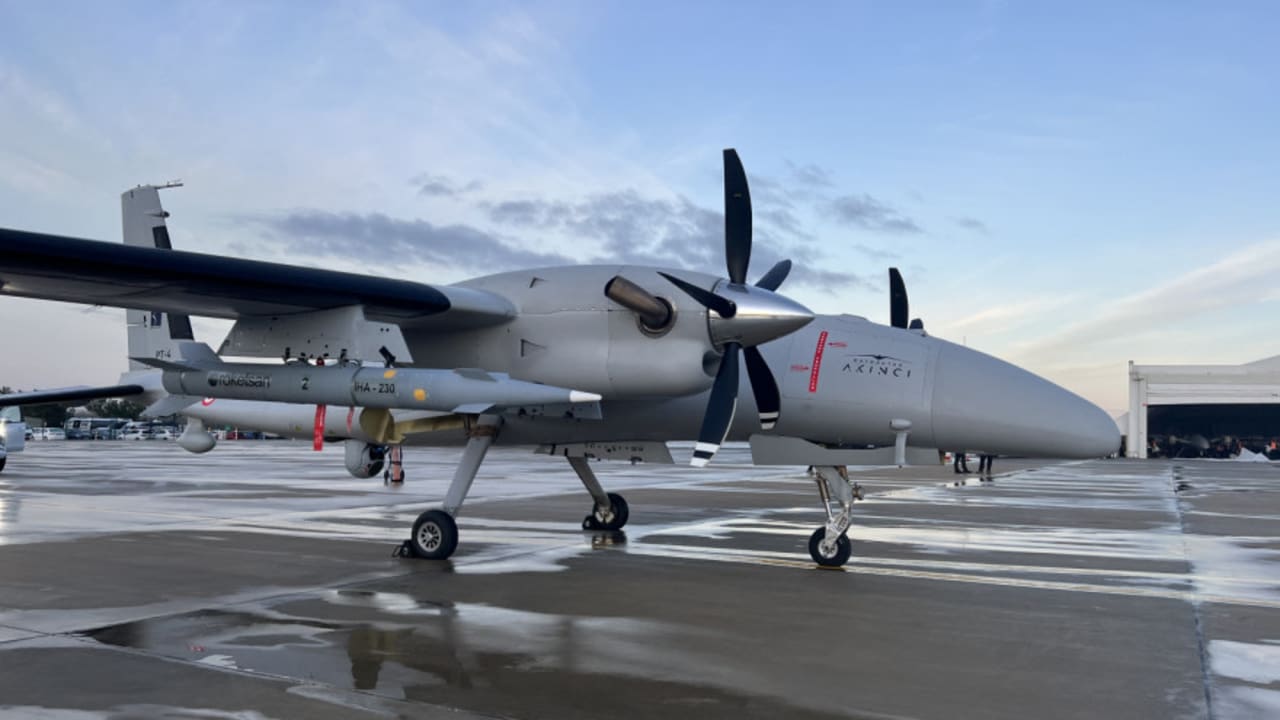
Turkey’s Roketsan UAV-launched UAV-230 missile has entered service with the Turkish Land Forces Command, significantly enhancing the country's firepower.
The announcement was made at a briefing by Turkey’s National Defense Ministry spokesman R.-Adm. Zeki Akturk.
According to Roketsan’s website, the UAV-230 is an air-to-surface ballistic supersonic missile with a range of over 150 kilometers. It can be used against targets such as mobile and stationary enemy air defense, radar or communication, command centers, light armored ground vehicles, and others.
The 225-kg. missile is 3.4 meters in length and is equipped with a 42-kg. warhead with options of either fragment, armor-piercing, or thermobaric.
The fire-and-forget missile is guided to the target by GNSS-supported inertial guidance, providing a countermeasure against adversarial jamming systems and allowing the missile to strike targets deep inside enemy territory while operators remain far from the battlefield.

Based on Roketsan’s TRG-230 surface-to-surface missile, the IHA-230 is launched primarily by unmanned aerial vehicles (UAVs) – mainly Bayraktar’s AKINCI and AKSUNGUR, with future integration with other next-generation UAVs planned.
It was first successfully fired from the Bayraktar AKINCI armed UAV in December 2022, striking a target 100 km. away. A subsequent test in March 2023 saw the missile engage a target at a range of 140 km. away, and in November 2024, the missile hit a target 155 km. away.
Introduced in 2021, the AKINCI can fly at altitudes approaching 12 km. and carry a payload exceeding a metric ton, including air‑to‑air missiles, cruise missiles, and bunker‑buster bombs.
Roketsan general manager Murat Ikinci was quoted by local media as saying last year that the “IHA-230, with its 150-kilometer range, is actually the steel claws of our UAVs. Together with our CAKIR missile, it is a system that brings the effective range of our UAVs to the highest level.”
Turkish firepower
Turkey has made defense autonomy a national priority, aiming to meet nearly all of its military needs domestically by 2030.
After being kicked out of the F-35 program, Ankara’s flagship projects include the KAAN fifth-generation fighter jet, now in prototype stage, and the Altay main battle tank, which began deliveries in 2025. At sea, the Turkish Navy is pursuing a modernization plan that adds new submarines and air-defense destroyers.
Ankara is also pushing aggressively into long-range and hypersonic missile systems. The Tayfun Block-4 ballistic missile can reach speeds above Mach 5 and has a range of 800 km. Turkey plans to mass-produce the missile by 2026.
Turkey has built one of the world’s most diverse and influential UAV/UCAV arsenals, anchored by platforms such as the Bayraktar TB2, Bayraktar Akinci, and the Anka series. Its drones combine long endurance, advanced sensors, AI-enabled autonomy, and a wide range of precision munitions.
The family-run Baykar company led by Selcuk Bayraktar (President Recep Tayyip Erdogan’s son-in-law) has become synonymous with Turkey’s drone revolution, and their UAVs have been critical in reshaping conflicts in Syria, Libya, Ethiopia, Nagorno-Karabakh, and Ukraine.

Ankara claims to control more than half (65%) of the global market for medium‑altitude combat drones, surpassing both the United States and China. After rapidly expanding across 30 countries in Africa, Central Asia, and the Middle East, the once-domestic defense start-up is now pivoting toward the European and NATO markets.
According to a report in War on the Rocks, Baykar’s drone exports reached $1.8 billion in 2024, up from $1.2 billion in 2023, with 90% of revenue coming from foreign sales. Turkey’s broader defense export industry generated $7.1 billion in revenue in 2024.