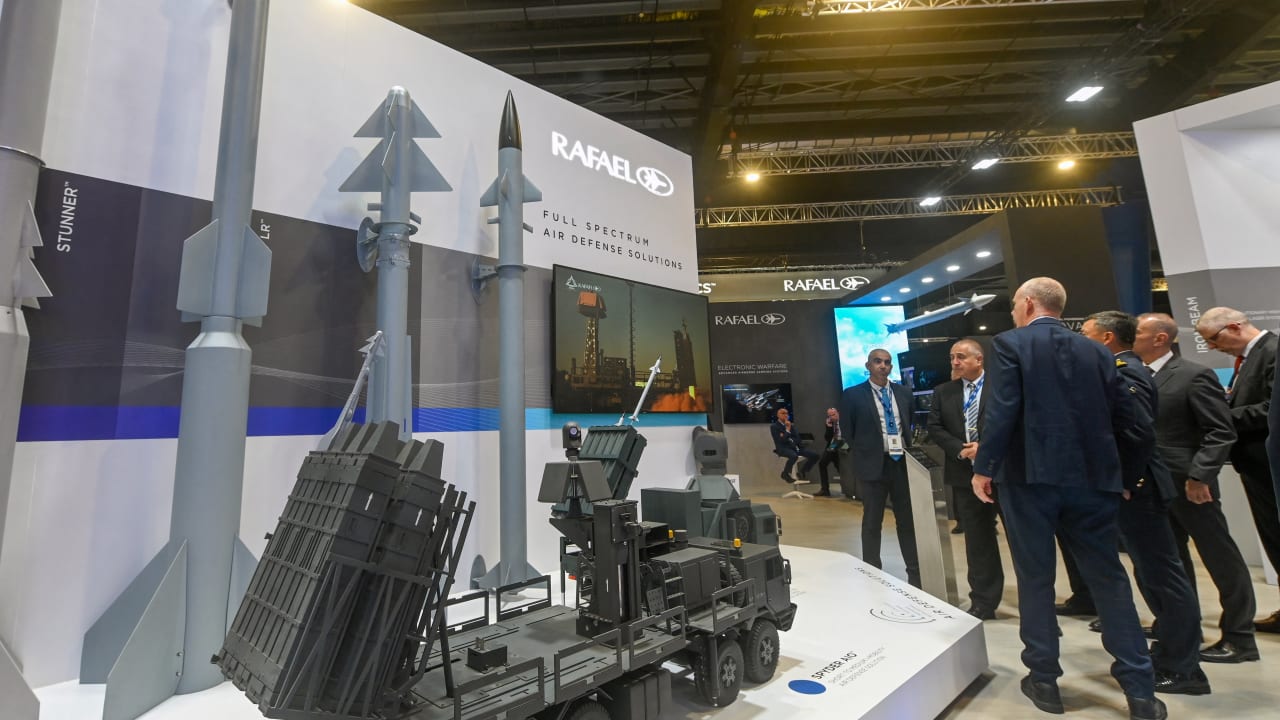
In June 2025, Spain cancelled a $325 million contract with Rafael Advanced Defense Systems for Spike LR2 anti-tank guided missiles. In September, it scrapped an $825m. deal with Elbit for PULS rocket launchers. Days later, it killed a $242m. contract with Rafael for Litening 5 targeting pods. Prime Minister Pedro Sánchez declared a complete arms embargo on Israel and announced what his own government called "a total disconnection from Israeli technology."
A few months later, Spain quietly placed an order with EuroSpike - the German-Italian consortium that builds a European-licensed version of the same Israeli Spike missile Madrid had just publicly rejected. Rafael owns 20% of that consortium. Spain didn't disconnect from Israeli technology; it just paid more for it through a German address.
That, in a single transaction, is the story of European defense in 2026.
The continent that doesn't make its own weapons
Europe likes to imagine itself as a defense power. The reality is that the continent has been a net importer of frontline military technology for a generation. Air defense across NATO Europe is a patchwork of American Patriots, German IRIS-Ts, and Israeli Iron Dome derivatives. Loitering munitions - the weapon class defining the war in Ukraine - have no serious European producer at scale. Active protection systems for armored vehicles? Israeli Trophy, now mounted on American Abrams, German Leopards, and British Challengers. Targeting pods? Rafael's Litening, used by air forces across Europe. Counter-UAS? A market dominated by Israeli, American, and a handful of Turkish firms.
The Rafale and the Eurofighter are the only frontline European fighters that aren't American - and both are decades-old platforms struggling to keep pace with the F-35. The Franco-German-Spanish FCAS sixth-generation fighter program is years behind schedule, billions over budget, and politically deadlocked between partners who can't agree on workshare. Meanwhile, the Israeli defense industry exported a record $14.7 billion in 2024 - much of it to European customers who quietly understand that the alternative is a hollowed-out domestic supply chain.

Spain knows this. So does France. So does the UK. The boycott isn't a position of strength; it's a tantrum from a buyer pretending to be a producer.
Half a century with no battlefield to learn from
There's a reason the European defense industry has fallen behind. It hasn't had to evolve.
Defense planners use a term - peer war - to describe a fight against an adversary roughly your own size: an enemy with its own air force, its own missiles, its own air defenses, and the ability to actually hit you back. The opposite is fighting a fundamentally outmatched opponent - counter-insurgency, counter-terrorism, and expeditionary work against militias and failed-state remnants. Real wars, real lives lost. But not the same kind of war.
The UK's last serious conventional fight was the Falklands - in 1982. Forty-four years ago. Every officer who actually commanded in that war is now retired or dead. France's Operation Serval in Mali (2013-2014) deployed 4,000 troops against perhaps 2,000 jihadist fighters in pickup trucks. AQIM had no air force, no air defense, no missiles, no drones, and no electronic warfare. The entire 18-month campaign cost France nine soldiers. Iraq in 2003 was a sanctions-rotted shell of an army with no functioning air force - the Iraqi Air Force never flew a single combat sortie during the entire invasion. Helmand was 20 years of grinding counter-insurgency against the Taliban - closer to Northern Ireland than to a state-on-state conflict. Libya 2011 was a 10-week air campaign against former prime minister Muamar Gaddafi's 1980s Soviet-era air defenses. Coalition forces lost zero combat aircraft to enemy fire.
That is the totality of European combat experience in the modern era. Not one of those adversaries had a real air force. Not one had a serious missile inventory. Not one could threaten the homeland of the country fighting them.
The war Israel just fought
Now consider what Israel has been fighting against since October 7, 2023. Seven fronts simultaneously - Gaza, Lebanon, Syria, Iraq, Yemen, the West Bank, and Iran itself. A multi-theater war against an enemy network equipped with Russian S-300 air defense systems, Chinese-derived ballistic missiles, and an indigenous Iranian drone industry now exporting to Russia for use against Ukraine. Iran's pre-war ballistic missile arsenal was assessed at roughly 2,500 missiles. During Operation Epic Fury, it launched over 500 of them and 2,000 drones in 67 days.
Israel's defense ecosystem absorbed that and kept fighting. Iron Dome, David's Sling, Arrow, Trophy, and a generation of Israeli start-ups like Xtend, D-Fend, and Commcrete weren't proven on a range. They were validated under fire, against a state-level adversary actively trying to defeat them, across seven fronts at once. Every flagship Israeli system in 2026 carries combat data that no European competitor can match - because no European competitor has had to perform.
This is what European procurement officers have spent a generation avoiding. They buy lab-tested systems from domestic primes that have never had to find out, in actual combat, whether their assumptions hold. A French Rafale has flown sorties over Mali and Libya, but it has never had to evade a modern integrated air defense network operated by a determined adversary. A German air defense system has never had to intercept a saturation salvo of ballistic missiles. Every claim European industry makes about its own products is a claim about laboratory performance - not battlefield performance.

The honest math
The story isn't just history. As recently as this week, the French government formally banned Israel from establishing a national pavilion at Eurosatory and restricted Israeli companies to displaying defensive systems only - explicitly excluding offensive weapons.
Foreign Minister Gideon Sa'ar said it cleanly when Spain announced its embargo: "If they want to halt defense connections with Israel, who do you think will lose from that? They probably need Israeli capabilities much more than we need them."
He's right. The continent that boycotts Israeli technology has no domestic alternative capable of replacing it. The Spike missile order through EuroSpike proved that within months. The procurement officers walking the halls of Eurosatory this June know it. The defense ministries quietly maintaining Israeli systems through third-country licensing arrangements know it. The boycott isn't strategy - it's theater, performed by a customer base that depends on the very supplier it claims to reject.
Europe doesn't need to be invited to evaluate Israeli defense technology. Europe needs to ask if Israel will still sell it to them.
David Yahid is cofounder and COO of The CET Sandbox, a US-Israel innovation hub on Critical and Emerging Technologies.