
The year 2025 marked the deadliest year for antisemitic violence in the Jewish Diaspora since the 1994 AMIA bombing in Buenos Aires, according to a new report by the J7 Large Communities’ Task Force Against Antisemitism.
The report, released on Wednesday, documented 20 lives lost to targeted antisemitic attacks across the globe in 2025. From the Hanukkah massacre at Bondi Beach in Sydney that left 15 dead to shootings at the Heaton Park Synagogue in Manchester on Yom Kippur, and two killed at the Capital Jewish Museum in Washington, DC, as well as one killed in Boulder, Colorado.
The J7 task force, which unites major Jewish organizations representing over 90% of the Jewish Diaspora outside Israel across Argentina, Australia, Canada, France, Germany, the UK, and the US, tracked over 23,000 antisemitic incidents in 2025 alone. While total incidents dipped slightly in a few nations compared to record highs in 2024, overall figures remain up 136%, and violent incidents up 97%, compared to the baseline year of 2022.
“Antisemitism in our seven countries is no longer a surge; it is our new normal,” the task force said in a joint statement. “Governments must stop reacting after Jews are attacked and start acting before, with real security funding, stronger laws and social media platforms that enforce their own rules.”
The report aggregated more than 91,000 cumulative incidents recorded across the J7 nations between 2021 and 2025.
In the United States, despite a 33% drop from its 2024 peak, largely driven by the winding down of campus encampments, 6,274 incidents were recorded in 2025, averaging 17 per day. Three people were killed, and at least 300 were physically assaulted.
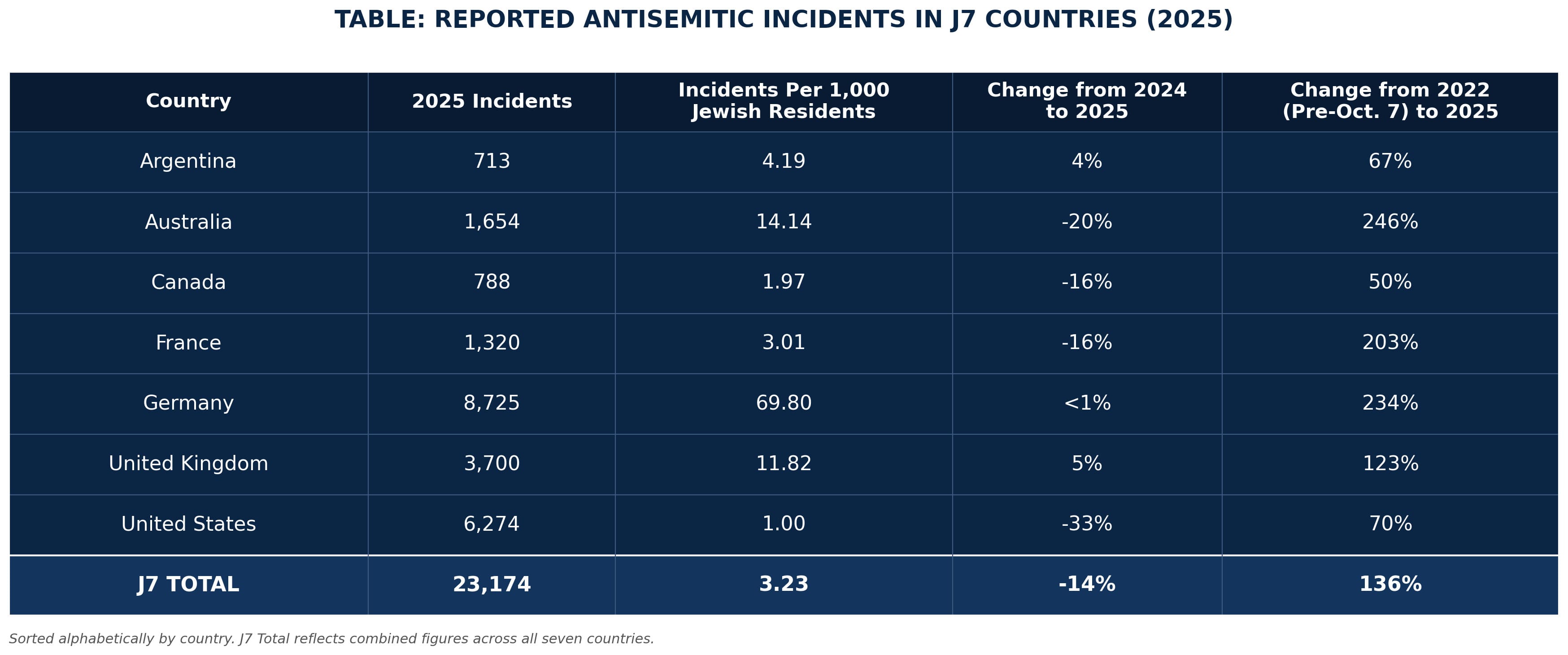
Germany continues to record the highest per capita rate of antisemitism among J7 nations by a large margin, reaching nearly 70 incidents per 1,000 Jewish residents in 2025.
Australia faced a severely violent 2025 that culminated in the Bondi Beach massacre, contributing to a 270% cumulative increase in incidents since 2021, and prompting the federal government to expand a security inquiry into a full Royal Commission into Antisemitism and Social Cohesion.
On the other side of the Atlantic, the United Kingdom recorded 3,700 incidents, heavily impacted by the October terror attack at Manchester’s Heaton Park Synagogue, while France logged 1,320 incidents as community leaders warned of an emerging “atmosphere of antisemitism” bleeding into professional and social spaces.
Digital platforms incubate hate as antisemitism moves into the mainstream
The report highlighted a qualitative shift in how hate is propagated, noting that the digital sphere has become a primary incubator for extremism. In Argentina, 66% of incidents originated online, while in France, 58.5% of hateful content concentrated on the social media platform X/Twitter.
Across the J7 nations, the report found the 2025 landscape was defined by several convergent trends. Jewish community organizations across all seven countries reported that “anti-Jewish hostility is no longer confined to the fringes.” The report documented that “the normalization of antisemitism is not a metaphor; it is a measurable and documented phenomenon,” with anti-Zionism frequently serving as a vehicle for antisemitic expression, accounting for 45% of incidents in the US, 48% in the UK, and at least 22.6% in Germany.
Educational institutions emerged as “an acute flashpoint,” where Jewish students across all seven countries reported “self-censorship, exclusion, hostile classroom environments, and inadequate institutional responses.”
Additionally, the report highlighted that the digital sphere became “the primary arena of antisemitic expression,” driven by the “weaponization of artificial intelligence [AI] to generate, amplify, and disseminate antisemitic content at scale.” This technological shift is compounded by the rise of antisemitic influencers and social media personalities who command significant followings with conspiratorial narratives, operating alongside severe legal and regulatory limitations that struggle to address the speed and scale of online hate.
Consequently, Jewish communities faced a “growing Jewish concern for personal and communal safety,” with individuals reporting “hiding their Jewish identity in public and questioning whether they have a future in their home countries.”
According to Anti-Defamation League (ADL) research cited in the report, “four leading large language models, namely OpenAI’s GPT, Anthropic’s Claude, Google’s Gemini, and Meta’s Llama, exhibited measurable anti-Jewish bias in English, and that AI video tools produced antisemitic outputs at least 40% of the time when tested.”
“This technological dimension represents a qualitative shift in the threat environment that no existing legal or regulatory framework has yet adequately addressed,” the report said.
Different countries face different drivers of antisemitism
While these convergent trends appeared globally, the report noted that the specific sources of antisemitism differed by context.
Germany confronts a “confluence of far-right ethno-nationalism, left-wing anti-Zionism, and Islamist extremism simultaneously.”
In Canada, the Centre for Israel and Jewish Affairs (CIJA) warned of “foreign state interference and the exploitation of domestic institutions by extremist networks.” Meanwhile, Argentina’s Delegación de Asociaciones Israelitas Argentinas (DAIA) identified a unique paradox in which a pro-Israel government’s alignment with Israel has generated “conspiratorial antisemitic backlash from the Left and from fringe nationalist movements.”
Additionally, the United States faces a “politically polarized environment in which the nonpartisan consensus needed to combat antisemitism is itself under strain.”

In addition to examining core J7 nations, this year’s report featured an “In Focus” chapter on Ireland, contributed by the Jewish Representative Council of Ireland (JRCI).
The report noted that Ireland’s inclusion offers a valuable comparative lens, illustrating the experience of a small Jewish community in the absence of the data infrastructure and policy frameworks developed by most J7 countries.
Between July 2025 and January 2026, members of Ireland’s roughly 2,200-person Jewish community reported 143 antisemitic incidents through a community reporting mechanism established by the JRCI.
The report detailed that the most commonly reported incidents in Ireland included 52 instances of verbal abuse or slurs, 47 cases of vandalism or graffiti, 35 threats or intimidation events, and 29 reports of exclusion or discrimination, alongside 24 instances of direct digital targeting. Approximately 75% of these incidents occurred in physical, everyday environments such as public spaces, educational institutions, workplaces, and service settings.
Furthermore, the report highlighted that Ireland lacks a dedicated national strategy to counter antisemitism, a centralized incident-recording system, routine disaggregation of hate crime data, and targeted security funding for Jewish institutions.
The J7 task force is demanding that world governments move beyond symbolic gestures by closing legal loopholes that shelter hate speech under the guise of anti-Zionism, ensuring robust and sustained security funding, as well as compelling tech companies to strictly moderate online hate.
The task force’s concluding call stressed that concrete, systemic intervention is required to protect communities from further violence: “On behalf of the 20 people killed last year in antisemitic attacks, we demand immediate, comprehensive, and life-saving actions to stem the tide of antisemitism.”