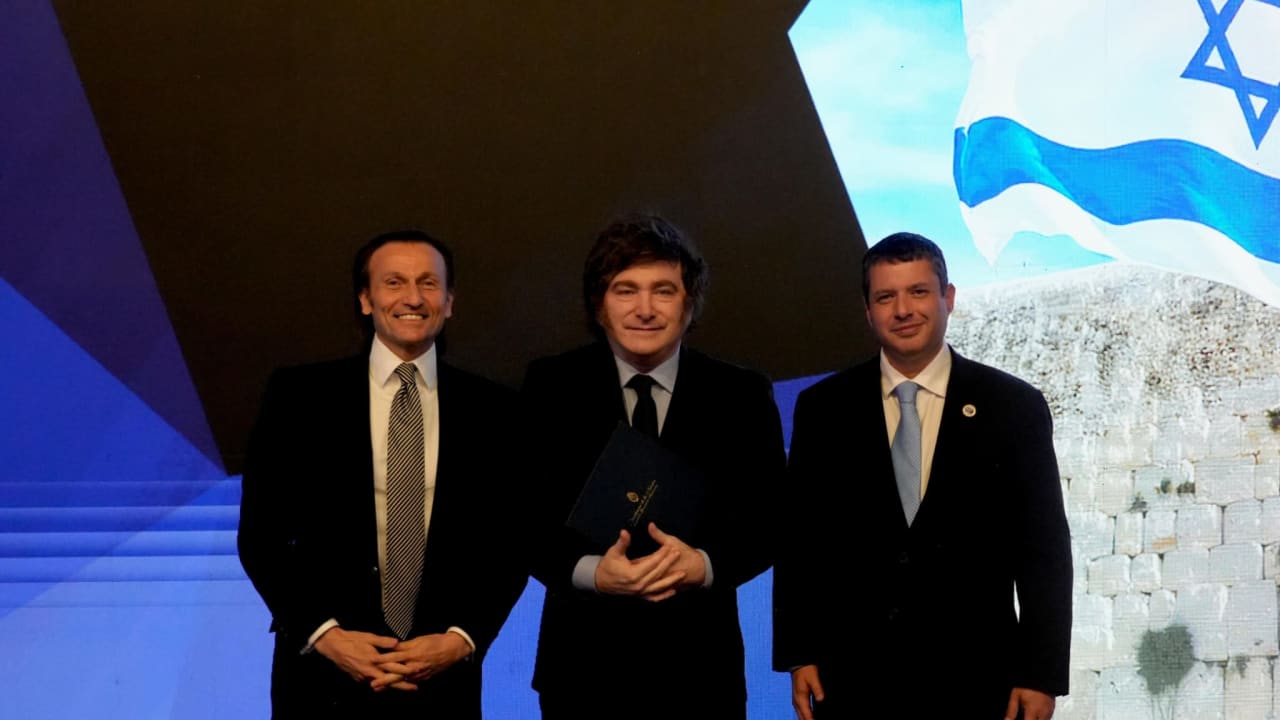
A year ago, Argentinian President Javier Milei received the Genesis Prize for standing with Israel at a moment of growing international isolation.
Milei waived the prize’s $1 million monetary award, and the Genesis Prize Foundation (GPF) directed the funds to establish American Friends of Isaac Accords (AFOIA).

The newly formed NGO became the Isaac Accords’ operating platform, working at the crossroads of public and private-sector diplomacy to build bridges between Israel and Latin America. It focused on ties in security, innovation, trade and culture – connecting governments, legislatures, businesses, and civil-society organizations.
“The Isaac Accords bring the spirit of the Abraham Accords to the western hemisphere through a model adapted to Latin America,” said Stan Polovets, co-founder and chairman of the Genesis Prize Foundation. “It seeks to establish a web of relationships among governments, parliaments, businesses, universities, and communities that build long-term bonds in an unstable world. Political leaders change, but a network this broad is built to endure.”
Prime Minister Benjamin Netanyahu and President Milei formally launched the initiative at the presidential level in Jerusalem in April 2026. The summit gave state backing to the Isaac Accords, reinforcing AFOIA’s work in public diplomacy and its efforts to deepen commercial and cultural ties.
Israel and Argentina also signed intergovernmental memoranda on cybersecurity, counterterrorism, and trade finance.
Polovets singled out Argentinian Ambassador Axel Wahnish for his contribution. “Ambassador Wahnish’s partnership and unwavering support have been critical to the success of the Isaac Accords and to strengthening ties between Argentina and Israel.”
Early results
“AFOIA was officially registered only in September 2025, making it, in fact, eight or nine months old,” said S. Fitzgerald “Fitz” Haney, former US ambassador to Costa Rica, who serves as the Genesis Prize Foundation’s managing director for Latin America and heads AFOIA. “Yet it has already produced tangible results across the region.”
Journalists, influencers, and student leaders from six Latin American countries received training in media advocacy and countering hostile narratives about Israel. In Costa Rica, AFOIA organized the training of 200 medical professionals in mass-casualty and trauma-care protocols through a partnership with Rambam Health Care Campus. AFOIA has supported Ecuador’s new innovation office in Jerusalem with diplomatic standing, while Costa Rica announced plans to establish its own with AFOIA’s support.
AFOIA worked with Permanent Representative of Israel to the United Nation Danny Danon to engage Latin American ambassadors and permanent representatives in strengthening support for Israel at the UN and other multilateral organizations.
Establishing the Isaac Accords Fund – a landmark joint initiative between Israel and the Inter-American Development Bank (IDB), signed in Washington on June 3, 2026 – marked a defining moment in the maturation of the Isaac Accords, said Fitz Haney.
“Institutionalization, with real multilateral capital behind it, dedicated to public and private joint ventures in infrastructure, innovation, and sustainable growth across the region – this is the framework moving from vision to reality.
“AFOIA has worked alongside the IDB and Israeli government to advance this initiative and looks forward to continuing to do so as it takes shape.”
Brazil: A test case
Brazil, Latin America’s largest country and economy, offered an early test of AFOIA’s strategy. The country holds a special place in Israel’s story: Brazilian diplomat Oswaldo Aranha presided over the 1947 UN vote that paved the way for the establishment of the Jewish state.
Official ties deteriorated under President Luiz Inácio Lula da Silva: Brazil recalled its ambassador in 2024, and Israel downgraded relations in 2025.
Yet even as Brazil’s executive branch pulled away from Israel, nearly one-third of the nation’s National Congress sought closer relations.
In 2026, AFOIA partnered with the Brazil-Israel Parliamentary Front as it became the first legislative caucus in Latin America to endorse the Isaac Accords’ Declaration of Shared Principles. Led by Brazilian lawmakers, the front provided a parliamentary counterweight to the administration’s foreign policy.
And, 10 weeks later, at a Buenos Aires summit, in conjunction with the Israel Allies Foundation, this strategy was expanded across the region.
The Buenos Aires summit
While much of AFOIA’s first-year work has taken place outside public view, the Israel Caucus Chairmen’s Conference, held in Buenos Aires on June 28-30 by the Israel Allies Foundation in partnership with AFOIA, became one of its most visible milestones.
It brought together lawmakers from 12 countries who chair pro-Israel caucuses in national legislatures across Latin America.
The conference featured opening remarks by Argentinian Foreign Minister Pablo Quirno and a keynote address by Milei, with US. Ambassador to Argentina Peter Lamelas and US Ambassador to Uruguay Lou Rinaldi also taking part.
Legislators from 12 countries signed the Isaac Accords’ Declaration of Shared Principles. The conference also produced pledges to adopt the International Holocaust Remembrance Alliance working definition of antisemitism, champion the relocation of their countries’ embassies to Jerusalem, and strengthen legislative frameworks to combat terrorism and extremism across the region.
David Hatchwell Altaras, chairman of the Genesis Prize Selection Committee, introduced Milei before his keynote address.
Reflecting on the conference, he said: “President Milei’s vision, which inspired the Isaac Accords, is to build a network of cooperation spanning several domains.
“The parliamentary track is crucial because it gives elected lawmakers a direct role in developing their countries’ relationships with Israel. It is especially effective when complemented by relationships in business, innovation, education and culture. Together, these connections give Israel-Latin America relations breadth and continuity.”
Looking ahead
AFOIA’s second-year agenda will seek to bring the Declaration of Shared Principles to still more national legislatures. The aim is to complement relationships with presidents and governments with support from lawmakers – creating ties that endure even when executive-branch policies change.
“It is through legislative activity and by being written into national law that these ties become resilient,” explained Fitz Haney.
Haney detailed other priorities for the coming year: “We’re helping to plan an Ecuador-Israel innovation delegation connecting Israeli tech leaders with Ecuador’s government and private sector.
“We’re also looking to deepen programming in Chile and do more work with Bolivia, Costa Rica, Honduras, and Paraguay.”
As AFOIA gears up for its second year, Haney argues that closer cooperation between Israel and Latin American democracies in trade, technology, security, and counterterrorism serves a wider US strategic interest by reinforcing a pro-Western alignment across the western hemisphere.
GPF chairman Stan Polovets echoed the point: “An increasingly unstable world puts a premium on dependable relationships among democracies.
“Our vision is to build these connections across an entire region – among governments, legislatures, businesses, and civil societies – so the network takes root and grows in many places at once and does not rise or fall with any single election or government.
“When pro-Western democracies link arms, everyone wins.”
This article was written in cooperation with the Genesis Prize Foundation.