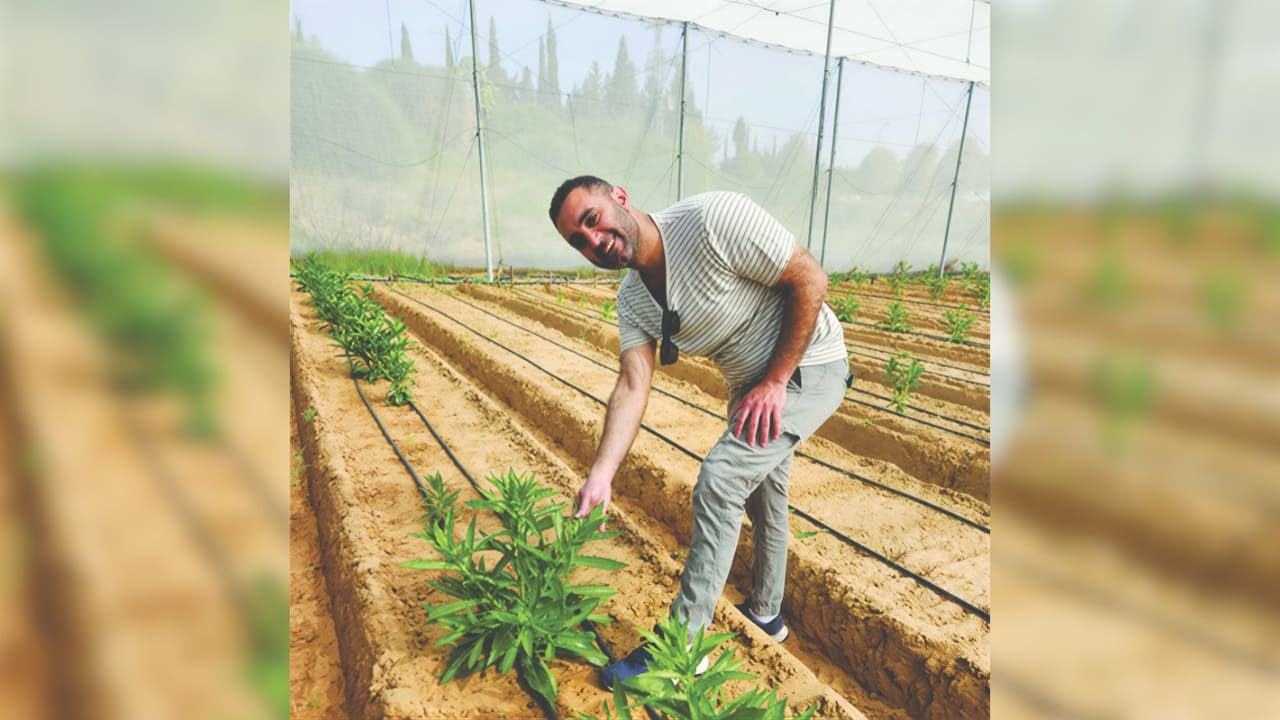
Can plants go moo? Well, not exactly, but a new Hebrew University of Jerusalem (HUJI) study has brought a step closer to the possibility that plant seeds could manufacture and store one of milk’s most important proteins – the same ones that give milk its nutrition, creamy texture, and cheese-making properties.
The discovery would thus help overcome a major hurdle in producing real dairy proteins without cows, paving the way for more sustainable dairy ingredients, less climate change, and alternative food production.
Just published in Frontiers in Plant Science under the title “Microscope reveals surprising milk protein clusters in engineered seeds,” the research was led by Prof. Oded Shoseyov of the Robert H. Smith Faculty of Agriculture, Food, and Environment at HUJI, together with lead author Almog Ozeri and Mai Shamir, Miron Abramson, Barak Cohen, and Amir Rudich.
The team showed that plants can successfully manufacture ß-casein, one of the major proteins found in cow’s milk. Even more surprising, the protein accumulated in an entirely unexpected location inside plant cells, revealing a previously unknown pathway that could help improve the production of animal proteins in crops.
According to their press release, “As global demand for dairy continues to grow while concerns mount over greenhouse gas emissions, land use, and water consumption associated with livestock farming, scientists have been searching for sustainable ways to produce authentic dairy proteins without relying on animals.

“Plant molecular farming, using crops as miniature protein factories, has emerged as one of the most promising approaches, but producing complex milk proteins in plants has remained a major technical challenge.”
To tackle this problem, the researchers engineered seeds from Arabidopsis (thale cress), a weed in the mustard family (Brassicaceae) native to Eurasia and Africa. It is commonly found along the shoulders of roads where plant cover is lost, or soil is churned up by construction, grading, fire, or heavy traffic.
Plants used to produce bovine ß-casein
They used it to produce bovine ß-casein fused to an oil-body protein called oleosin, which is bound to plant oil bodies. Testing several different “cellular addresses,” they directed the protein to various compartments within the plant cell to determine where it would accumulate most efficiently.
Shoseyov told The Jerusalem Post in an interview that the team’s findings were totally unexpected. “The protein absolutely behaves like real dairy ß-casein – even better.”
Asked why the plants ignored their instructions, he suggested that it was “probably due to the gap between what we think we know and what we actually know.”
“Biological systems are far more sophisticated,” Shoseyov continued. “While we can’t claim it’s an entirely new biological pathway – we need further investigation to come up with such a statement – it opens some very interesting opportunities. It’s likely that we’ve simply overlooked something that plants have always done.”
They created a “novel food ingredient that combines protein and oil that may be either integrated into existing dairy products or will be used to produce entirely new tasty and nutritious food products more cost-effectively and sustainably compared to the existing dairy industry,” he said.
“We estimate that in 18 to 24 months, we’ll reach the commercial stage. The biggest remaining obstacle ahead is adoption of the technique by industry. We have already begun discussions with the US Food and Drug Administration.”
Shoseyov already holds over 100 patents relating to his work in protein engineering, nanobiotechnology, and bio-inspired materials.
Although precision fermentation already produces dairy proteins, plants have an advantage because protein production and extraction in plants is up to 100 times cheaper compared with fermentation, he said.
Shoseyov suggested that safflower (Carthamus tinctorius) is the intended commercial and agricultural crop platform for this technology. Arabidopsis was the research model that was used in the lab because of its fast life cycle, small genome, and ease of genetic transformation, but safflower is the targeted crop.
Once the artificially designed segment of DNA is assembled in a lab and everything is validated in Arabidopsis, it is transferred to safflower for scaled agricultural production.
Milk is only four percent protein, 3% fat, with some sugars, but it’s mainly water, said the HUJI expert. “Safflower seeds contain about 10 times more concentrated protein and fat.”
“Thus, for every 10 trucks that carry cold milk, we would need to use only one at room temperature, and upon arrival at the factory, the seeds could be stored in a silo at room temperature for up to one year.”
Safflower seeds are white; the oil is colorless and has no flavor, therefore avoiding coconutty, beany, or oaty cereal-like odors of “milks” made from coconut, soy, or oats. In addition, safflower plants prefer hot weather and require very little water for irrigation, if any, thus making them an ideal crop for global warming.”
As demand grows for environmentally sustainable sources of protein, discoveries like this bring scientists closer to producing authentic dairy ingredients in plants that require only sunlight, water, and soil to grow, he continued.
More opportunities for dairy farmers
Asked what dairy farmers will do, Shoseyov said they’ll have more opportunities. “Regular dairy is not going to vanish. In the next 20 years, most of the plant-based dairy proteins will be used in hybrid products to reduce price and meet sustainability goals. The farmers may expand their growing seasons to grow our crops and supply them to their dairy factory customers.”
The largest growth in demand will come from the Asia-Pacific region, and countries that are likely to become the major growers are Australia, the US, Argentina, Brazil, Ukraine, China, and eventually India and Africa.
“We already started discussions with the FDA. There is a very clear path. It should not be too difficult. In five years, I hope to see our plants grown all over the world and the shelves in the supermarkets loaded with our plant dairy products,” Shoseyov said.
“But mostly, I hope that our dairy safflower seeds will contribute to the food security of Israel. I look forward to tasting mozzarella cheese made of our novel ingredient.”
Asked if his discovery could end up being more important for medicines than for dairy since plant molecular farming also produces pharmaceuticals – so farms would become protein factories rather than food factories, Shoseyov responded, “I am positive that the pharmaceutical industry will enjoy this discovery to manufacture biological drugs, such as humanized antibodies.”
“Nevertheless, the food industry is four times larger than the pharmaceutical industry. Consumers will know they’re eating proteins that came from a flower instead of a cow because transparency is mandatory in the food industry.”
“One of the most exciting aspects of science is when nature surprises you,” Shoseyov went on to say. “We set out to send the protein to one location inside the cell, but instead, we found that the plant had effectively created its own storage solution.”
“Understanding this unexpected behavior gives us valuable insight into how plants handle complex proteins and may help us engineer more efficient systems for producing sustainable dairy proteins in the future.”