
The Prime Minister's diagnosis recently brought one of the most common types of cancer among men back into the headlines. For most of the public, prostate cancer is still primarily identified with PSA tests, biopsies, and sometimes surgeries or radiation. However, while the public debate often focuses on the diagnosis itself, the world of prostate medicine has undergone a true technological revolution in recent years.
A combination of advanced imaging, robotics, and artificial intelligence is gradually changing the way doctors diagnose the disease, make therapeutic decisions, and tailor treatment to the unique characteristics of each patient. The result is more precise, safer, and, in many cases, more personalized medicine.
"When talking about prostate cancer, most people think about the diagnosis itself, but in fact, one of the most significant changes has occurred precisely in the way we diagnose the disease," says Prof. David Margel, Director of Innovation, Research, and Risk Management at Assuta Ramat Hachayal, speaking to Walla Health. "The ability to understand exactly where the tumor is located, what its size is, and what its characteristics are is what allows us to make better decisions for the patient."
The long journey the biopsy has undergone
Prostate cancer is one of the most common tumors among men worldwide. Despite impressive advances in blood tests and MRI imaging, the only way to determine with certainty whether a tumor is cancerous is through a biopsy, meaning the taking of tissue samples from the prostate.
For many years, most biopsies were performed transrectally under ultrasound guidance. The method allowed doctors to sample different areas of the gland, but it had significant limitations. Sometimes it was necessary to perform between 10 and 20 different punctures to try to locate the suspicious finding, and the procedure also involved a risk of infections and various complications.
Later, Fusion systems came into use, which combined pre-performed MRI scans with real–time ultrasound. This was a significant leap forward, but even these systems still relied heavily on the skill of the practitioner and their ability to guide the needle accurately.
"We know today that the first test is critical," explains Prof. Margel. "The more accurate the sample is the very first time, the more we can save the patient uncertainty, repeated biopsies, and delays in receiving the appropriate treatment."
The robot that entered the biopsy room
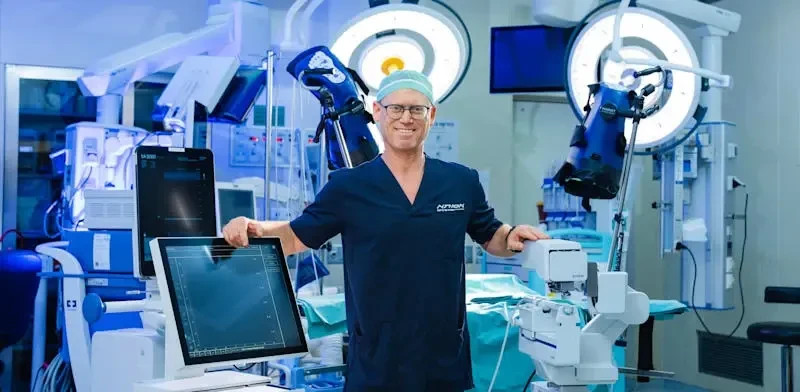
One of the most intriguing developments in the field is the Mona Lisa system, a robotic system for performing prostate biopsies. The system combines MRI imaging with real–time ultrasound and creates a three–dimensional model of the prostate. After the doctor marks the suspicious finding on the imaging, the robotic system navigates the needle to the selected target with exceptionally high precision.
The system operates via a transperineal approach, meaning through the skin rather than through the rectum. In recent years, this approach has received increasing recommendations from urological associations worldwide, primarily due to the lower risk of infections.
The PREVENT study, which included approximately 658 patients, found that with this approach, no infection cases were reported at all, compared to a rate of about 1.4% with the traditional transrectal approach.
Another advantage of the system is the ability to take multiple samples through the same entry point, instead of performing a large number of separate punctures.
"Our goal is not only to achieve a more accurate diagnosis," says Prof. Margel. "We also want to make the experience safer for the patient, with less tissue trauma, less pain, and fewer complications."
When artificial intelligence enters the picture
One of the central differences between the new generation of biopsy systems and traditional methods is the integration of artificial intelligence and robotics into the diagnostic process.
The Mona Lisa system is capable of detecting needle deviation in real time and performing an automatic correction of its progression path. This capability makes it possible to reach the target area with an accuracy of just a few millimeters.
According to Prof. Margel, it is important to understand that the technology does not replace the doctor, but rather assists them.
"People hear the words artificial intelligence and think the computer is replacing the doctor," he says. "In practice, the goal is exactly the opposite. The technology gives the doctor better information and tools, so that they can make more precise decisions."
Not just diagnosis: A completely different treatment as well
The revolution in the prostate field does not end at the diagnostic stage. In fact, accurate diagnosis is what enables one of the most significant developments in the field in recent years: focal treatments.
In the past, when a cancerous tumor was diagnosed in the prostate, the accepted approach was to treat the entire gland using surgery or radiation. Today, in appropriate cases, focused treatment targeting only the area where the tumor is located can be considered.
"The goal of focal treatment is to treat the tumor itself while trying to preserve as much of the surrounding healthy tissue as possible," explains Prof. Margel. "To do this, we must know exactly where the tumor is located and what its boundaries are. Therefore, the quality of diagnosis has become critical."
According to him, this is part of a much broader trend currently occurring in modern medicine.
"We understand today that not every prostate cancer behaves the same way, and not every patient needs the same treatment. The more accurate the diagnosis, the better the treatment can be tailored to the characteristics of the disease and the needs of the patient."
Over the past decade, the world of prostate medicine has undergone a dramatic change. A combination of advanced MRI, robotic systems, artificial intelligence, and targeted treatments is gradually changing the way doctors diagnose and treat the disease.
If in the past the primary efforts focused on the mere detection of the tumor, today the goal is much broader: To reach an accurate diagnosis right at the first stage, reduce complications and infections, diminish unnecessary treatments, and preserve the patient's quality of life as much as possible.
"This is not a revolution that happens in one day," concludes Prof. Margel. "But we are definitely in an era where technology allows us to be more precise than ever. And in diseases like prostate cancer, precision can make all the difference."