
In recent years, defibrillators have become an integral part of the landscape in public places across Israel. They can be found in malls, sports arenas, train stations, office buildings, educational institutions and many businesses. The law requires their placement in certain locations, and the technology itself has become more accessible and simpler than ever.
Yet, when a person suddenly collapses from cardiac arrest, many times the device remains hanging on the wall unused.
The reason for this is not technological but human. Although the device was designed specifically for the general public, many people are still afraid to approach, touch or operate it. The fear of making a mistake, causing damage or performing a medical procedure they are not qualified for gives the most precious minutes an advantage to the greatest enemy of cardiac arrest victims: Time.
What happens during cardiac arrest?
Sudden cardiac arrest occurs when the heart stops beating at a normal rhythm due to a life–threatening arrhythmia, usually ventricular fibrillation. In such a state, the electrical activity of the heart is disrupted, blood flow stops, and within a few seconds, the person loses consciousness.
Without rapid intervention, brain damage begins within just a few minutes, and the chances of survival drop rapidly. The recommended treatment includes performing CPR to maintain oxygen supply to the brain, alongside using a defibrillator to deliver an electric shock aimed at restoring the heart rhythm to normal activity.
The statistics are well known to medical professionals: For every minute that passes without delivering an electric shock using a defibrillator, survival chances decrease by about 10%.
The critical minutes do not belong to the ambulance
Many of us assume that in an emergency it is enough to call MDA and wait for a medical team. However, in reality, even when the ambulance is dispatched immediately, arrival time is affected by distance, traffic congestion, road conditions and call volume.
During this time, the most important person on the scene is not the paramedic but whoever is next to the victim: An employee, a customer, a neighbor, a family member or a bystander.
The decision to act immediately can be the difference between life and death. The problem is that many still view the defibrillator as a complex medical device intended for professionals only.
You do not need to be a doctor
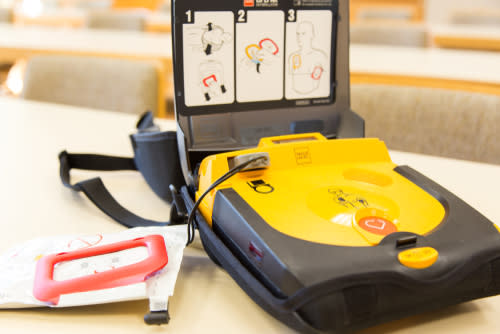
Yet the reality is entirely different. The new public defibrillators were developed specifically to allow people without any medical training to use them.
Their operation is very simple. In most cases, it is only required to press the power button, and the device immediately begins to provide clear and precise voice instructions.
It guides the user step by step, explains where to place the electrodes, and automatically performs the electrical analysis of the heart rhythm.
Equally important: The defibrillator does not allow an electric shock to be delivered if it does not identify a real medical need. In other words, the user is not required to make a complex medical decision. They simply act according to the instructions the device provides.
The device exists, the confidence is still missing
In recent years, the State of Israel has promoted legislation requiring the placement of defibrillators in a wide range of public places. This is an important and significant step, but it is not enough on its own.
Regulation alone does not save lives. People save lives. The big gap today is not between places that have a defibrillator and places that do not, but between the presence of the device and the willingness to use it.
The fear of making a mistake, causing damage or taking responsibility prevents many people from acting even when the device is just a few meters away.
For the defibrillator to become a true life–saving tool, more than physical placement of the device is needed. Short and repeated training sessions for employees in public places can significantly improve the sense of confidence and the willingness to intervene in real time. In addition, it is important to appoint a maintenance manager to ensure that the device is functional, charged and available for use at all times.
Signage also plays a significant role. In stressful situations, every second counts, and therefore a quick location of the defibrillator could be critical. Alongside this, public campaigns can help reduce fear and convey a clear message: It is better to act than to stand by.
In an era where employee safety and corporate responsibility have become an integral part of managerial culture, a defibrillator is not just emergency equipment or a regulatory requirement. It represents a statement of commitment to human life.
Ultimately, the device on the wall is only a means. The one who saves lives is the person who chooses to use it. And when it comes to cardiac arrest, this decision must be made within a few short minutes.
The writer is the director of the emergency medicine department at Eldan–Med of the Neopharm Group.