
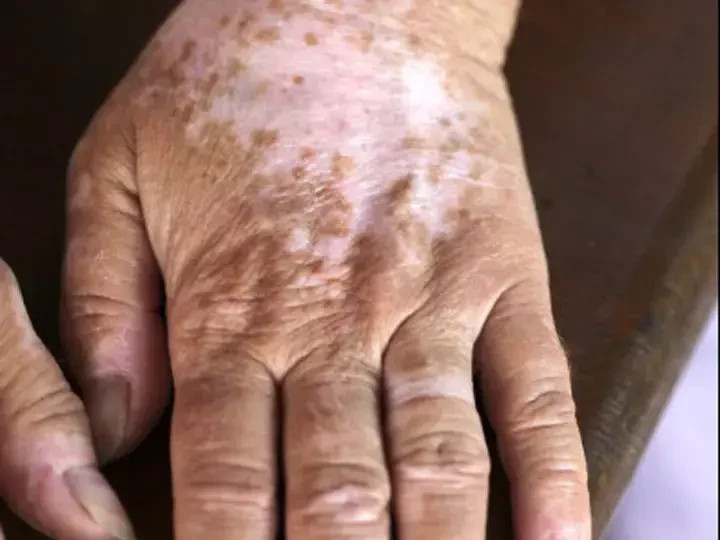
White spots on the face, hands or around the eyes are the most recognizable sign of vitiligo. But whoever looks only at the spots, misses the real story.
Vitiligo is an autoimmune disease in which the immune system mistakenly attacks melanocytes – the cells that produce melanin, the pigment that gives skin its color. According to a large-scale Israeli study published in 2024, it affects about half a percent of the population in Israel, meaning about 50,000 people. It is not contagious and not life-threatening, but for many it changes self-confidence, quality of life and sometimes mental health as well.
Precisely because it is so common, it is surprising to discover how much it is still surrounded by myths.
For more than 3,000 years vitiligo was mistakenly identified with other skin diseases, including leprosy. This confusion was not just a medical error. It led to social stigmas that accompanied patients for centuries. Even today, despite scientific progress, quite a few people still think it is a contagious disease or a purely cosmetic problem.
The reality is completely different.
Today we know that this is a complex disease resulting from a combination of genetic predisposition, abnormal immune system activity and environmental factors. Significant stress events, sunburns or skin trauma can sometimes serve as a catalyst in people with a predisposition, but they are not the cause of the disease. Understanding the mechanisms of vitiligo has advanced dramatically in recent years, and it is currently considered one of the autoimmune diseases in which the most significant leap forward was recorded.
A disease that affects self-confidence, quality of life and relationships
But the biggest change is perhaps in understanding the impact of the disease on patients' lives. For many years we focused mainly on the spots on the skin. Today it is clear that the coping of many patients does not end with external appearance.
A broad international study that included more than 3,500 people living with vitiligo in 17 countries found that the disease significantly affects self-confidence, quality of life, relationships and the sense of social belonging. Many participants reported that they avoid social activities, choose clothes that cover the skin and change their daily routine because of the disease.
The most interesting finding was that the damage to quality of life was not necessarily dependent on the size of the spots. Even relatively small lesions, when appearing on the face or hands, can significantly affect personal feeling and quality of life.
Family members are also affected. Studies have shown that vitiligo changes family dynamics, especially when spots are in visible areas, and sometimes it also affects relationships, social integration and even career-related decisions.
When celebrities "come out" with the disease
Alongside the change in understanding the disease, public discourse has also changed.
Figures like model Winnie Harlow contributed to the world beginning to see vitiligo differently. Her exposure raised awareness and made the disease more visible, but for many patients daily reality still includes stares, questions and sometimes a sense of embarrassment.
A real revolution has also occurred in the medical world.
For decades we relied mainly on steroids, phototherapy and topical treatments that were not developed specifically for vitiligo. As we understood the mechanisms of the disease better, the therapeutic approach changed as well.
Today, for the first time, there are dedicated treatments developed specifically for vitiligo. They act on the immune system mechanisms involved in the development of the disease and allow, in some patients, a gradual return of pigment to the skin.
Long-term studies indicate that targeted treatments can deliver results that last over time, while new combinations between different treatments are being studied to further improve their efficacy.
The path to change passes through society
We are also moving toward an era of personalized medicine. International consensus documents are already addressing how to adapt treatment for each patient, how to identify who is expected to respond better to different treatments and how to reduce the risk of disease recurrence.
International Skin Health Day reminds us that skin health does not end with sunscreen or a skincare routine. For tens of thousands of Israelis living with vitiligo, it is also connected to self-image, social integration and quality of life.
Science today offers much more hope than in the past, but the path to change does not pass only through the laboratory. It also passes through society. The better we get to know vitiligo, the more we will learn to see less of the spots and more of the person living with them.
Dr. Mor Pavlovsky is a specialist in dermatology and venereology, director of the Dermatology Department clinics and head of the Pigmentation and Vitiligo Clinic at the Tel Aviv Medical Center (Ichilov).