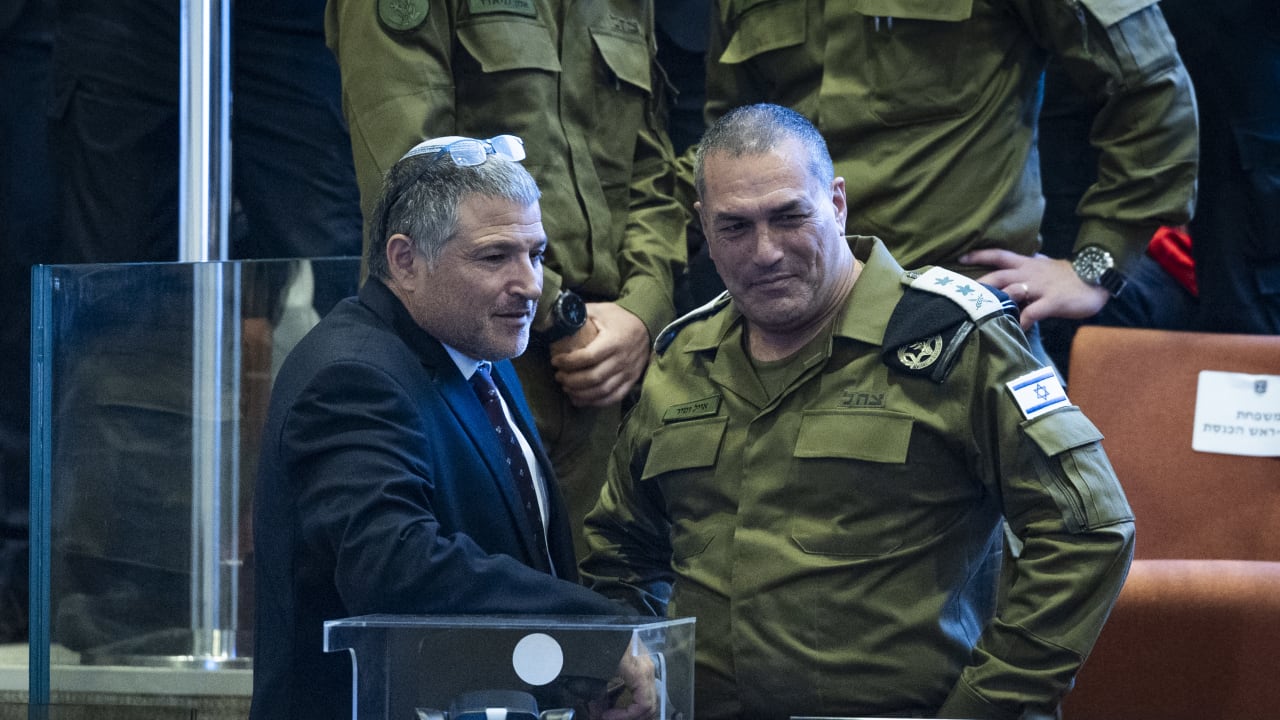
This is an abbreviated version of the profile. A longer, expanded version will be published separately on The Jerusalem Post’s website.
David Zini
Shin Bet chief David Zini is one of the most powerful men in Israel.
But if Yashar party leader and former IDF chief Gadi Eisenkot becomes the next prime minister and Zini somehow keeps his job, it will be in spite of a series of disastrous public relations moves he has made.
His most recent was denying Eisenkot a Shin Bet security detail despite successive weeks of polling showing that the former IDF chief is the clear challenger to Prime Minister Benjamin Netanyahu and possibly even the favorite in the October 27 elections.
Whether it is required or not according to the letter of the law, Zini made this misstep even as he has authorized a lifelong security detail for Sarah Netanyahu, something never granted before to any family member of a premier, so the Shin Bet chief knows how to stretch when he wants to.
Zini was even rebuked by a Knesset advisory committee which has recommended that the agency should extend Eisenkot protection, despite the agency chief’s views.

In addition, at one point Zini provided an opinion that Netanyahu could have potentially used to stall testifying at his trial based on safety concerns, despite the fact that most current and all former Shin Bet officials thought that the claims were nonsense and that Netanyahu has continued to regularly appear in public exposed areas to campaign.
These are only the latest of Zini’s missteps, which have convinced much of the public that he has politicized aspects of his post.
In less than a year in office, he has managed to offend much of the Shin Bet’s female staff, LGBT staff, and families of Shin Bet agents killed on October 7 and created a media storm with comments that many understood as a readiness to intervene on Netanyahu’s behalf either in the election or in a conflict with the judicial branch.
The Jerusalem Post received exclusive explanations about what he really meant in his recorded comments, and many of those explanations were coherent, but the fact that he fell into the trap in the first place showed a disconnect in terms of the concerns of many sectors of the public.
Further, he has been accused by other Shin Bet and defense officials of going easy on violent Jewish extremists who attack Palestinians in the West Bank, even if most of the blame for the issue is placed on National Security Minister Itamar Ben Gvir.
And yet, neither Eisenkot nor Naftali Bennett, has said he must go the way they have top police officials who have served under National Security Minister Itamar Ben-Gvir.
Apparently, despite Zini’s regular shooting himself in the foot, he retains the respect of a large portion of the defense stablishment as a manager who knows how to stop Palestinian and Iranian terror – the agency’s main mission.
According to the most recently posted Shin Bet report on thwarting terror for May of this year, the agency stopped 406 attacks.
In terms of attacks that took place, 282 involved rock throwing, 32 involved Molotov cocktails, 24 involved burning tires, eight involved explosive devices, and two involved car ramming.
Despite all of these terror actions, only one Israeli was killed by terror in March and none in April-May, while only between eight and nine Israelis were wounded per month.
This could support those who want to keep Zini in office as an effective anti-terror czar despite the many downsides he has highlighted, and possibly under a new boss, he might work harder to stay out of the headlines on side issues.
Eyal Zamir
When IDF Chief of Staff Lt.-Gen. Eyal Zamir finished 2025, he was on track as one of the most popular IDF chiefs in recent memory.
He had stormed onto the world stage in June 2025, leading Operation Rising Lion, Israel’s remarkably successful massive strike on Iran’s nuclear program, radars and air defenses, top military officials, and some ballistic missile sites.
Next, he was the IDF chief in October 2025, when a deal was struck with Hamas to end the Gaza War, including the return of all remaining living and deceased hostages.
But 2026 has been a much more mixed bag for Israel and for him as well.
Israel’s early 2026 Operation Roaring Lion is viewed by most in Israel and globally as less successful than the 2025 operation, even as the IDF did destroy significant aspects of Iran’s ballistic missile program, caused between $200-300 billion dollars of damage to its broader military industrial complex, and assassinated supreme leader Ayatollah Ali Khamenei.

Regardless of the successes, it has been highly problematic diplomatically, turning even more of the world against Israel and even losing important measures of support from the Trump administration over gas prices and the crisis in the Straits of Hormuz as well as the fact that the Iranian regime survived with an intransigent attitude.
This in turn may limit the IDF’s future military options against Iran and even against Hezbollah in Lebanon, which Zamir had initially seemed to succeed in weakening even more in early 2026 than during the fall 2024 campaign against the group.
Through all of this, Zamir has inherited a multi-headed problem of terror emanating from the West Bank since early 2022. He has tried to order harsher crackdowns on certain more problematic Palestinian areas, reducing aspects of the terror threat substantially, but nothing close to stopping the threat.
At the same time, Zamir, along with the police, the Shin Bet, and the government more broadly, have lost control over several hundred violent Jewish extremists who have been regularly attacking both Palestinians and soldiers alike.
Zamir has not fought with Defense Minister Israel Katz to restore administrative detention of violent Jews, a tool the Shin Bet has consistently demanded be returned to them for use. Rather, he has been strategic about public fighting with the defense minister, with a focus on keeping control of key IDF appointments and on pressing the government to draft more haredim (ultra-Orthodox) despite pushes by Katz to make political-friendly appointments and to protect haredi political parties from any substantial concessions on drafting more young men from their sector into the military.