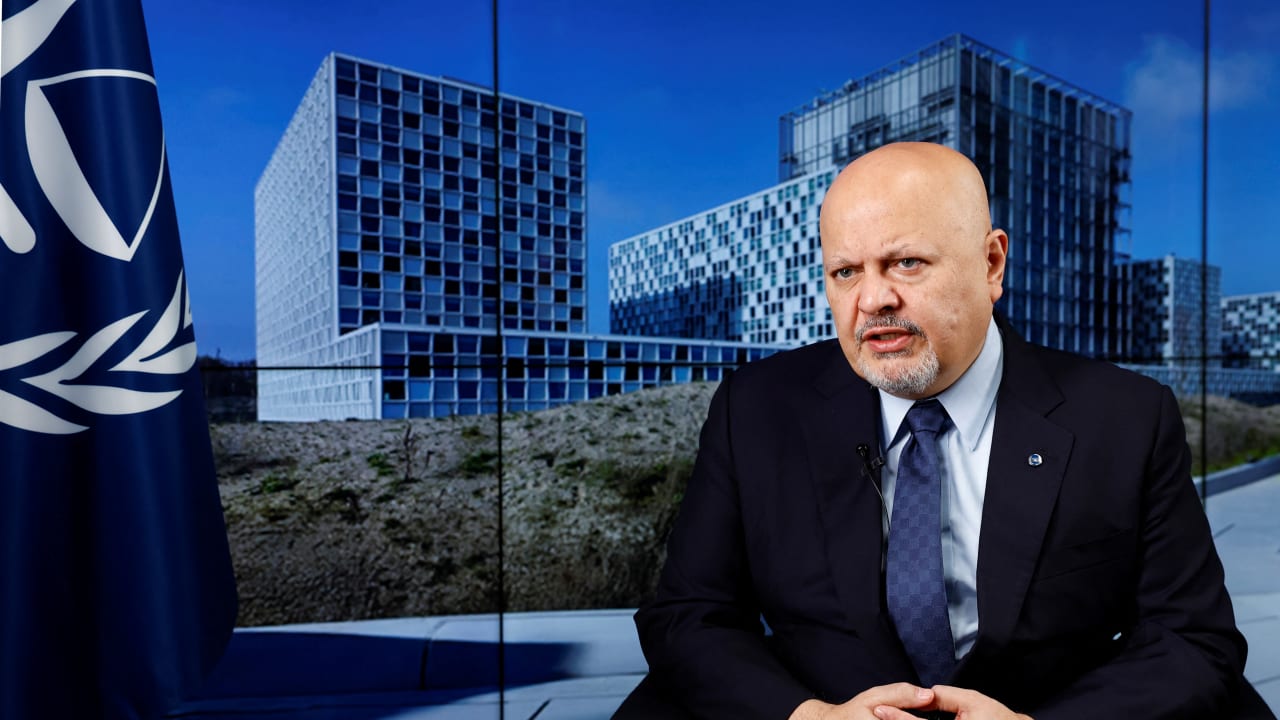
International Criminal Court Prosecutor Karim Khan’s dismissal after around two years of scandal for alleged sex and sexual harassment crimes is a seminal event.
There are large impacts, which can be called good news, bad news, and just a plain ugly mess. Among the pro-Israel coalition, there are generally two views about the ICC, both defining it as unfairly biased toward Jerusalem.
The first view is that the ICC should not exist, that it is an unsalvageable institution, and anything that can be done to bring it down should be pursued.
This crowd is on a high right now and views Khan’s fall as brilliant news. For them, it seems to prove everything they have argued about the ICC: that it is an alternately anti-Israel and anti-US or ivory-tower-style institution divorced from the realities of having to fight asymmetric warfare against terrorists and that it is filled with hypocrites.
The punchline is that Khan unfairly accused Israel of war crimes while he was perpetrating sex crimes himself.

Two camps, two strategies for Israel to confront the ICC
This camp also believes that the entire ICC case against Israel rested on Khan trying to cover up his alleged crimes, and so they are hoping his fall will make it go away.
Then there is the second camp, which views the ICC as a reality that the Jewish state must deal with, like it or not, and believes that dialogue with the court, even if aggressive, is the best – albeit imperfect – strategy to handle the problem.
According to this view, it makes sense to attack Khan and the ICC for allegedly targeting Israel in order to cover up Khan’s alleged sexual crimes, but that is only a secondary defense.
The primary defense remains going after the substantive charges themselves.
These arguments break down into multiple tracks.
One is attacking the idea that the ICC can have jurisdiction when the UN Security Council does not recognize a state of Palestine as a full-fledged voting member and when the Oslo Accords explicitly prohibit outside interference in the parties resolving their decades-long dispute.
Another is claiming the ICC must stay out of the issue because Israel has its own legal system and rule of law, which is in the midst of around 100 criminal probes and over 3,000 disciplinary probes of its own soldiers for alleged violations.
Such arguments delayed the ICC from going after Israel in a criminal probe from 2009 until 2021 and delayed arrest warrants until spring to fall 2024.
There is still hope that such arguments will prevent indictments and any trial, and there is even stronger hope that it would be nearly impossible to convict under the criminal law standard of “beyond a reasonable doubt” in such a trial.
This second camp is ready to fight this fight, knowing that much of the world is relatively ignorant about the arguments for and against the ICC and will generally accept it as an important moral body with which to contend.
Both camps believe that Khan, at minimum, rushed his final decision on Israel, at least partially to try to cover for the sexual allegations probe against him at the time, which bought him several additional months in office before the story burst forward fully.
This is because Khan was due to visit Israel to discuss its counterarguments to his allegations but canceled at the last minute, jumping on CNN instead, like a political campaigner, rather than filing a legal brief with the ICC like a standard apolitical prosecutor.
Also, both camps reject the false defense by Khan claiming that the sexual charges were trumped up by Israel to get rid of him.
His accuser is a Malaysian woman who is strongly in favor of prosecuting Israel and who herself tried to suppress the allegations from leading to a criminal investigation until the controversy leaked.
It definitely seems that Israel worked hard to raise scrutiny on the charges once they emerged, but Khan ultimately made his own bed here.
However, the two camps then split somewhat over the next question: if Khan had been pushed to the side in May for the sexual allegations probe, would the ICC have still gone after Israel?
The first camp probably thinks no, whereas the second camp probably thinks yes.
Whether the first or second camp is right about how best to handle the ICC as a challenge will continue to be hotly debated, but all evidence The Jerusalem Post gathered at the relevant times from both ICC and Israeli legal sources indicated that Israel would have faced war crimes charges or arrest warrants anyway.
Look at what has happened since Khan took indefinite leave in mid-May 2025.
When the ICC Prosecution filed its first brief after Khan’s suspension, responding to Israel on May 21, 2025, his deputy, Shameen Khan (no relation), signed the papers, meaning there was little internal debate.
If his subordinates had disagreed with his call, this would have been their moment to roll it back.
Also, the ICC Pre-Trial Chamber itself endorsed Khan’s arrest warrants, albeit in a 2-1 split vote, making the warrants even less dependent on Khan as an individual.
One perplexing aspect of Shameen Khan’s role in all of this is that she comes from Fiji, which has an awful human rights record.
In fact, Shameen Khan, according to local coverage of Fiji developments, was fired from the country’s High Court in a dispute over political coups.
She was then out of public service for some years until she was plucked up again to serve on the UN Human Rights Council and from there to the ICC office.
Without getting deeply into which side Shameen Khan is on, the point is that she is no stranger to politics mixing in with law and comes from a country with a problematic version of democracy, all of which raises questions about how she will understand Israel’s complex context versus the Palestinians.
Israel is not free from ICC scrutiny
In any event, her decision to continue pursuing the Israeli arrest warrants showed that Khan’s extended leave from his position, and now his dismissal, did not free Israel from the ICC’s ongoing scrutiny.
After all of this, there was – and might still – one way to freeze the ICC arrest warrants.
To date, the ICC has only issued public warrants against Prime Minister Benjamin Netanyahu, former defense minister Yoav Gallant, and three secret (leaked) warrants against Betzalel Smotrich, Itamar Ben-Gvir, and one still unnamed IDF official.
The ICC was able to issue these warrants because all of Israel’s 100 criminal probes and 3,000 disciplinary probes are against lower and mid-ranked soldiers.
On May 4, 2024, weeks before Khan made his fateful decision, former deputy attorney-general for international affairs Roy Schondorf said that the best way for Israel to mitigate the potential threat of war crimes allegations from the ICC would be to establish an independent state inquiry led by a former judge.
Schondorf led Israel’s efforts to defend itself against war crimes and the ICC for about 13 years, until mid-2022, and is still viewed as one of Israel’s top experts on the issue, having also served for over a decade as an IDF lawyer.
Essentially, Schondorf’s suggestion was to adopt the Turkel Commission model, which Israel used to successfully ward off ICC scrutiny after the 2008 to 2009 Gaza conflict, as well as the UN Goldstone Commission Inquiry, which subsequently examined alleged war crimes related to that conflict.
The Turkel Commission, led by former Supreme Court justice Jacob Turkel, evaluated Israel’s system for probing alleged war crimes and made several recommendations that eventually fundamentally altered the system, making it more aggressive, faster, and transparent in handling such probes.
Much of the Israeli legal community backed Schondorf’s recommendation, but Netanyahu disregarded it.
Many Israeli lawyers have also pressed for Israel to publish more of its probe results and do so more rapidly, as it did after past wars, but the Post has reported that various government parties have repeatedly delayed such publication.
The ICC has already damaged Israel’s reputation substantially. But opening such an inquiry before indictments are filed could still block such indictments permanently or delay them for years.
Until then, all of this is just plain ugly. The ICC has tarnished its reputation because of Khan’s alleged sexual violations and how the court handled them.
Israel’s reputation has been tarred and feathered, whether the prosecutor is Karim Khan or Shameen Khan.
And while Israel may have a one-up for a few news cycles due to Karim Khan’s scandal, the battle over the war crimes charges is ugly and is not likely to go away if Israel does not alter its strategies.