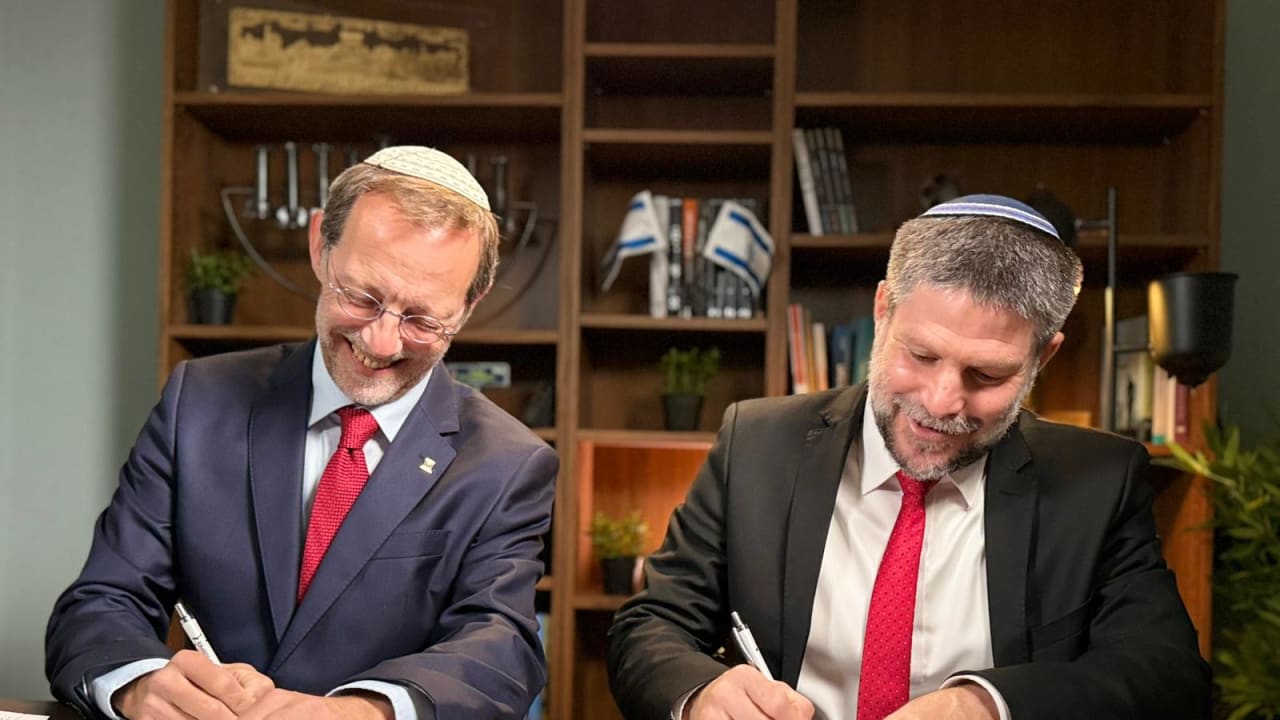
Finance Minister Bezalel Smotrich, who chairs the Religious Zionist Party (RZP), and Zehut party leader Moshe Feiglin announced on Tuesday evening that they will run together in the upcoming October elections, stating that the alliance is aimed at consolidating the right-wing vote.
The two right wing party leaders signed an agreement to run as a technical bloc, which can be split after entering the Knesset. Feiglin is expected to receive the second spot on the list unless additional alliances are formed, his spokesperson confirmed to The Jerusalem Post.
The alliance comes ahead of the deadline for submitting party lists next week and as a group of small right-wing parties continues to fail to pass the electoral threshold in recent polling.
Smotrich said upon signing the agreement for a technical bloc that the alliance was formed to preserve right-wing votes and called on other right-wing figures to join them.
“We are taking responsibility for the national camp, bringing forces together and ensuring that no right wing vote is lost,” Smotrich stated at the signing.

Uniting fragmented parties
While RZP had been hovering near the electoral threshold, Feiglin’s far-right Zehut party had failed to pass it in recent polling.
RZP added that its goal was to form as broad a right-wing bloc as possible, “unite the fragmented parties in the national camp, and ensure that right-wing votes are translated into political power that will enable the formation of a strong right-wing government.”
According to reports, the two may attempt to pressure Brig.-Gen. (res.) Ofer Winter, who recently formed his own right-wing party, into joining the alliance. However, following the announcement of the merger, Winter released a statement that citizens were “demanding something new, not more of the same.”
Recent polls had shown that Winter’s new People of Israel party could win five seats, largely at the expense of Smotrich’s Religious Zionist Party, which would fall below the electoral threshold.
Ben-Gvir rejects alliance
Last week, Prime Minister Benjamin Netanyahu called on Smotrich and National Security Minister Itamar Ben-Gvir, who leads the far-right Otzma Yehudit party, to run on a joint list, as they did in the 2022 elections.
Ben-Gvir had openly rejected such an alliance, prompting reports that Smotrich and Feiglin were negotiating a joint run.
Smotrich has stated that he intends to remain part of Netanyahu’s bloc in the upcoming elections.
Netanyahu had also called on voters not to support the small parties on the Right, warning that splitting the right-wing vote could cost his camp the election and allow the opposition bloc to form the next government.
Feiglin previously served in Likud, led by Netanyahu. He resigned after he did not receive a higher slot on the party’s Knesset list after its primaries and founded the Zehut Party in 2015.
Zehut and RZP both advocate for far-right security policies, including the annexation of the West Bank and Gaza. Zehut also supports libertarian economic policies and the legalization of cannabis.
Smotrich stated upon the signing of the alliance that “the upcoming elections are critical to the future of the national camp and to the future of the State of Israel.”
“Security, settlement, the judicial system, preventing the establishment of a Palestinian state, and our ability to continue leading the major changes that Israel needs – everything is at stake,” he added.
Feiglin stated that he and Smotrich were “bringing the news that so many have been waiting for and embarking on a joint effort aimed at maximizing the strength of the national and faith-based camp.”