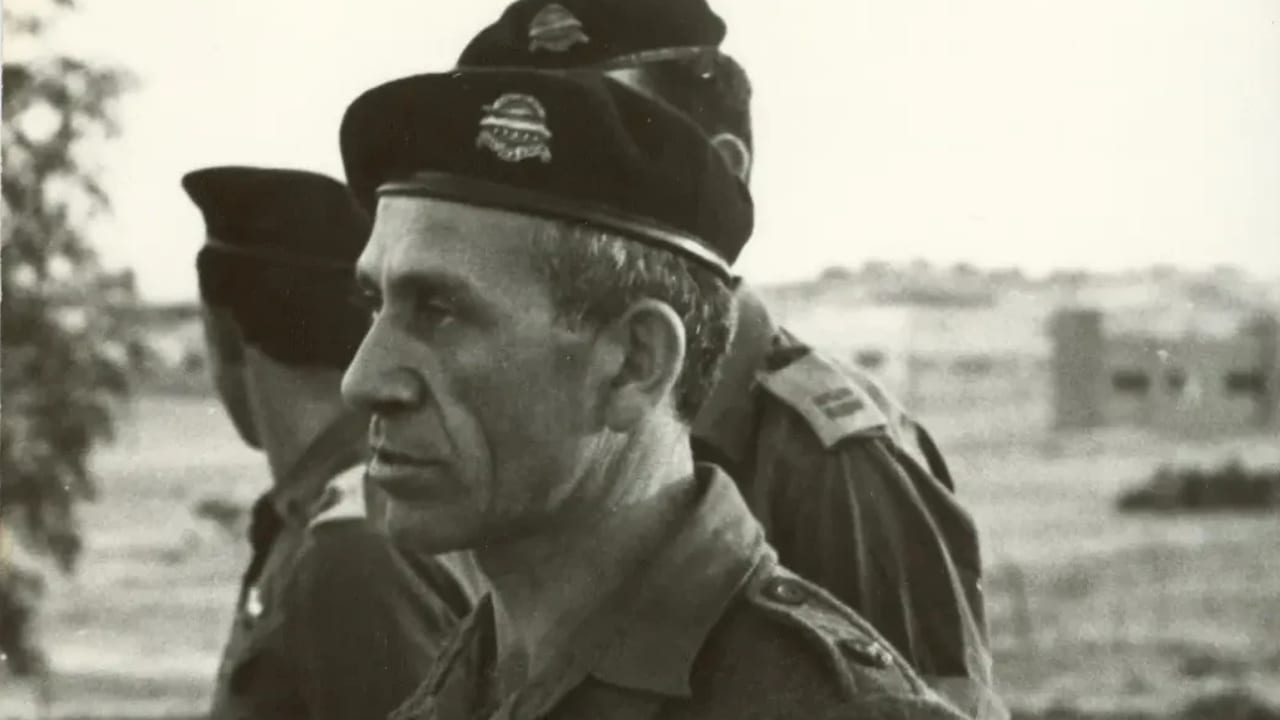
Holocaust survivor and reservist Colonel Simcha Applebaum passed away on Tuesday at the age of 99.
Applebaum served as deputy commander of the 188th Brigade in the Yom Kippur War and was among the founders of Kibbutz Netzer Sereni.
Having moved from the horrors of the Holocaust to dedicating his life to the revival of the Jewish state, his personal experiences are the essence of the story of the Jewish people in the 20th century.
Applebaum was born in 1927 in the town of Malch, in the Pruzhany district (today in Belarus), into a traditional family.
His father, Yaakov, was a leading Zionist activist who worked on sending young people to agricultural training in preparation for immigration to the Land of Israel. In November 1941, Applebaum, along with his parents, Yaakov and Rachel, and his older sister Ella, was deported to the Pruzhany ghetto.

Deported, escaped twice, sent to Auschwitz, and liberated
In May 1942, Applebaum joined a group of Jewish youth who escaped to the forests in an attempt to unite with Jewish partisans and Soviet soldiers.
In November of that year, he risked his life and secretly returned to the ghetto with several young people in order to obtain food and clothing. During the operation, several of his friends were hit by German fire, but Applebaum managed to escape and reached his parents’ home.
In January 1943, the Pruzhany ghetto was liquidated. Applebaum and his family were sent to the Auschwitz-Birkenau extermination camp, where his parents and older sister perished.
Applebaum posed as older than his age in order to avoid the death selection and was sent to forced labor. The number 78524 was tattooed on his arm. He was employed carrying heavy bricks for the construction of crematoria and the establishment of the Gypsy camp.
In April of 1943, he was transferred to Auschwitz, where he worked in construction, laying railway tracks. During his work, he was severely beaten, losing half of his teeth and, oftentimes, his consciousness.
In September 1943, after a series of selections, he was transferred to an SS-run ammunition factory, and in April 1944, he was moved to the Siemens factory in the nearby Bobrek camp.
In January 1945, with the approach of the front, Simcha was sent on a death march toward Gleiwitz and from there was loaded onto an open railway car moving westward.
Once in the Czech Republic, Applebaum jumped from the moving train and escaped. He hid for five weeks with the help of local farmers, but was eventually captured by the Gestapo, brutally tortured, and sent to the Buchenwald and Sachsenhausen camps.
In April 1945, he was again forced on another death march toward the Baltic Sea under SS guard. In the midst of the grueling journey, Simcha made a vow that if he survived and remained alive, he would immigrate to the Land of Israel, establish a settlement in memory of his parents and family members who were murdered, and join the security forces of the Yishuv to help establish the state.
On May 3, 1945, the remaining marchers were liberated by the United States Army.
Simcha immediately began fulfilling his vow. Following liberation, he joined the Buchenwald Kibbutz in Germany, and in March 1946, he immigrated to the Land of Israel aboard the immigrant ship Tel Hai.
In the summer of 1946, Applebaum underwent agricultural training at Kibbutz Afikim and was sent to a squad commanders' course in the Haganah.
With the outbreak of the War of Independence, Applebaum fought in the Givati and Negev brigades on the southern front.
On June 20, 1948, during the first truce and before Operation Dani, he went up to settle as a commander together with 16 of his comrades from Kibbutz Buchenwald at the Shapira farm near Be’er Ya'acov. This laid the foundation for the establishment of Kibbutz Netzer, known today as Kibbutz Netzer Sereni. In doing so, he fulfilled the first part of his vow.
Later in the war, he attended an officers’ course and, at the end of 1948, was appointed platoon commander in the Negev Brigade. At the end of January 1950, he returned to his kibbutz and held senior positions there, alongside his activity in the Manufacturers Association.
Simcha continued to serve and fought in Israel’s wars. One of his greatest tests came in the Yom Kippur War, when he served as deputy commander within the 188th Armored Brigade. He also played a central role in rebuilding the brigade after it suffered heavy losses in the early days of the war.
Simcha reached the rank of reserve colonel in the armored corps and was among the initiators and founders of the memorial site for the brigade’s soldiers in Latrun.
'I am fighting... so that what happened to my generation does not happen to yours'
In those difficult days of October 1973, when he was asked to speak to the young soldiers who were about to go into battle, he delivered a chilling monologue that expressed the essence of his life: "Look, boys, I am no longer so young, and this is my fourth war in this country. The worst was in Europe. They took my parents, my entire family, without even being able to defend ourselves, to raise a hand, to make a sound. I have not seen them since. If you ask what a man my age is doing here? Here is your answer: I am fighting! I am fighting like crazy, so that what happened to my generation does not happen to your generation, to your children."
Yedioth Ahronoth journalist Aharon Bacher described those moments in his article, saying, "Simcha remained on his halftrack, his body even more tense, and only his gaze followed them to the edge of the horizon, until the tanks disappeared into a cloud of dust. His face remained impassive. When he finally turned to his duties and reached for the communications device, I saw that identification numbers from the Auschwitz death camp were tattooed on his arm."
Even after he left the uniform, Simcha made it his mission to teach youth about the Holocaust.
For decades, he continued to serve as a witness on youth delegations to Poland and to tell his life story in schools and at IDF bases out of a deep sense of mission. Simcha Applebaum is survived by a large family that continues his path: he was married to Naomi, and they had three children and nine grandchildren, all of whom served or are serving in combat units in the IDF.
Lior Simcha, secretary general of the Kibbutz Movement, eulogized Applebaum: "Simcha was a guide in the fullest sense of the word. A Holocaust survivor, partisan fighter, survivor of concentration camps, and hero of the Yom Kippur War. As deputy commander of the 188th Brigade, he took a battered brigade and rebuilt it. He was one of the leaders of the kibbutz industry and among the heads of industrialists in Israel."
The secretary general of the movement shared that only a few weeks ago, the late Lt. Col. Dor Ben Simhon was buried in Beit Hashita. According to him, the event brought thoughts of Yom Kippur. "In my mind’s eye I saw Simcha standing there, facing the tired tank crews returning from war, putting everyone back into their vehicles, gathering the pieces and leading them from defensive battles to the offensive," he said.
He also said that Simcha Applebaum was "a man who knew the hardest battles, but also knew how to build."
He said that "He was among the founders of the state, of settlement and kibbutz life, a leader in industry, and among those who shaped the face of Israeli society. His life story is interwoven with the story of the State of Israel, from the horrors of Europe, through Israel’s wars, to the building of community, society, and economy."
The secretary general added that Applebaum was among the iron-and-steel generation of the state’s founders. "He built a home and laid strong foundations for the future. May his memory be blessed."