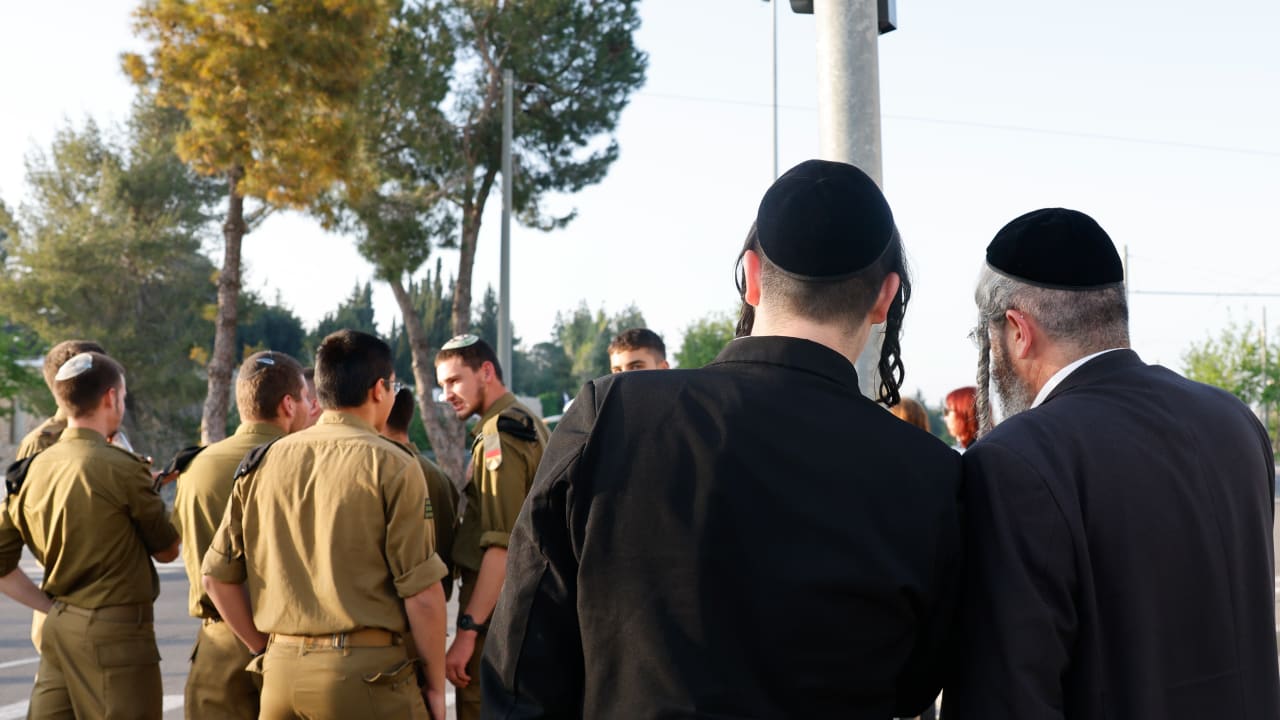
Almost three years after October 7, Israel continues to face one of the most severe manpower shortages in its history. Yet after two years of unprecedented legal pressure, economic sanctions, mass draft orders, and repeated Supreme Court intervention directed at the haredi (ultra-Orthodox) community, enlistment has not increased on the scale policymakers had hoped.
For more stories from The Media Line go to themedialine.org
Whatever one’s views of the recent legislation concerning Torah study or the temporary suspension of mass arrests of haredi draft evaders, the central question should no longer be who is right. It should be whether Israel’s current strategy is producing the security outcomes the country urgently needs.
For the past two years, Israel has effectively conducted a national policy experiment. The assumption was simple: Greater legal and economic pressure would produce greater enlistment. Yet the expected breakthrough never came. Perhaps it is time to ask not how pressure can be increased, but whether policymakers have spent too much energy debating coercion and too little time understanding what actually produces participation.
Israel’s security environment has fundamentally changed
The answer begins with recognizing that Israel’s security environment has fundamentally changed. October 7 demonstrated that Israel needs far more than additional infantry soldiers. It needs a new security manpower architecture capable of sustaining a prolonged, multifront conflict.
Israel requires tens of thousands of additional reservists to defend communities, strategic facilities, and the home front against future infiltration scenarios. It needs personnel for base security, emergency response, civil defense, logistics, intelligence support, and advanced technological warfare. At the same time, the country’s expanding defense industries require thousands of skilled workers to sustain long-term military readiness.

The question is no longer simply how many haredim can be drafted into conventional military service. It is how the haredi community can become an integral part of Israel’s broader security ecosystem.
For many within the community, the issue is experienced not primarily as a legal obligation but as one of communal identity, cultural continuity and the preservation of a way of life centered on Torah study. As long as the state and the haredi community define the problem differently, even well-intentioned policies will struggle to generate broad participation.
Approximately 70% of married haredi men in the workforce are willing to serve
One development after October 7 deserves far more attention than it has received.
In the months immediately following the attacks, more than 6,000 working haredi men approached the Israel Defense Forces (IDF) seeking to volunteer for reserve service. They were not responding to draft orders or legal sanctions. They came forward voluntarily, motivated by a desire to contribute during Israel’s greatest security crisis in decades. Yet only a small fraction were ultimately recruited, and those who were accepted generally received only basic training.
This was not an isolated phenomenon. Ironically, while the national debate has focused overwhelmingly on drafting full-time yeshiva students, it has largely overlooked the much larger population of working haredi men.
A survey conducted by the Institute for Strategy and Haredi Policy found that approximately 70% of married haredi men in the workforce expressed a willingness to serve in reserve frameworks adapted to their circumstances. Based on those findings, the institute, together with senior former officials and experts from Israel’s defense establishment, developed a practical plan to recruit approximately 15,000 haredi reservists for home-front defense, base protection and other essential security missions.
The proposal went further. It outlined a broader strategy for integrating tens of thousands of haredi men and women into Israel’s national resilience infrastructure, including emergency response systems and the country’s rapidly expanding defense industries—areas that have become increasingly critical since October 7. Yet while the public debate continued to revolve around coercion and legal confrontation, these proposals received remarkably little attention.
Their significance extends well beyond a single policy proposal. Programs such as Kodcode prepare haredi men for elite technology and intelligence roles. Maalot Tzur integrates vocationally trained recruits into essential engineering and technical positions. The IDF is also examining frameworks for large-scale haredi service in base protection, freeing combat soldiers for front-line missions. These are not theoretical ideas. They are existing models that demonstrate how adapted frameworks can produce meaningful participation.
The country needs practical results
Supporters of the recent legislation argue that its purpose is not to provide a permanent solution but to reduce tensions and create the political space needed to expand precisely these kinds of long-term frameworks. Whether that assessment proves correct remains to be seen. Still, it reflects a broader strategic question that deserves far more attention.
Israel’s security establishment cannot afford to confuse legal victories with strategic success. Nearly three years into a prolonged regional conflict, the country needs practical results rather than increasingly polarized arguments.
If two years of escalating pressure have failed to generate the manpower Israel urgently requires, perhaps the national conversation should shift from how to punish nonparticipation to how to build participation at scale.
The central question is no longer who wins the argument over the haredi draft. It is whether Israel is prepared to build a security strategy broad enough to mobilize every part of its society for the challenges ahead.
Eli Paley is the publisher of the Mishpacha international media group and the founder and chairman of The Institute for Strategy and Haredi Policy.