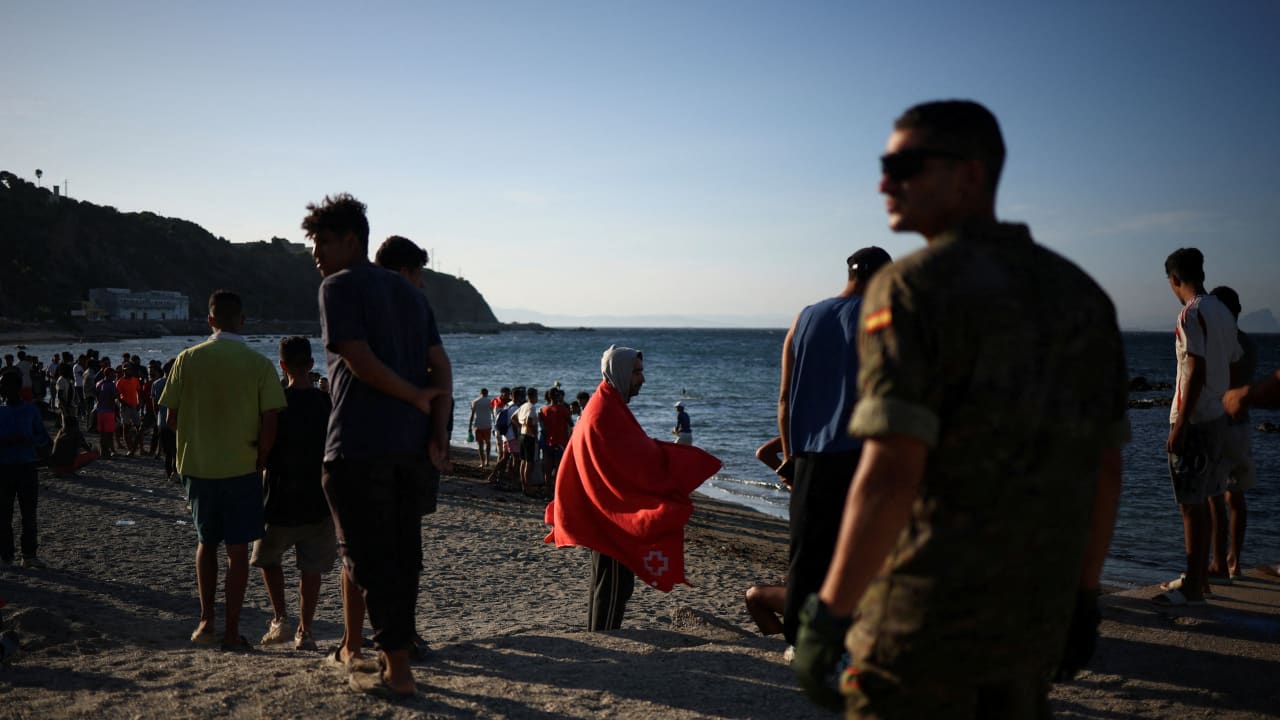
The tens of thousands of young people who have been attempting to swim across the border between Morocco and Ceuta are only the beginning of a much larger migration crisis, journalist and Reichman University lecturer Henrique Cymerman explained in an interview with 103FM on Sunday.
"There are two cities, Ceuta and Melilla, and they have belonged to Spain for more than 400 years, with Africa surrounding them," Cymerman explained.
"There are fences in certain areas, and each time young people try to jump over them, they have two and a half minutes. That's the amount of time they have before the Spanish police arrive and may send them back to Morocco. They run to the refugee center, and if they manage to make it there within those few minutes, and some of them do, they are no longer returned to Morocco. They've made it. From there, within a few months, they can move on to Europe and fulfill their dream."
Conspiracy theorists blame Israel for Spain's crisis
Cymerman went on to explain why conspiracy theories have emerged accusing Israel of pulling the strings behind the crisis.
"Israel enters the picture indirectly because of our alliance with Morocco and with the Americans," he said. "Spanish Prime Minister Pedro Sánchez has become the leading anti-Israel voice in Europe, and some say he has sought to sever relations with the State of Israel."

Others, he noted, are blaming Morocco's king, who is reportedly unhappy with the Spanish government's growing closeness to Morocco's historic rival.
"Some people say this is an attempt by the King of Morocco to show Sánchez what could happen if he compromises on other issues, for example in his relationship with Morocco's biggest rival, Algeria. He is due to visit there soon, and Spain also buys large quantities of Algerian gas. About 40% of Spain's gas comes from there."
Beyond the local political complexities in the Maghreb, Cymerman believes the refugee crisis is only set to intensify.
"Today there are 1.5 billion people in Africa, with huge numbers of young people who have no hope. We are going to see a wave of young Africans trying to reach Europe," he said. "Europe faces a major test in how to deal with this, as it tries to balance the humanitarian aspect, at least ostensibly, with its ability to absorb millions of Africans."