We have a more-than-fair idea how the world in general sees us, well, at least the media-funneled viewpoint. If you happen to catch some random news report on the BBC, CNN, or – if you speak the lingo – any of the leading non-English-speaking outlets such as France’s TF1 or Italy’s Rai 1 TV channels, the chances are there will be some negative coverage of our governmental or military conduct.
Leaving aside whether that is justified, the plain fact of the matter is that anyone, anywhere on the globe, following the news coming out of this end of the Mediterranean, will surely quickly arrive at the conclusion that there is only one side doing the bad deeds here.
Those who tend to take media-provided information as is, without even considering the possibility of politically oriented agendas seasoning the factual mix, will probably not take too kindly to Russian-born, London-based photographer Sasha Gusov’s latest offering, Report: Israel.
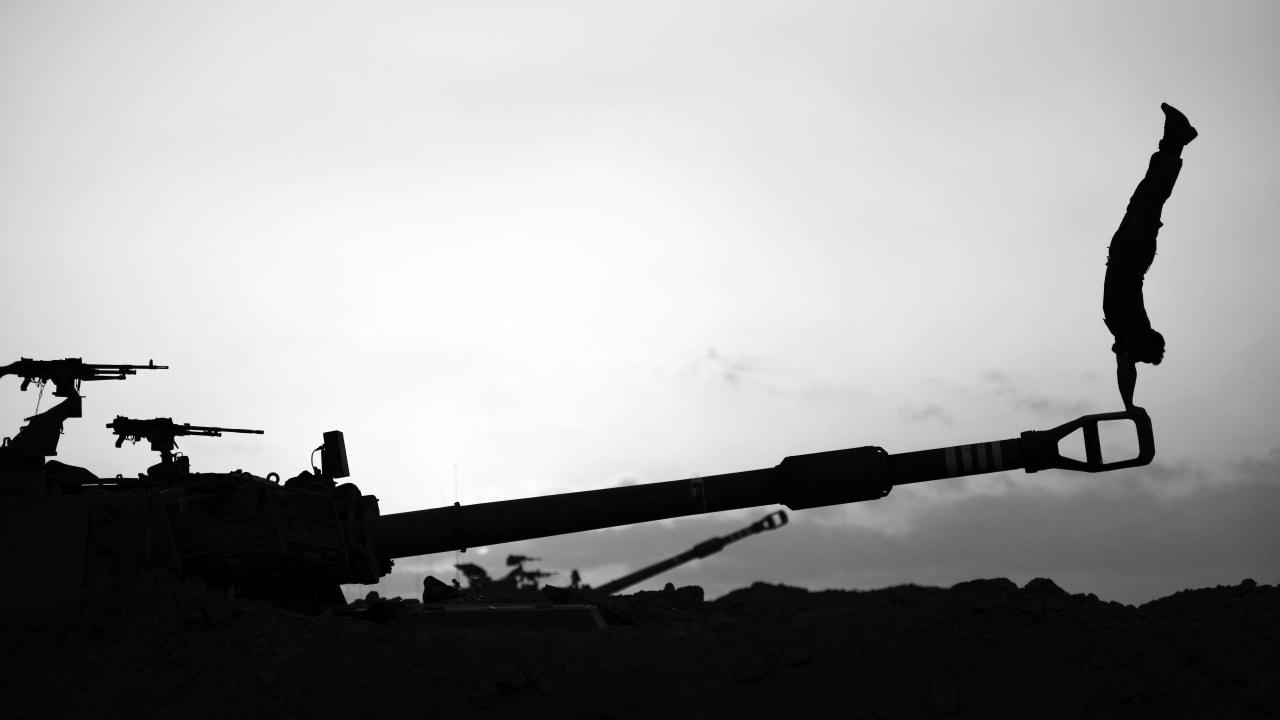
It is a weighty coffee-table-sized tome jam-packed with over 250 pages of crisply shot, dramatic pictures that run a studied rule over a broad sweep of events and populace sectors in this country.
The prints are definitively striking and eminently compelling, and there is an almost tangible narrative pulsating just beneath the pictorial surfaces. It is as if Gusov came over here and thought to himself: What can I do to show the world the positive side of this beleaguered country?

Vignettes snapped across a 15-month period shortly after Oct. 7
Presumably, if that is indeed the case, he was looking to drum up some empathy for our psychological and security considerations to offset some of the worldwide national profile damage.
The spread certainly ticks all the requisite boxes across all the thematic sections that run the full emotional and existential gamut. Chapter headings such as: “Destruction,” “Aftermath,” “Mourning,” “Tel Aviv,” “Training,” “Protest & Debate,” “Offence,” and “Jerusalem” cover an abundance of local everyday life bases, with post-Oct. 7 fallout infusing much of the pictorial roll out like a ubiquitous pall.
As he explains in a brief textual intro, Gusov snapped his vignettes across a 15-month period, starting shortly after that fateful day in 2023. He writes: “These are moments I witnessed and, whether by chance or by choice, I become (sic) a part of.” That the photographer was deeply engaged with his subjects is patently obvious. The man clearly knows a thing or two about the psyche of the people and the vibe of the scenarios he sees through his viewfinder.
One senses that this was not about staying strictly within the rigid parameters of a cool, calculating objective stance, and just weighing up the aesthetics and dynamics in as dispassionate and professionally detached a manner as possible. Gusov appears to have been driven.
He sets the tantalizing mood from the off, opening his hefty tome account with a classic, almost biblical, grand landscape scene. The shot ambiance is dominated by a lone tree. There it is, front and center, a solitary arboreal outcrop looking spindly and weather-beaten yet defiantly sprightly, oxymoronically complemented by a desolate, hazy, barren landscape shimmering in the relentless summer heat. Could that be a metaphor for the way the photographer perceives Israel?
Gusov pulls nary a single punch as he unfurls streams of powerful images that appear to cascade out of a veritable cornucopia of gorgeous, lush monochrome prints. The arresting curtain raiser is followed by frames clearly designed to present the viewer with headliner apogees of local goings on. There is a densely structured, suitably forbidding security fence seen through a windshield – it is unclear whether the vehicle is military or civilian.
That serves to set the factious regional political-security scene which Gusov deftly dovetails with a charming shot of a settler dad and kids enjoying a day out in the sun with an expansive out-of-focus landscape behind providing a salient geographic-political milieu. The emotive political pendulum is immediately sent careening in the opposite direction on the very next two-page spread with an image of seeming bucolic tranquility as a kaffiyeh-clad shepherd guides his flock through tufted terrain.

Orchestrated rhythm in comically absurd morsels of life
As you leaf your way through the book, you get some sense of orchestrated rhythm as the pictures document Gusov’s meandering sojourn here, shifting seamlessly from comical-absurd morsels of life in Tel Aviv to unexpected military or ethnic juxtapositions.
The introductory section closes with four endearing portraits of young soldiers quizzically offset by what looks like a marketing-oriented shot of famed illusionist-magician Uri Geller getting up to some trick or other.
The shock waves of the calamitous events of Oct. 7 are well and truly spelled out for us as Gusov visits kibbutzim near Gaza, and travels up to the far North, even documenting Hezbollah rocket fire as he makes his way through the Golan Heights in the company of a high-ranking reserve IDF officer.
Behind-the-scenes volunteer activity, in support of the war effort, is also well documented, with one caption talking of the multi-national interfaith spread of civilian helpers, who “rally behind a noble cause.”
Stunning military action shots are counterbalanced by slices of eclectic urban life, running the gamut of haredi street scenes in Bnei Brak and Mea She’arim to a Tel Aviv café packed with laptop-toting youngsters and a man taking a selfie together with his trusty pooch. The flip side continuum also digs deeply into political machinations here, with a benignly defiant bunch of haredim sporting no-nonsense placards against military service followed by a demo in Tel Aviv calling for a ceasefire and a hostage deal.
Gusov clearly did his homework and doesn’t miss a political, emotive, or aesthetic trick in his lovingly crafted Report: Israel.
Report: Israel
By Sasha Gusov
Gefen Publishing House
270 pages; $60