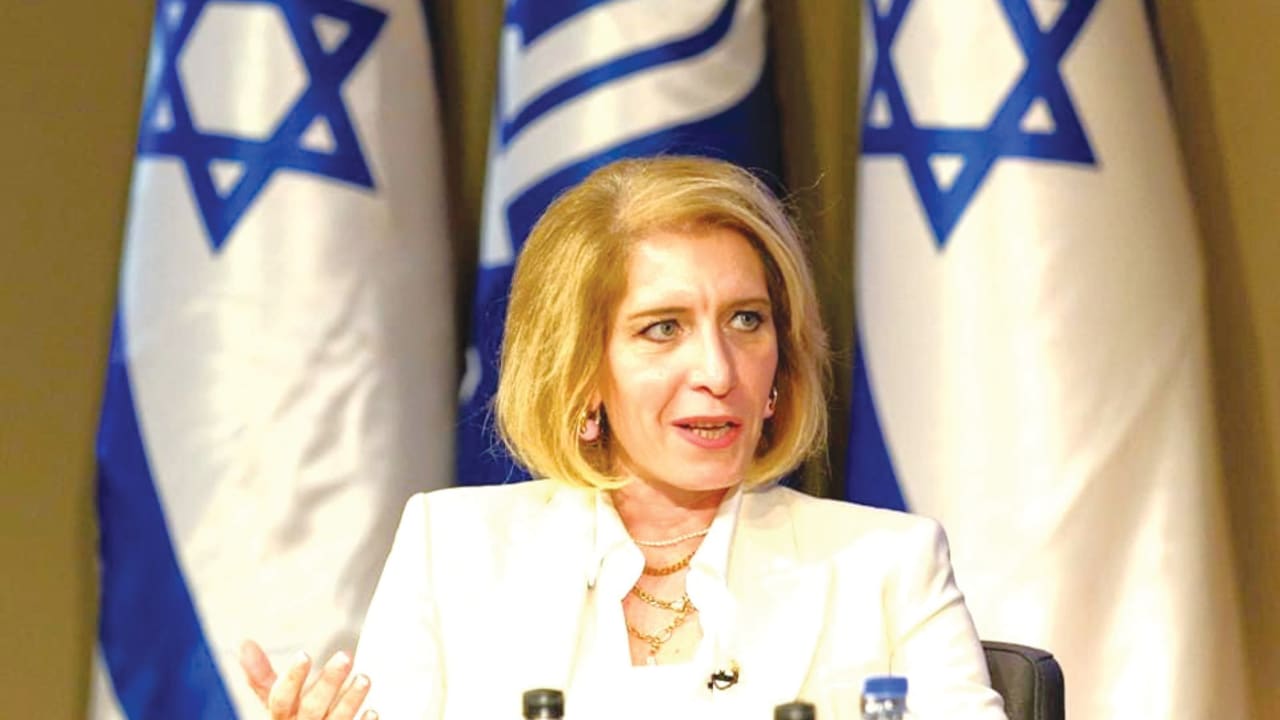
The State of Israel rescued Olga Deutsch twice in her first two decades of life. It seems only fitting that Deutsch, in turn, has spent the last decade helping to rescue the State of Israel.
Deutsch is vice president of NGO Monitor, founded in 2002 by Prof. Gerald Steinberg in response to the increasingly weaponized political influence of foreign human rights groups antagonistic to Israel. In January, she will succeed Steinberg as president and CEO, following his retirement.
Many of the NGOs whose funding sources and anti-Israel activities get exposed by NGO Monitor are based in Europe, where Deutsch lived and worked since her birth in 1979. She was raised in Belgrade, in what was then Yugoslavia and is now Serbia.
In 1992, the Yugoslavian republics of Bosnia and Herzegovina declared independence, sparking a long, bloody regional war. Deutsch was among many Jewish children evacuated from Yugoslavia to Israel by the Jewish Agency.
“My parents asked me if I wanted to go, and I said yes – though I’d never been there before,” she recalls. “I didn’t speak the language and didn’t have relatives here.”

Aliyah after evacuating from Serbia during bombing
She was placed for a year at a WIZO agricultural boarding school in Rishon Lezion. “I was a city girl who played piano. But from the moment I stepped foot there, I loved the energy, the people, and even the school’s cows and chickens. According to my parents, I wanted to stay. But I was only 13, and I had to go back. Since then, my goal was to move to Israel,” she says.
“In 1999, when NATO bombed Kosovo and Serbia, I was part of a big group from Serbia that was evacuated, and a lot of us ended up making aliyah. I spent a year here as a new immigrant, living in Jerusalem and working in the Jewish Agency.
“But because I was still in the middle of my studies in Serbia, I decided to go back and finish. And then my career took me elsewhere. But I always knew I was coming back to Israel. Sixteen years ago, it came full circle.”
In those intervening years, Deutsch earned degrees from the University of Belgrade and the University of Munich in banking, insurance, and finance, and did a six-month fellowship at the School of International and Public Affairs of Columbia University in New York.
From 2003 to 2006, she worked at a consulting company in Germany until her involvement in Jewish communal work led her to her next job.
“I had created the Serbian Union of Jewish Students after my year in Israel. In 2006, when the opportunity emerged to become chairwoman of the European Union of Jewish Students, an umbrella organization of 34 national student bodies, I moved from Germany to Brussels.
“This job was the winning combination that allowed me to work at something I truly believed in, and to build on my business skills. I think a lot of pro-Israel organizations and charities could do a much better job if they had an actual businessperson running their operations. After completing my two-year term there, I decided to move back to Israel.”
By that time, she’d accumulated valuable expertise in international politics and Europe-Israel relations, and was fluent in English, Hebrew, and German. She also understands Russian.
“I enjoyed and learned so much everywhere I lived. All that experience of being a new immigrant made the absorption in Israel softer and easier. It’s not an easy country, and the better equipped you come with skills and education and experience, the better the chances you will succeed here.”
In 2011, she married Menachem Deutsch. She notes that his surname means “German.”
“The joke is that my maiden name is Israel, so I was Olga Israel when I lived in Germany. And then I moved to Israel and became Olga Deutsch,” she says with a laugh.
During her first seven years in Israel, she worked in hi-tech and international sales. “But I was missing that sense of meaning and purpose in my work,” she recalls.
“It took a while to articulate what was missing, but eventually it became clear that I really wanted to put my skills into what I hold dearest, and that is the fact that we have a Jewish state and there is still a need to defend it and fight for its legitimacy,” she notes. “That was how, 10 and a half years ago, I came to meet Gerald Steinberg at NGO Monitor.”
She was hired as head of the watchdog organization’s Europe department, and seven years ago was promoted to vice president. She has written and spoken extensively about the dark underbelly of human rights organizations uncovered by NGO Monitor’s 18 researchers.
“Our work can be very depressing because the types of things we monitor are the worst examples of terror affiliation, antisemitism, anti-Israel bias, discrimination, and incitement – all disguised as defending human rights.
“But I don’t think we are in a battle where one side will lose or win in a knockout boxing match. Antisemitism is always going to be there. It is only going to change its manifestations. We are in a game of exhaustion and permanent survival,” she says.
'In my opinion, we already have won because we have a state'
“In my opinion, we already have won because we have a state. But we have to keep fighting an ongoing battle to make sure that the big win that happened on the day we declared our independence does not fade away,” she notes.
“I celebrate incremental successes because I understand – and this is something that I try to instill within our entire team – that you don’t build a building overnight. You build it brick by brick, and you have to start with incremental successes that set a precedent and tell a broader story. That’s what NGO Monitor, and a lot of our partner organizations in the same field, are fighting for day in and day out.”
NGO Monitor's research has convinced multiple countries to slash governmental funding to NGOs revealed as terror-affiliated or that glorified terror, promoted BDS and anti-Israel agendas, or promoted antisemitic narratives. The amount of taxpayer money saved adds up to more than $200 million, Deutsch says.
The organization’s research had a significant impact on the US State Department’s imposition of sanctions against five Palestinian NGOs affiliated with the Popular Front for the Liberation of Palestine for their lawfare against Israel, especially at the International Criminal Court in the Hague; and the European Union’s post-Oct. 7 decision to add an anti-incitement clause in contracts with Palestinian NGOs alone.
“We were among the first to issue reports on these NGOs and flag them for their activities, and we shared the reports with officials around the world,” says Deutsch.
She emphasizes that all NGO Monitor research is available online as open-source information that can be verified independently. “In today’s discourse, people need a qualified place to vet the news. You can read The New York Times and The Jerusalem Post and get diametrically opposite reporting over the same issue.”
Regarding the infamous Times op-ed by Nicholas Kristof accusing Israel of sexually abusing Palestinian prisoners, NGO Monitor “debunked and provided information on the organizations that he based these horrific claims on. We have reports on our website on each of these groups. Euromed, one of the main ones, is a known Hamas front in Europe.”
After the Hamas-led massacres in Israel on Oct. 7, 2023, she continues, “a lot of people felt powerless and helpless, but all of us at NGO Monitor felt we were on the frontline of the battlefield, that this was our moment. We received hundreds of phone calls and emails from elected officials around the world asking us for exactly the type of information that we uniquely provide.
“It is a privilege and a tremendous responsibility to be soldiers on the political warfare front – in social media, in media, in international courts, on campuses, and in the business arena. I feel empowered by what we do.”
Deutch lives in Petah Tikva with her husband and their “two beautiful, mischievous boys.” David just turned 13, and Aaron is nine. “My dream was not only to make aliyah; my dream was to raise sabras. For my kids to be born here, I think that is my biggest achievement.”
Balancing career and motherhood has been challenging in a job that demands frequent travel and a lot of after-work hours appearing at conferences, panels, and events.
“It’s easier now that they’re older. When they were younger, there were times when I would take the boys with me. My younger son was a month and a half when I took him with me to testify before a Knesset committee. And they didn’t necessarily know what to do with a stroller in the Knesset.”
What aspect of Israel does she appreciate most? For Deutsch, it’s a simple answer: the people. “Israelis are the warmest people that you will find anywhere. The way Israelis marry the North American entrepreneurial spirit and drive for success with Middle Eastern chaos and laissez-faire is something unique. I come from the Balkans, where people love to party and love life. But it’s not coupled with this entrepreneurial spirit.”
Although Israel “is incredibly intense,” she continues, “there’s no place like Israel. Even on the toughest days – and we have had so many in nearly three years – I have never, not once, had a moment where I questioned whether I should be here. There’s no other place. This is home.”