
Four Christians, three Jews, four languages, six days, and 111 kilometers from Jaffa Port to Jaffa Gate.
That’s how Michigan resident Jody Bernat, 67, summed up the parameters of the modern-day pilgrimage she and her husband, John Belsher, took last spring under the leadership of The Way to Jerusalem (W2J).
“We were two Taiwanese women, a gentleman from Catalonia, a man from West Virginia, an Israeli woman, and John and me. With a variety of language barriers and fitness levels, we needed to find a group pace and a way to communicate,” she recalls.
“Sometimes it was gestures, glances, knowing looks. Sometimes we walked in silence. Often, we sang, and many times we exchanged views on life,” Bernat says.
Led by an English-speaking guide, the pilgrims bonded through their shared exploration of the places, people, and cultures they encountered along the route.
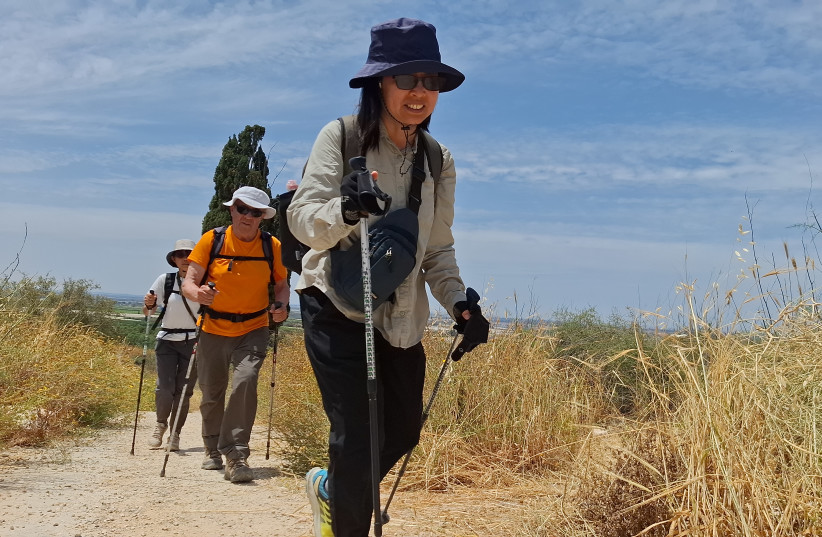
“Our stays in Christian monasteries, Arab villages, and Jewish quarters were all part of the landscape that outsiders rarely see or understand in the diverse embrace of this powerfully beautiful land,” Bernat says.
“The Ethiopian restaurateur, the man selling flowers on the street, the market bustling as Shabbat approached – all the people living day to day in this region who want to live simply, peacefully, and in harmony,” she continues, describing her impressions.
If ancient pilgrimages were about holy sites, religious ritual, forgiveness, and redemption, modern pilgrimages are about personal growth and connection with people and places, say W2J co-founders Yael Tarasiuk-Nevo and Golan Rice, both secular Jewish Israelis who formerly worked in El Al security.
“It can be an inner spiritual experience or even a culinary or social experience. It’s different for each type of person. We give a platform for Jews, Christians, Muslims, or non-believers to experience what they want on their pilgrimage to Jerusalem,” Rice says.
Tarasiuk-Nevo adds that meeting residents and hearing their stories is key. “Pilgrimage has always been a community journey, even in biblical times. People would journey with you, and others would host you. You’ll have good food, a warm shower, and a comfortable bed at the end of each day of your journey.”
‘We went on faith’
Bernat recalls that the military escalation with Iran earlier in April made getting to Israel complex and expensive. Yet the stress of those difficulties dissolved when they arrived at Jaffa Port.
“It was quite profound to see where the [ancient] ships came in with pilgrims like us, making their way to Jerusalem. For a moment, we were voyageurs from centuries past, with the same desires and the same uncertainty of what we would encounter as we embarked on this journey,” Bernat says.
“We walked in a calm week – a surprise to all who begged us not to go to a war zone,” she notes. “We went on faith.”
Faith was the primary pull for W2J pilgrim Suju Ellen Chen, 55, of Taitung, Taiwan.
“I am an Evangelical Christian. Over the past seven years, I have traveled to Israel three times. Twice, I came with church groups during the Feast of Tabernacles (Sukkot),” Chen says.
“In 2023, I came for Shavuot and joined a gathering of intercessors from around the world who had gathered at the Southern Wall to pray for Israel,” she adds.
After October 7, Chen yearned to gain a deeper understanding of the region’s modern history and reality but waited until the Gaza conflict simmered down.
“Toward the end of 2025, I came across a post by a Taiwanese YouTuber called Israel Mega about W2J’s first international pilgrimage group. I signed up almost without hesitation.”
For Chen, the first highlight of the itinerary was Rishon Lezion, where she learned about the influence of the Rothschild family, the origins of Israel’s flag and national anthem, and the stories of the early settlers scrambling for water and other essential resources.
“Even before the establishment of the State of Israel, there were people who clearly knew who they were and understood that they were building a home in the Promised Land. This continuity of identity and its connection to the land deeply moved me,” she says.
“Every place we visited along the way allowed me to experience Israel personally and to discover a country that is vibrant, resilient, remarkably diverse, and open-hearted,” Chen notes. “We often pray for Israel, but we do not necessarily truly know the people we call ‘our family in Israel.’”
According to her, “This pilgrimage allowed me, for the first time, to hear their voices, share their spaces, and begin to see Israel not simply as a place we pray for, but as a people and a land we are called to know.”
The shared multifaith encounters of the diverse pilgrims drew them close, Chen continues. “We were so different from one another, yet somehow, we were able to walk this road together without offending or excluding one another.”
The power of modern pilgrimage
This effect is exactly what W2J’s founders hoped to achieve.
“In building W2J, we had our own pilgrimage journey,” Tarasiuk-Nevo reflects.
In October 2021, Rice completed his first of three pilgrimages along the Camino de Santiago, a European network of walking and cycling routes frequented annually by half a million people for fitness, history, or personal growth. He started writing a book about his experiences.
In July 2022, after his final Camino de Santiago trek, he met with his former El Al coworker at a café. Tarasiuk-Nevo, then managing social projects for the Bat Yam Municipality, agreed to help with his book.
Their discussion turned to the power of modern pilgrimages.
“Why did Golan [Rice], a nonreligious Jew, start to cry along the Camino de Santiago? We tried to understand what this was about,” Tarasiuk-Nevo recalls. “We realized it was the human encounters.”
“We are not businesspeople or tourism executives, but we felt a mutual call to start a pilgrimage route to Jerusalem. We just came with a dream that W2J can make a real change,” she says.
Funding the project out of pocket, they conducted research and started a closed Facebook group for Israelis to explain their idea and recruit trial participants.
“At the beginning, we were aiming for Spanish-speaking people from Europe because they know the Camino de Santiago. But we knew that the local community had to be engaged in this,” explains Tarasiuk-Nevo.
“In January 2023, we made the first pilot journey with Israelis,” says Rice. “We started with six people at Jaffa Port and ended with more than 50 at Jaffa Gate because each day more people joined us.”
In September, they registered W2J to Jerusalem as a nonprofit association. “The only way this dream will last is if it’s not beholden to any agenda,” Tarasiuk-Nevo notes. “Israel has always been a place of conflict, and that’s our reality. This pilgrimage is above conflict and politics; it gives another point of view.”
The first organized group, Pioneer Pilgrimage, took place in May 2025 and was led in Hebrew by a certified tour guide trained by W2J. The second one followed in October 2025. Itzik Albachari, an Israeli participant in the first Pioneer Pilgrimage, coordinates the Hebrew-language treks.
Global Pioneers
Bernat inspired the inaugural English-speaking Global Pioneers pilgrimage in April.
She had completed the 500-mile Camino de Santiago across Spain for her 65th birthday and found it empowering, she says.
“But in each town we were encouraged to go to Mass in the local churches. As a Conservative, fairly observant American Jew, I had wished there was something that had more of my Jewish history. I thought maybe there might be a Camino de Santiago in Israel. So I searched and came across The Way to Jerusalem. I wrote to [Tarasiuk-Nevo] and asked if it was possible to go on this journey.”
With Bernat’s welcome persistence, the founders made it happen despite the linguistic, religious, and cultural differences among their international clientele.
“Each pilgrim speaks a different language and eats different food,” Rice says. “Without W2J, they probably wouldn’t meet. Suddenly they’re walking together for seven days to the same places. Yet each translates that place individually. They are very excited by the stories in each place.”
“We ask local people along the way to tell their stories. We don’t edit those stories,” Tarasiuk-Nevo adds. “If someone in Rishon Lezion wants to tell the story of Zionism and the first synagogue, if the shawarma vendor in the Ramla Market wishes to tell the story about his family there, we enable them to do so. We work hard to ensure that every encounter will be a good encounter.”
When the Global Pioneer group arrived at Jaffa Gate, Rice says, “They were crying because the adventure culminated in one place called Jerusalem. This is a powerful way to bring people together and give them an opportunity to express their journey in any way they want.”
Bernat comments that although she lived on a kibbutz for a summer, visited Israel several times with her family, and has children living in Tel Aviv, “I was not expecting to feel the immense heart-and-soul response that overcame me as we marched into Jerusalem with our awesome guide, Alon.”
Chen adds, “As I have been reflecting on this journey, I have increasingly realized something very simple: I now have friends in Israel. Real relationships are beginning to grow between us.”
Pilgrimage of light on Hanukkah
Most of the W2J pilgrimages, which are not kosher or Sabbath-observant, are conducted in Hebrew and geared to locals.
The next Global Pioneer trek in English is planned for December 5-12, paralleling the eight days of Hanukkah, the festival of lights.
Dubbed the First Pilgrimage of Light, this journey from Jaffa Port will culminate in Jerusalem with a nighttime tour of hanukkiot illuminating the windows of the Old City.
“A lot of Jews and non-Jews from abroad are excited about this, wanting to share and experience this together, the reality of this holiday in Israel,” Rice says.
Details are available on W2J’s website, thewaytojerusalem.org/general-5, or write to mail@thewaytojerusalem.org
W2J Global Pioneer: A travelogue
Below are excerpts from Jody Bernat’s travelogue from her Global Pioneer pilgrimage this past year, April 30-May 5.
Day 1
Our pilgrimage began early this morning in Jaffa. The seven pilgrims and our guide, Alon, walked to Jaffa Port, where original pilgrims once arrived in the Holy Land by sea.
Our journey took us through the busy streets of Tel Aviv and briefly through a sandy route to Rishon Lezion. We got our pilgrim credential stamped in several locations. Along the way, we saw a powerfully moving memorial tree garden for the victims of October 7.
We visited the Museum of the History of Rishon Lezion, where the Israeli flag was first created, the national anthem was written, and the first all-Hebrew school was launched. We checked into the Raphael House Hotel and made our way to an authentic Ethiopian restaurant where we met up with the creators of the Way to Jerusalem, Yael and Golan.
Day 2
We walked to a synagogue where a cantor sang a prayer for us. It was so beautiful. His great-grandfather was the rabbi there. The lay leader was surprising: Yael’s husband, Gad. We walked on to Be’er Ya’acov and then into Ramle, where we visited an ancient water source, and we all paddled in the water.
We came upon a man selling flowers. He offered us cold water and then allowed our guide to put a sticker on his store for the W2J. We walked through a local market that was bustling with people shopping for Shabbat.
Day 3
We left Ramle and made our way into the countryside. The path was rugged and the scenery beautiful. Golan and Yael organized a wonderful rest stop with drinks and snacks just before we climbed up to the Tel Gezer lookout. This site is where, thousands of years ago, civilizations built upon one another, including King Solomon’s.
We are walking history. From here we headed to the Monastery of Our Lady of the Seven Sorrows (the Trappist Abbey) in Latrun, where we were greeted by one of the monk-padres, attended Mass (chanted in French), and ate dinner in the courtyard. They made us a special dish that was created for the pope. The women slept in a spacious house next to the church bell – no sleep for me!
Day 4
We left the Trappist Monastery early and climbed up to an old cemetery with a nearby dome that had incredible acoustics. We sang a few songs there. We kept climbing hills for hours and stopped for a picnic hosted by Yael and Golan in the forest.
The rest of the day was spent climbing up and up and up into Abu Ghosh, where we visited the Saxum Visitor Center, which depicts religious history.
We climbed up some more to the Benedictine monastery. The monks cooked us a fabulous dinner – they are French and have the cuisine touch! Father Olivier came and talked with us about life, love, and being a monk.
Day 5
We attended early morning prayer at the 12th-century Benedictine monastery church. After a quick breakfast, we set off along beautiful pathways, climbing toward Jerusalem. We stopped for a picnic snack with W2J guide Miri and climbed up to an old ruin near Nataf. It’s believed to be perhaps an olive oil production ruin.
We continued climbing up to Sataf – panoramic views of the Judean Hills. We had lunch at the amazing café before making our way down the steep ancient stone steps on the Israel National Trail, then began to ascend again to Ein Kerem.
At the Franciscan monastery, Yael and Golan greeted us with a gift of limoncello liqueur made by the Benedictine monks. Dinner tonight was by the Italian Franciscan monks. Tomorrow we make our way into Jerusalem.
Day 6
The majority of the morning we walked up and up and then more up on a path toward Jerusalem. Construction blocked the path just before entering the city, causing us to maneuver over big rocks to a memorial for a Righteous among the Nations who saved many Jews when the Nazis marched in.
[When] we arrived at the Jaffa Gate, Yael and Golan and a Tourism Ministry representative greeted us. They stamped our credentials, gave us our certificates, and then escorted us to a private tour in the Tower of David.
We gathered for an emotional farewell, collected our belongings, and made our way through the market to the Western Wall. A powerful and amazing week of wonder. It was not an easy walk, but one that was worth the long miles and hours on the trail.
The experience is profound. One hundred and eleven kilometers from Jaffa Port to Jaffa Gate. We did it!!!