
Radiating a Jerusalem vibe, Rachel Kainy was born in 1981 in Kibbutz Nahshon. An artist and art teacher, this recipient of a 2024 Plumas Art Foundation grant is best known for her aquarelles.
Since graduating with honors from Hamidrasha School of Art with a Bachelor of Education in Fine Arts in 2008, her work can be found in private and public collections and has been featured in numerous exhibitions, including at The Israel Museum, The Jerusalem Artists House, Tel Aviv’s Rosenfeld Gallery, and The Artists Studio in Tel Aviv.
Her recent works are on view in a group exhibition, Drift, at the Art Cube Artists’ Studios in Jerusalem, until August 21.
Kainy has been living and working in Jerusalem for the last 11 years, and incorporates the Holy City in her art.
Although she is known for her watercolor works, she also drew throughout her life. And drawing, her newest project, is the direct reason why we sat and talked.

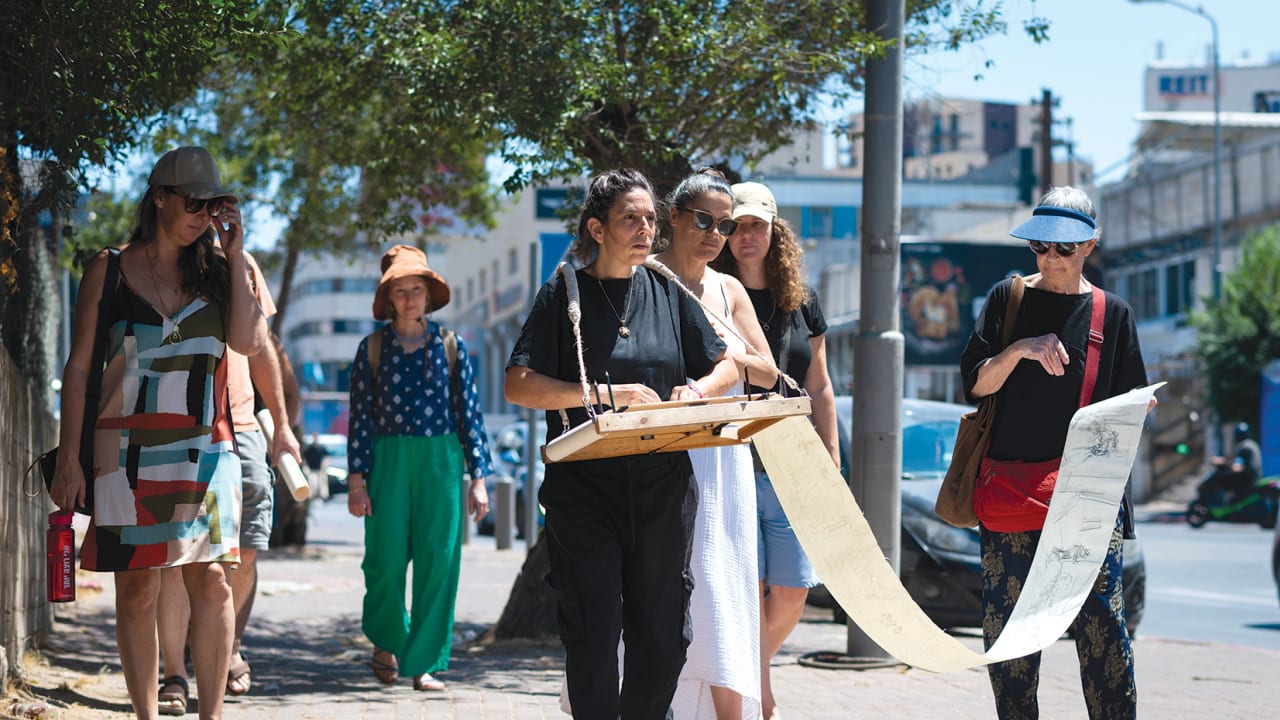
Urban walking drawing made with custom-made device, portable drawing harness
Kainy created her urban walking drawings, Road Sketch scrolls, using a custom-made device by artist Itamar Mendes-Flohr (Kainy called it a portable drawing harness). It enables her to draw with both hands simultaneously, while walking. She was inspired to draw with two hands at the same time by her studies of the book of Zohar.
Speaking with In Jerusalem, Kainy shared that she has always carried a sketchbook with her, like an extension of the drawing table, her only private space in early childhood, in the kibbutz’s “children’s home” where she shared a room and lived with other children until the age of 10.
In her new artistic drawing-while-walking project, the symbolic table accompanies her in walks on the streets of Jerusalem. Kainy draws what she observes, especially in her beloved neighborhood of Ein Kerem.
The artist documents the capital of Israel, with all its social and cultural shades and contrasts, creating the story of the city on paper scrolls – in a way, a megillah of Jerusalem.
We met briefly in September, almost three years ago, at the opening of the group watercolor show ‘STILL WATERS into Living Colors’ at the Center for Near Eastern Studies at Brigham Young University in Jerusalem.
In my article about the exhibition, I wrote, “Rachel Kainy focuses on the conflict between nature and culture; she constructs a unique symbolic language. Her enigmatic landscapes and compositions in watercolor and ink embody personal, ecological, and historical themes, woven into a rich tapestry of cultural myths, global concerns, and personal associations.”
All correct. [Kainy smiles]
I am glad to hear. Much has happened in Israel during these past three years… Despite the war, also in art. Recently, visiting Jerusalem, I rediscovered you as a very different artist. Still a watercolorist, but also a drawing artist who walks and draws on the streets of Jerusalem. What prompted this change?
I have never exhibited my drawings before, but I’ve always walked with my sketchbook and pencil. I’ve always been drawing while walking... I grew up on a kibbutz. From the age of three months, we all used to sleep [live] in a “children’s house” without our parents. I had only four hours a day at my parents’ house, from four to eight o’clock.
Until what age?
Until the kibbutz stopped this practice, I moved to my parents’ home when I was 10. Until then, I lived with other children. I didn’t have my own room, my space. There was a drawing table in the house, and that became my place, my [private] space. When I take the sketchbook everywhere, it’s like I take my space with me.
Your kibbutz life calls for a separate article, but the story of the table and the sketchbook is beautiful! I appreciate you sharing it. So, all your life, you’ve been going with your sketchbook?
Yes. I never really stopped drawing and painting. All children paint, but most adults stop at some point. I continued.
Do you come from an artistic family?
My mother is an art curator, and my father is an architect.
Therefore, was it clear to you that you would become an artist?
No, not exactly… I decided to study art when I was 19. At the end of my army service, in some course, someone asked me: “What’s the thing that frightens you the most?” I answered, “To be an artist.”
I realized that I was afraid of this because it was what I wanted most. And I studied art for four years at Hamidrasha [at Beit Berl College]; it was a very good school, with excellent teachers.
Before we return to your drawing practice, why did you focus on watercolors at first?
It’s also an interesting story. When I was in the second year of my studies, I felt like I didn’t know anything about painting. I had an acrylic course, a great class, but I felt like I couldn’t see anything. I went once for an oil [painting] class, but I felt like I couldn’t even smell it; I couldn’t touch it. It was also not for me. I took another course.
That whole year I felt like I was in this swamp. So I decided maybe I was not a painter. I would draw and make sculptures instead... I told Tsibi Geva, the head teacher of painting, that I wanted to leave painting. He looked at my works for a while, and he saw one place, one painting, which was very fluid. He told me, “Look, in the watering places, that’s where you live.”
Insightful!
Yes. Great teacher! He told me to work with watercolors for two weeks, and come back to him. No one taught watercolor in contemporary art schools – not in Bezalel, not in Hamidrasha. In Israel, they didn’t teach it. They didn’t respect it.
Then I opened a box of watercolors that my kibbutz art teacher had given me for my bat mitzvah, and I started to paint. It was like discovering the world. It was amazing! I fell in love completely.
And aquarelles became your artistic language. But also, you just told me you were always drawing.
Yes. From the table of the children’s house, I carry it in my bag as a sketchbook. And I have always been drawing, but I didn’t exhibit it.
It was my space. During the COVID times, I started to draw with both hands.
Simultaneously?
Yes. Shortly before the pandemic, encouraged by my friend, I started studying the Zohar according to Baal HaSulam, and we learned that the correct spiritual path in this world is to work with “two lines.” This means left and right – judgment and mercy, boundaries and expansion.
We also learned a core axiom in the Zohar: “the root is reflected in its branches,” which illustrates the connection between the upper and lower worlds, where this world acts as an inverted mirror. I decided to translate this Kabbalistic concept into a drawing technique: sketching with both my left and right hands.
The results have been truly amazing and deeply multi-layered. It transformed the drawing itself – making the entire space between the two lines vibrate, while profoundly impacting the mind, creating a highly focused sense of presence.
Are you right-handed? Was your right hand much more skilled?
Yes, and the left hand was very sensitive. The space between the right and left hand was like a poem, like a life.
A technical question: How could you walk and draw with both hands, holding a sketchbook?
I used an old baby carrier; I put it on me with a sketchbook on top. This way I could walk and draw with both hands. Then my friend, artist Itamar Mendes-Flohr, built me a special tool. I call it a portable drawing harness.
How does it work?
It’s like a board that I can roll the paper on, and I can carry it with me. It’s still new to me. For example, after an hour and a half of walking, I drew a seven-meter scroll.
Do you feel more connected to Jerusalem by walking and drawing what you see and experience?
Yes, and also I want even more now. With the scroll, many new possibilities opened up, because it’s long – unlike pages in a sketchbook. I can think ahead and choose very special paths with events, like historical landmarks and current events. I can also go back and forth; I can look at movements, and I can really connect West to East in Jerusalem – the past and present.
Now I am going to connect to Jerusalem even more, and I am going to study where I am walking.
Do you mean to research beforehand?
Yes, because when I had a sketchbook, I drew everywhere I walked; now I walk to places that I want to go.
Walking, intentionally. You are wearing the Star of David on your neck. Do you feel safe wearing it in the Arab neighborhoods in Jerusalem?
It depends where…
With your drawings on scrolls, you are documenting the life of the city and the lives of its various social and ethnic groups. In Hebrew, a scroll is a megillah; we have Megillat Esther and Megillat Ruth. Are you creating Megillat Rachel?
It’s Megillat Jerusalem. I think it’s always about connecting to the world and to myself. And maybe to other people. It’s a matter of connection. To touch things. To touch existence through art.
Also with the watercolor. It comes only if it’s very sincere, and the water brings it to life. I like to lose control. That’s why I also work with both hands. This way, I have a discovery through art.
I love this explanation! And as you like working simultaneously, in the ongoing exhibition, ‘Drift,’ next to ‘Road Sketch,’ you show your aquarelles inspired by illustrations in the book ‘The Art of the Ancient World,’ and the love letters you found in that book. Please, tell me more about it.
Last September, when I came to the workshops at the Art Cube Artists’ Studios in Jerusalem, I had ideas about what I was going to do. But when I entered this studio, I just pulled this book from the shelves, and inside it, there were dry flowers and love letters from 1976, in Hebrew and English. I was very much moved by it.
It was like a love letter for me, about life. I found this during the war, when I didn’t know how to do art and how to live.
And you incorporated the findings into your watercolor paintings.
Yes. I looked at them and started to paint them. At first I painted the sculptures from the images in the book, then the letters were like a message to me.
Is there a name for the series?
Not yet; it’s just a new project that I began. I don’t know where it’s going to take me. But it’s about love.
Rachel Kainy does not have a social media account. More about the artist can be found on the Rosenfeld Gallery website: rg.co.il/artist/rachel-kainy/