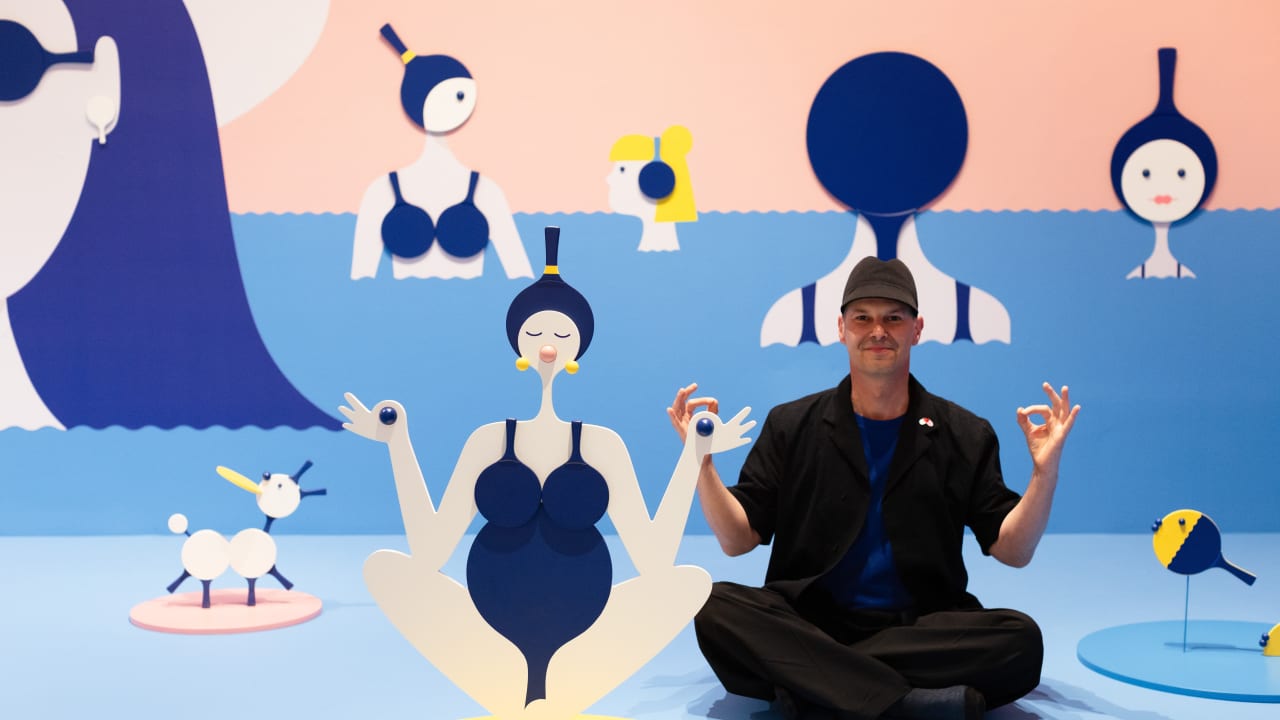
Seeing beyond the barriers and shapes, encouraging viewers to perceive space in the most unexpected places – that’s Noma Bar.
Born Avinoam Bernstein in 1973 in Afula, Bar is one of the world’s most awarded and recognized illustrators.
His distinctive visual language is known for its minimalism, use of negative space, humor, and bold flat colors. In his interview with the Magazine, to show an example of negative space, he picked up his phone and pointed out the space between his fingers and the phone.
Bar has been drawing since a young age, often weaving satire into his work. At age nine, he drew a picture of his rich neighbor with financial graphs instead of teeth.
At the age of 17, during the First Gulf War, sitting in a shelter and reading about Saddam Hussein and chemical weapons, he noticed a resemblance between the radiation symbol and Hussein’s face. He created his portrait. Years later, after graduating in visual communication from the Bezalel Academy of Arts and Design in Jerusalem and moving to London in 2000, he recreated this iconic image as a postcard. It opened the door to his career.

Over the past 25 years, his work has appeared on the covers of leading newspapers and magazines, including The New Yorker, The Guardian, The New York Times, The Economist, and Time Out. His illustrations have also appeared on the covers of best-selling novels by Margaret Atwood and Haruki Murakami, and anchored major campaigns for cultural institutions and global brands such as Apple, Coca-Cola, Mercedes-Benz, the Victoria and Albert Museum, and Netflix.
Throughout his career, he has also not shied away from addressing political issues and opinions; however, his solo exhibition in Tel Aviv, which opened on August 5, is not focused on this.
After spending half of his life in London, he brings a wide range of his works back to Israel, presenting illustrations, two- and three-dimensional prints, animation, sculpture, and installation in his first solo museum exhibition, “Look Again” (Hebrew name: “Mitzad sheni” [lit., From the Other Side]), at The Tel Aviv Museum of Art.
The exhibition attracts both adults and families with children.
How does it feel to show your art in Israel?
It’s exciting! It’s the first time seeing my work in Hebrew. I’ve seen it in English, French, German, Dutch, and Japanese, so suddenly seeing my work next to the Hebrew letters is amazing, and it’s good to be here.
“Mitzad Sheni” in Hebrew and “Look Again” in English, the exhibition (curated by Yuval Saar) at the Tel Aviv Museum of Art is your first solo museum exhibition, right?
I’ve participated in group exhibitions in various museums, but yes, this is the proper solo museum exhibition.
I’ve seen it twice now, and my initial thoughts were: first, the colors – they’re fun; and second, I felt a bit like I was taking a major psychological test. A Rorschach test, or looking at Edgar Rubin’s vase.
It also reminded me of the famous, ambiguous image of an old woman and a young woman from a 19th-century postcard, popularized in 1915 by William Ely Hill as “My Wife and My Mother-in-Law.” Later, this image was also used in psychology. Do you base your work on psychology?
No, it doesn’t come from there; it’s actually [rooted in] typography and negative space, a term in design and architecture. [Negative space] is the space between. Every architecture or design student studies it because it’s very important to understand the gap between buildings and how to make the most of space; for designers as well. In illustration, which is my area, you don’t see it a lot.
I’m coming from design, less from the Gestalt theories. But over the years, it really developed to that, without talking about the Rubin vase, that there is something there about two sides. I think it’s in my biography. Obviously, coming from here, from Afula, a place where Arabs and Jews live next to each other, had an impact.
You explore positive and negative space in your illustrations. Does it also relate to your life? You spent half of your life in Israel, and half in England. Which is the negative?
I don’t think it’s clear what’s positive or negative. I see them as two sides that complete each other, and when I’m here I miss there; when I’m there I miss here. I think it’s the constant striving for something or for an ideal place.
Yet back in Israel, you worked as a graphic designer at the Channel 2 news desk.
For two years, it was a part-time job, from 5 a.m. to 9 a.m. And afterward, I used to go to the Bezalel Academy. I learned a lot about how to work fast and how to work in journalism.
These tools helped me when I came to the UK to become an illustrator for a weekly column for The Guardian. Speed was necessary there.
What made you move to the UK?
When my wife and I were in our second year of studies (at Bezalel), [we visited London] and went to a shop in Covent Garden, a three-story bookshop dedicated solely to graphic design and illustration! We’d never seen anything like that. That was before the Internet; all the knowledge was in books and magazines. We spent three days there, just looking and buying books. We realized that there was an interesting scene in London.
Did you intend to stay?
It was a gamble. Let’s see what’s going to happen. But I found a job very quickly, and they sorted out a visa because they really liked my work.
I started working as a graphic designer in a design agency, and at night I used to do illustrations and send my work to magazines and newspapers.
Did you always know you wanted to be an illustrator?
I knew that I wanted to be a graphic designer or illustrator. Today, I am an illustrator, not a graphic designer. But at the start, it wasn’t clear.
Your first famous portrait was of Saddam Hussein. Could you please share the story of how you created it as a teenager, while sitting in the shelter?
I was 17 during the First Gulf War, and I had a gas mask. Everything was kind of very blurry because of the steam and all the breathing in the shelter, and I read in a newspaper that Saddam Hussein was using chemical weapons on his own people, and the icon of the chemical weapon was there. And I drew around it, which looked like eyebrows and a mustache.
When I came to London, I recreated it as a postcard and sent it to magazines and newspapers, and so that was one of my portraits that I shared with the world in a way.
It opened some doors for you. Was the second breakthrough Shakespeare’s image?
Yes, Shakespeare was the first time that I worked with Time Out, which led to The Observer and The Guardian, and one led to the other. After six months, I left my day job as a designer, and since then, I have been working as a full-time artist and illustrator.
As an illustrator, you also work with writers. How does the collaboration work? Does a writer have an idea and tell you, or do you read the book and come up with the idea?
I read the book. The ideal scenario is that I have the whole book, but sometimes I have a summary because the book is not ready; it depends on who the writer is and what stage the book is at. Sometimes it’s a new cover for an existing book, so it depends.
Do you build relationships with the writers?
No, normally not. It’s going through my agent and their agent. I have a few days to read the book, and the courier is coming to collect it.
And where does the artist in you come in?
It’s always there when I wake up in the morning, and I go to the [Highgate] woods. Even with [books] of Atwood or Murakami, a lot happens in the middle [of a walk]. I look at things, I discover things, so I always have my sketchbook, and I’m writing and sketching, and it’s kind of in between; ideas are coming, and I’m not stopping it.
So I work on commission jobs, but at the same time I work on an exhibition with new prints or a new book. It’s an ongoing process.
Is the connection with the trees something that you brought from Afula, where your father worked as a forester for Keren Kayemeth LeIsrael-Jewish National Fund?
Yes, my father used to drop me off at 5 or 6 in the morning with a group of workers on Nazareth mountain, and I spent the day with them in the field.
How old were you then? Did you work with them?
From age eight to 17. I was cutting, mainly trimming trees, because trees need constant trimming; otherwise, they touch and pull each other. I spent a lot of time in the woods.
And this bond continues nowadays.
Yes, but I also knew that I didn’t want to be fully in the woods.
Was it also when you started noticing the negative space?
Yes, it’s those years as well that I discovered [other] things, if you look at my nine-year-old’s sketchbook.
It is on view at the exhibition. Already at that age, there was humor in your pictures. You drew, for example, your rich neighbor with a graph instead of teeth.
Like a financial graph.
And who was your favorite artist when you were a child?
Igael Tumarkin and Menashe Kadishman. And my aunt and another uncle; he worked in Haifa Port, and in the evening, he used to paint.
Who is your favorite artist now?
I think Mark Rothko. And I love [Alberto] Giacometti!
Interesting! By using very limited elements in your works and negative space, you create multiple perception effects. You show a mouse in a cat, a wolf in a sheep. When did you start thinking about those ideas?
Maybe 30 years ago. There isn’t any specific date, but I always had this kind of dialogue with the other side.
For example, when I worked in the news, on the morning shifts, I noticed that the napkins were left from pizza ordered in the evening. Someone who was tidying the room put the napkins in order. So I put the straws between the napkins, and then someone put spoons like that on the edge of the table, and [thus] I started a dialogue with someone I didn’t know. I added something every day, and he added something. I actually made it a project at Bezalel.
I didn’t know who it was, but eventually we met. I realized that he was the cleaner, an Arab from east Jerusalem. At some point he disappeared. So it’s kind of a bittersweet memory.
Which, by the way, was the title of your book. Why “Bittersweet”?
I did a book that used everything, kind of all the bitterness in the world: from wars, crime, and drugs. It’s a bit like writing a song where the lyrics are very sad, but the melody is a bit happier.
I think that a lot of my work has this kind of bitterness in the subject, but the sweetness in the rap of it. It’s very simple; it looks very colorful and appealing, but when you go deeper, you can find the bitter pill.
In the Tel Aviv exhibition, some works address politics, and yet it’s not a political show.
No, it’s not. It’s there, but it’s not obvious. Many of my other exhibitions were very political, but there’s so much politics here.
And when you do your political things, is your intention to put your foot in? In your 2013 show in London, “Cut the Conflict,” one of the works there was gun/dove. Simple, yet powerful.
I have a big 750-kg “dog” [a dog-shaped industrial die-cutting machine]. Her name is Flora, and she’s cutting my work. She has a huge engine inside her body and produces 60 prints in a few seconds.
When I did “Cut the Conflict” at Rook & Raven gallery in London, I asked people from all over the world to send me materials. People from Iran, the US, Israel and Palestine, Lebanon, and Syria. And I started to cut things together with a machine. It’s a machine that cuts both positive and negative, cuts my shirt, and [allows me to] create prints mixed with materials. This was a very political work, but one that brings two sides together.
So is it more of an act of activism?
It is activism by someone who wants to bring sides together. It started with cutting and showing the differences between them, and then I realized that they’re so similar. I ask people online to send me materials that represent their countries – maps, books, and papers – and suddenly I started to include all the countries: India, Pakistan, North Korea, South Korea. The materials showed how similar they are.
Could you explain the general process of your work?
It starts with drawing. Everything is hand-drawn, and then [I transfer it to the] computer. If it’s with a client, I will send [them] a rough, a few ideas, and then, if it all goes well, I move to the final. Sometimes this stage can be a week, and sometimes it can be a couple of hours.
And my sculptures are made with a 3D printer. There is a process for turning my drawings into 3D sculptures. I love to see the presence of the negative space. Not just to see it as flat, but to look at it from all sides.
In the times when AI is taking over our lives, what would you say to less experienced illustrators?
I would suggest that, if you want to create a personal language, stay away not just from AI; stay away from computers. Go out and experience the world, draw, and do your own thing. AI is a shortcut for people who don’t do that. The joy is in discovering things.
Speaking of discovery, I saw many children at the museum trying to figure out what they were seeing in the big, upside-down pink toy.
I’m showing them that there is another side to everything. Here’s the name of the exhibition, exactly. And I have a hidden philosophy: Behind everything that you see, there is another side to life. So don’t just look at the front and what they show you – that this is a monkey or a rabbit. Turn it, and you can discover a dog.
For me, that’s kind of the first lesson of coexistence for them, without saying they coexist, and I’m happy that kids relate to it and understand it. I wouldn’t create it if I hadn’t gone through that with my girls and become a father, when my house became more pink.
And “Tel Aviv Summer” is the installation created especially for this exhibition and this city.
I always look for one element, but make the most of it. “Matkot” was great, because it’s a very Tel Aviv thing in summer, and we were in August. They don’t play Matkot, but there is also a dialogue between the two sides.
I looked at your list of awards, and it’s endless!
Yes, I didn’t update it over the last few years.
Those are huge achievements, congratulations! What would you tell young you, the little boy from Afula back in time?
“Keep doing what you’re doing.” I was drawing all the time, and I had dreams. I wouldn’t change anything.