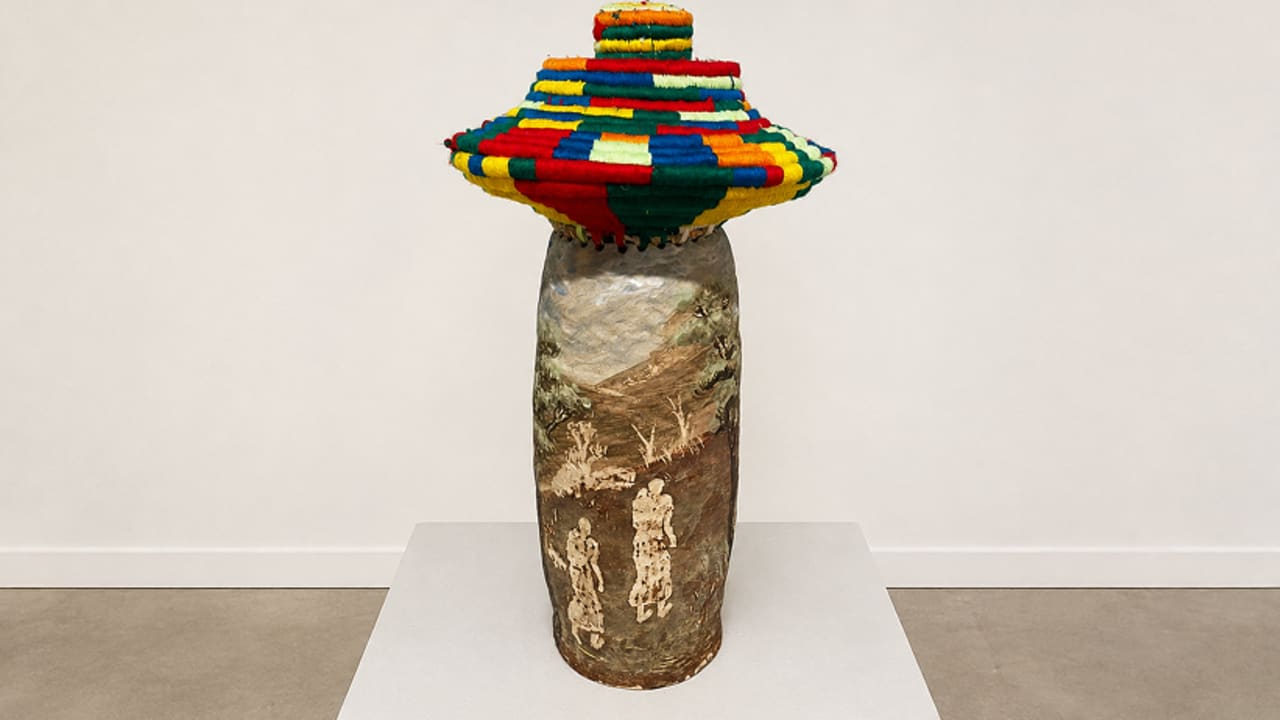
‘I remember drawing when I was six,” says Enatnesh Yallow, winner of the Promising Artist award at the 2026 Tel Aviv Biennale of Crafts and Design. “Then, it was a hobby and I did not know where it would lead, but I always loved to draw.”
The 32-year-old Yallow has developed her artistic abilities a great deal since then. Born in Ethiopia, she came to Israel with her family at the age of eight and grew up in the southern town of Kiryat Malachi, where she still resides. After graduating high school, she spent a year volunteering before her army service in the Nahal.

“After I was discharged from the IDF, I wondered what I would do,” she recalls. “At first, I did not have much direction. I knew I wanted something in the arts, but I did not know which profession to choose.” Yallow began working for an industrial designer, who encouraged her to continue her education.
“When I began painting after high school, I was not a professional, but I tried to use painting to convey messages and traditions to Israelis who did not know much about our culture,” she says. “At first, I painted subjects connected to the culture: the immigration from Ethiopia, the Sigd holiday and its meaning, clothing, food, agriculture, people plowing the land, how we grew up, and what the houses looked like; in short, every aspect of life. I tried to depict the culture so people would understand it.
“At that time, I didn’t know any Ethiopian artists, and that bothered me. I repeatedly saw paintings by European artists, but nothing that reflected me. Through my art, I tried to create what I could not see elsewhere.

“Today, I also paint on ceramics. In several projects, I used both techniques – painting and ceramics – to communicate the same ideas about culture. I work on canvas, ceramics, walls; on almost anything.”
Intrigued by the ceramics projects created by graduating students at Jerusalem’s Bezalel Academy of Arts and Design, Yallow applied there and was accepted into the department of ceramics and glass design. Four years later, after completing her degree, she returned to Kiryat Malachi, rented a studio, began working, and exhibited in group shows at museums and galleries.
In addition to her painting, ceramics, and glass work, Yallow teaches ceramics workshops at the Beit Faitlovitch cultural center in Tel Aviv, which is dedicated to documenting, researching, and preserving Ethiopian culture in Israel. She has also taught workshops in Ashdod and teaches classes there in traditional Ethiopian basket weaving and embroidery.
Yallow often combines materials in her work, creating interesting combinations. “Alongside ceramics, I use traditional Ethiopian basket weaving, which I learned from my mother, of blessed memory,” she explains. “I began that project as my final project at Bezalel and continue to explore it today. I also paint on canvas and sometimes incorporate embroidery materials. Combining materials is central to what I do.”
Art conveys messages and meaning, and Yallow shares that she tries to show the beauty of Ethiopian culture in her work. “I draw a great deal of inspiration from my Ethiopian culture and integrate it into contemporary art, thereby creating something new. I take traditional culture and contemporary art and create a new artistic language of my own.”
One particular project that epitomizes this combination of cultures was Yallow’s project at the conclusion of her studies at Bezalel. “I tried to think of a project that would sum up all four years of my academic studies, while also reflecting my life and everything I had experienced.

“It was during COVID, and I was at my parents’ home. I saw a woven injera-storage basket called a mesob. [Injera is a type of Ethiopian flatbread]. There were also smaller, colorful, beautiful containers for jewelry. I had never regarded them as anything special; they were simply part of the home.”
Yallow’s mother taught her daughter the techniques and plants used to create and dye the mesob. After returning to Bezalel, Enatnesh began to toy with the idea of combining the mesob with ceramics. “I wondered whether I could combine the techniques. I began researching how to do that; making holes and strips in the ceramic and initially trying to glue the materials.”
Yallow made holes in the ceramic, painted it, and brought it to her mother. “I told her, ‘I want you to continue this piece in your own way. I am not going to tell you how.’ At first, she did not understand, because combining the two materials was not something they traditionally did. She asked how she was supposed to connect them. I told her to improvise; to use the holes and weave into them however she wished.
“She began working and would show me pictures as she progressed, asking what I thought and whether she should correct anything. Later, she surprised me by saying that she had also made a lid. That amused me, because as a sculptor, I did not care whether it had a lid. But her way of thinking and mine came together to create the work and make it interesting.
“That was exactly the point. Through this work, I was also trying to speak about the relationship between generations. I felt there was a great deal of disconnection in our generation: young people did not share enough with their parents, and mentally the parents and children often inhabited different worlds.
“Traditional basket-weaving knowledge was once passed from one person to another, and that is how these techniques were preserved. In this project, my mother passed that knowledge to me so it could endure. The project became a way to preserve both the technique and the bond between us.”
The design on the ceramic section reflected Yallow’s life in Ethiopia and her life in Israel. “I remember that in Ethiopia we would walk with my mother to fetch water. The water source was always some distance from the village, so we walked a long way carrying water on our backs or heads. I painted that memory of Ethiopia and the connection between us, using the combination of the two materials.”
The other side of the vase features a landscape of trees in an Israeli setting. “The scenery changed when we moved from there to here, but we remained the same people,” she says. “My mother continued doing the same things. I tried to show that I contain both my tradition and my Israeli identity.”
Interestingly, she notes that Israelis who view her art perceive it as traditional Ethiopian designs, while Ethiopian members of the community focus on the Israeli aspect of her work. “That is precisely the point,” says Yallow. “I am trying to create both. I combine traditional techniques with my own contemporary sculptural practice.”
Yallow's mother died in September 2024. Yallow wanted to preserve her mother’s Ethiopian heritage and portray her character through her work. She created Still Blooming, a combination of ceramics and basket weaving, with the colors of the basket weaving suggesting growth and optimism.
“Usually, when I wove by myself, I used the natural material without colorful wool threads; I wanted the raw technique to serve my sculpture. But after my mother created the earlier piece, I tried to work more in her manner and used the colorful style of traditional basket weaving.”
The work is currently on display at the Eretz Israel Museum (MUZA) in Tel Aviv.
Through her art, Yallow seeks to help future generations appreciate Ethiopian Jewish culture and the heritage of the community’s elders. “They held knowledge that was disappearing and that we, the younger generation, were failing to preserve. That’s a shame, because if we do not preserve it, no one will.
“I often go to libraries and read books and studies, but I see almost nothing related to Ethiopian art. That disappointed me greatly and made me feel that I had to preserve it. My mother, of blessed memory, has now died, and I am glad I did this project because otherwise I might never have had the opportunity to investigate the technique with her.”
Yallow says that Ethiopians should not be embarrassed by their culture and heritage. “When I was in high school, many young Ethiopians were embarrassed to speak the language or eat traditional foods. Only after the army did many return to their original names or begin speaking the language more freely and confidently.
“There is no reason to be ashamed. On the contrary, our community has a great many positive qualities and talents in every field, including all these crafts. I believe the way for us to feel empowered and succeed is to bring our heritage into the open, not hide it.”
While surviving as a self-employed, independent artist in Israel today is difficult, Yallow is delighted with her profession. “This is something I love, something I am prepared to pursue all the way, and something that makes me feel good.”
She dreams of showcasing her work in the world’s most prestigious venues, such as Art Basel, the well-known international art show for modern and contemporary works, and making her mark on the international art scene.