
Considering the state of things in this information-laden, Internet- and social media-suffused age, one has to be driven and willing to put in an extra shift or two to eke out the incontrovertible facts on the ground betwixt the fallout of the data deluge.
Milo Rau is clearly determined to dive into the multi-layered, dense underbelly of various situations to divine the whys and wherefores and, hopefully, uncover the real state of play.
The latter, it seems, frequently involves nefarious deeds and injustices wreaked on innocent bystanders by folks with the financial, and hence political, clout to go about their profiteering business unopposed.
The 49-year-old Swiss theater director, festival honcho, filmmaker, and writer has accumulated a striking directorial and production bio to date, featuring the likes of Justice, a multimedia opera that premiered at the Grand Théâtre de Genève in January 2024.
The work fused documentary theater – complete with in situ video footage – and contemporary classical music, which shed an unforgiving spotlight on neocolonial exploitation, corporate crime, and systemic violence in the Democratic Republic of the Congo.
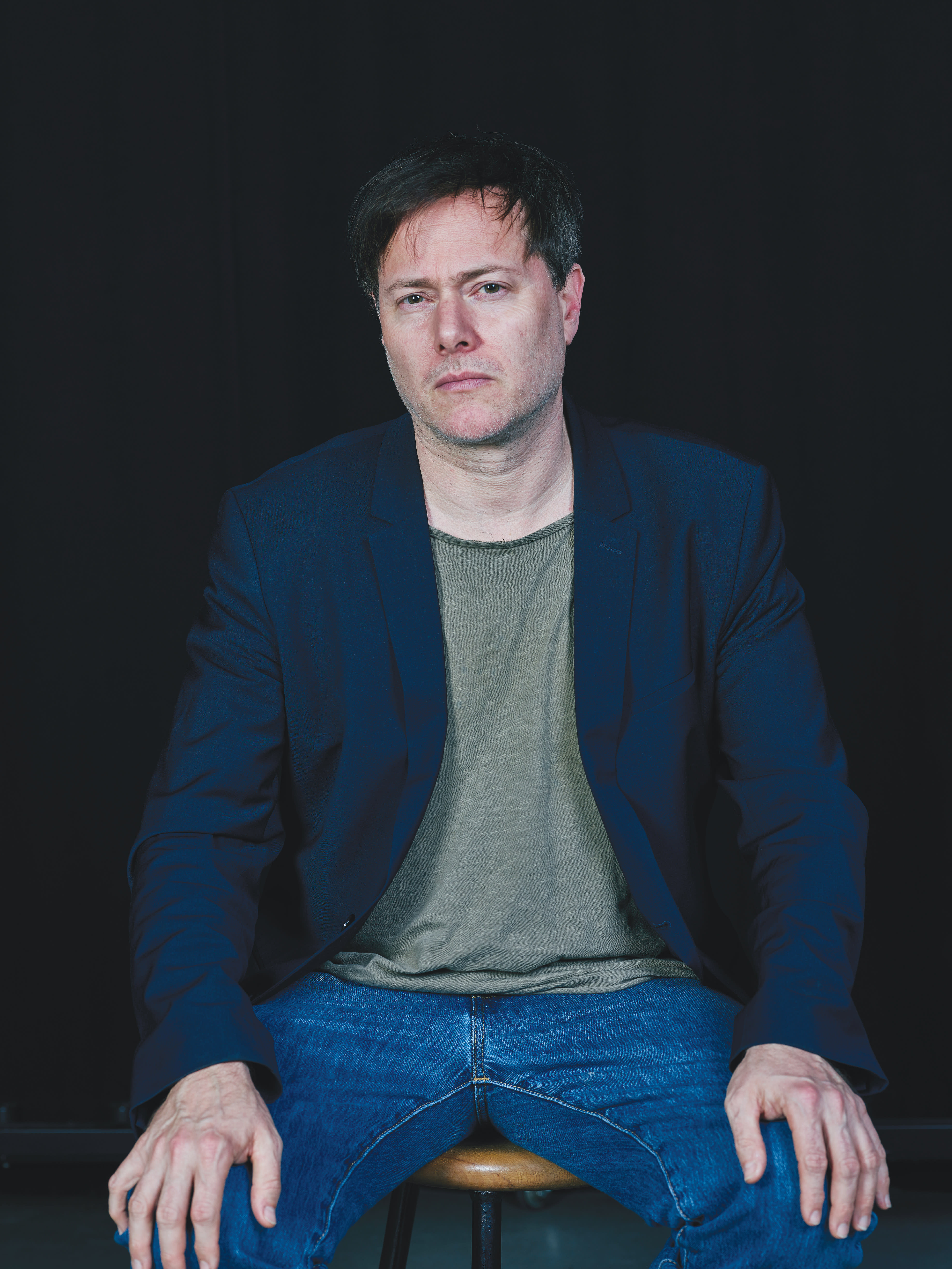
Rau, whose manifold professional purview includes heading the Vienna Festival, Europe’s largest crossover cultural event, recently popped over here with a hefty sleuthing agenda for an exploratory expedition. The thinking behind the foray was to lay the theoretical groundwork for his forthcoming production of Richard Wagner’s The Flying Dutchman at the Deutsche Oper Berlin, which begins a run in October and runs through February 2027.
Rau has been accused of all sorts of things during his stellar, storied professional timeline to date. But that’s par for the course when you ruffle a few feathers and put several noses out of joint. And all in seemingly good, altruistic, and creative causes.
He comes across as a “truth seeker,” a man fired up by his convictions and single-minded pursuit of justice, as he aims to bring it to the attention of the Western world.
Presumably, the hope is that his artistic endeavor will eventually bear corrective, or at least mitigating, political fruit, thereby improving the lot of the victims and possibly even obviating further cataclysmic developments.
That is indeed a commendable, lofty goal. It also serves to emphasize the role of cultural endeavor in society and offer an opportunity for art to make a real, street-level difference.
But, as Romain Rolland suggested, perhaps Rau should not hold out too much hope in that regard. The late-19th- to early-20th-century French Nobel Prize-winning writer is quoted by the celebrated Jewish Austrian writer Stefan Zweig as saying that art “can bring comfort to us as individuals, but it can do nothing against stark reality.”
When does altruism overstep the bounds that define it?
Is that the way the sorry things are? Judging by the ludicrously measly state support for cultural endeavor in this country – way below the average for OECD members – were Rau to try his hand at affecting the way the upper echelons of the local political hierarchy go about their business in the arts domain, he’d be chasing a lost cause.
But when does altruism overstep the bounds that define it? We can also enter more philosophical-moral realms by asking about the character and modus operandi of the artist or protagonist, and the creative end result she or he ultimately delivers for performance or presentation to public consumption.
Is that what it’s all about? Is it just about what we get to see or hear, or is there a place in the equation for, say, rectitude? Should we simply ignore the nature of the person who produced the work proffered for our wonderment and enjoyment, and just take an “it is what it is” attitude?
For the purpose of amplification, were we to posit an imaginary, extreme, simplistic situation whereby Adolf Hitler had made an oil painting that was considered by all experts in the field as a masterpiece, would the general consensus be that it should be hung in a museum somewhere? After all, art is art, right? Based on that aphorism, we should appreciate a work on the basis of its merits, regardless of any dark moral undergrowth that it may have navigated on its way out to the light of day.
That, in a nutshell, is the way Yonatan Livny sees things.
“Once a work has been completed, it no longer belongs to the artist; it belongs to the world,” he intoned when I asked him how he feels about the performing of music by Wagner in Israel.
This wasn’t any old rationale statement. Livny has the vocational cred to voice his opinion on the topic with authority.
He is the founder of the Wagner Association, established in 2016 with the express purpose of promoting the performance of works by the 19th-century German composer, who is lauded by musicians and fans of classical music – primarily opera lovers – alike for his brilliant writing.
But he is also known as a rabid antisemite whose oeuvre was lovingly embraced and powerfully endorsed by Hitler himself, albeit many years after Wagner’s death.
Built on the ashes of the Nazi crematoria
Hence the problem and the blanket taboo imposed here on Wagner’s music.
Sadly, Livny also has the bio collateral for his controversial stance.
“I come from a German family that was wiped out by the Nazis,” he explained to me. “My father was the only survivor. There were no aunts, uncles, or grandparents left. Nothing.”
Personal devastation notwithstanding, Livny actively works to have Wagner’s sheet music put to live instrumental practice here, in a country that was largely built on the ashes of the Nazi crematoria.
“Despite that, I love Germany, I appreciate Germany, I certainly appreciate the music of Germany, and I certainly appreciate the music of that damned antisemite called Richard Wagner.”
Livny even managed to see a darkly humorous side to that. “If, when I die, and I go up to heaven, and God – in whom I don’t believe – tells me I am allowed to ask one question, I won’t ask Him how the world works or anything like that. I will ask Him why He gave such a damned antisemite such wonderful musical talent.”
With his Wagnerian backdrop, Livny was duly targeted by Rau ahead of the theater director’s trip here. Livny wined and dined Rau and his associates at his home before settling down to answer Rau’s questions about Wagner, playing his music in Israel, and the Holocaust connection.
According to Livny, a few shortcuts were taken in disclosing the full extent of Rau’s plans during his brief pre-Berlin project visit here. “I received a phone call from the Deutsche Oper. They said they were coming here to hold a concert of The Flying Dutchman.”
I also received that information. In the end, the concert did not happen. Considering the muddied Wagnerian waters here, perhaps that is no surprise.
Then again, it seems that Rau’s primary intention in coming here was to sound out Israelis about playing the Jew-hating composer’s work in public, and to shoot video footage for screening at the concerts in Berlin.\
There wouldn’t be an interview, and he didn’t want any articles
I WENT to Tel Aviv to meet Rau, ostensibly to interview him for an article about his venture to Israel and his intent vis-à-vis staging The Flying Dutchman here in the face of such weighty emotional-historical baggage and still-festering Holocaust-related sores. At least that was what I was told.
However, when we met up at his hotel, Rau offhandedly informed me that, in all likelihood, he would not perform Wagner’s music during his 10-day stay. He said something along the lines of developing misgivings about it all on the flight over, when he sensed tension among the Israeli passengers. He thought it might be better to maintain a lower profile here.
He added that there wouldn’t be an interview and that he didn’t want any articles to run in Israeli papers while he was still in the country.
I was taken aback by this announcement and felt I’d been duped into giving up over half a day of my precious work schedule on a wild goose chase. Rau had known, ahead of time, that he wasn’t going to do an interview, yet failed to convey that to me so I could decide, based on that, whether or not I wanted to meet him.
The logical conclusion I drew from that, after I somewhat reluctantly sat down with him and his colleagues, was that I was being used, unwittingly, as fodder for his Deutsche Oper project. After all, I was a perfect guinea pig. I was an Israeli journalist who writes about culture and, as Rau was fully aware, I am the son of a Holocaust survivor.
He then proceeded to roll out a bunch of questions he had clearly prepared in the run-up to his trip here. He asked me, inter alia, if I thought Wagner’s music should be played in Israel.
I replied that, regardless of how I felt about it, if there is a single Holocaust survivor who objects, who finds the German’s music objectionable, the taboo should remain in place.
Judging by the blank facial expressions of Rau, his Italian assistant, and the German cameraman, that wasn’t the response they were looking for. Neither did they seem moved when I told them that every single Israeli is traumatized by the events of Oct. 7. Repeating that three times also failed, as far as I could see, to evoke any reaction.
'What took place yesterday was purely anti-Israel'
My sentiment was echoed by Tom Cohen, founder-conductor-artistic director of The Jerusalem Orchestra East and West. While taking a professional, seasoned overview of his craft, Cohen does not let his years on the creative-entertainment circuit cloud his humanist judgment.
“If I have ever encountered Wagner’s music – so far that hasn’t happened in Israel – I have listened to it and even enjoyed it,” he confessed.
“That said, as an artistic director or conductor, if I am due to perform music by Wagner, if I have the slightest suspicion that just one person in the audience – all the more so, if that person is a Holocaust survivor, or the descendant of one – will object to my playing Wagner’s music, there is no way I would take the risk [of hurting that person’s feelings]. With all due respect to the emotions in the loftier spheres, the earthy feelings in our belly are no less important.”
I had been looking forward to meeting Rau, learning about how his mind works, and getting the inside track on his moral and intellectual stance on his line of work.
But, as it turned out, that was not to be. He had come here to meet Israelis he felt could help him with his pre-Berlin production fieldwork. He didn’t bother to apologize for getting me to Tel Aviv on false pretenses, or thank me for my time, nor did he have the grace to even say goodbye as he waltzed off down Rothschild Boulevard to get something of a handle on the Tel Aviv vibe.
I’d done my bit for him and was now superfluous to his requirements. There was a vague promise to notify me should he manage to put on a concert of Wagner’s music while he was here.
I wasn’t holding my breath. However, about a week later, I received a WhatsApp message telling me there would be an outdoor event in the piazza in front of the Jaffa Theater.
It wasn’t clear what sort of program Rau had lined up; and, in all honesty, after my non-interview with him, I wasn’t at all sure it would actually happen. In fact, it did, although the proceedings left Livny less than happy. We spoke on the morrow.
“What took place yesterday was purely anti-Israel,” he retorted. “It was really terrible. The singer was great. It was the first time Wagner songs were performed in public [in Israel].” Apparently this was not an exclusively musical evening. “Everyone who spoke said things that were anti-Israeli. There was an Israeli woman who said there should be no music, just silence. She said we [Israelis] killed this person and that person, and left a child without parents. She only mentioned Muslims.”
Livny said he tries to take a balanced view of regional geopolitics. “I am certainly not right-wing, and I think what we did in Gaza was terrible. But we must not forget what the Arabs did on Oct. 7. I am not saying one is worse than the other. But it is a disgrace not to mention what Hamas did.”
Interpreting the Wagner opera in the context of the Holocaust
Livny also took Rau to task on his reading of the Wagner opera, which the Swiss interprets in the context of the Holocaust.
The PR material I was sent prior to Rau’s arrival in Israel said that his staging of The Flying Dutchman in Berlin in October would be based on the ambitious format of “a road movie through German-Israeli history: from the Holocaust to the resumption of diplomatic relations in the 1950s; from the traumatic 1972 Olympic massacre [of members of the Israeli team by Palestinian terrorists at the Munich Games] to the opening of the Holocaust Memorial in Berlin [in 2005].”
Livny doesn’t see it that way, and feels Rau is stretching the operatic plot too far.
“There is absolutely no connection between The Flying Dutchman and the Holocaust,” he declared.
Nevertheless, the Swiss director sees a direct line leading from the ghostly ship’s captain who is cursed to roam the seas until he finds redemption in the love of a faithful woman. The opera storyline is based on a book by German author-poet Heinrich Heine.
Rau expounded on his take in his preliminary text: “Aviel Cahn, the new artistic director of the Deutsche Oper, asked me if I would like to stage The Flying Dutchman to mark the start of his tenure in Berlin.
It was immediately clear to me that the production would revolve around the theme of the Shoah. Because, unfortunately, Wagner stands for antisemitism, for all the romantic ‘German’ fantasies of doom and redemption: The idea that even the worst can be transcended – through music.”
The Swiss director has been accused of being an antisemite himself, although he has taken pains to point out that while he strongly opposes the policies and actions of the Israeli government, he has nothing against Israelis per se.
“Israel and the Israeli government are two completely different things,” he stated. “I stand with Israeli civil society, as I stand with the Palestinian civil society, which goes without saying. I refuse to confuse the population with its government.”
He also asked me to stress that the alfresco Wagner concert-political posturing slot in Jaffa took place “without local institutional support” and that it was “part of a research for an opera, and not an ‘event.’”
Presumably, Rau wanted the former put out there so as to obviate any accusations of collaboration with any Israeli state body, which might have left him open to criticism of selling out to the Israeli government and its policies.
But, as I have learned from personal experience, it is difficult to read Rau’s mind and what really motivates him in his quest for strident artistic expression.
And so the Wagner conundrum goes on. Rau has his video material to slot into The Flying Dutchman in Berlin, and some insight into what Israelis think about the pros and cons of presenting Wagner’s music to the public. Job done. ■