
When Matan Eizenberg was shot during his service as a Golani officer in 2020, the Israeli Ministry of Defense provided him with top-tier medical care. But when he returned to civilian life, Eizenberg found himself trapped in a quiet, suffocating solitude.
"The Ministry gave me treatments, but no one was there to ask how I was sleeping at night," Eizenberg recalls. "No one asked what was happening with my nightmares, with my relationship, with my family. Everyone around me wanted me to feel good, but nobody knew how to help. You put on a mask, pretend everything is fine, but inside, you are sitting in a deep pit."
“Even after you return home, there should be someone to talk to you, someone to give you that love, that attention, that ongoing support, that sense of a family-like place.”
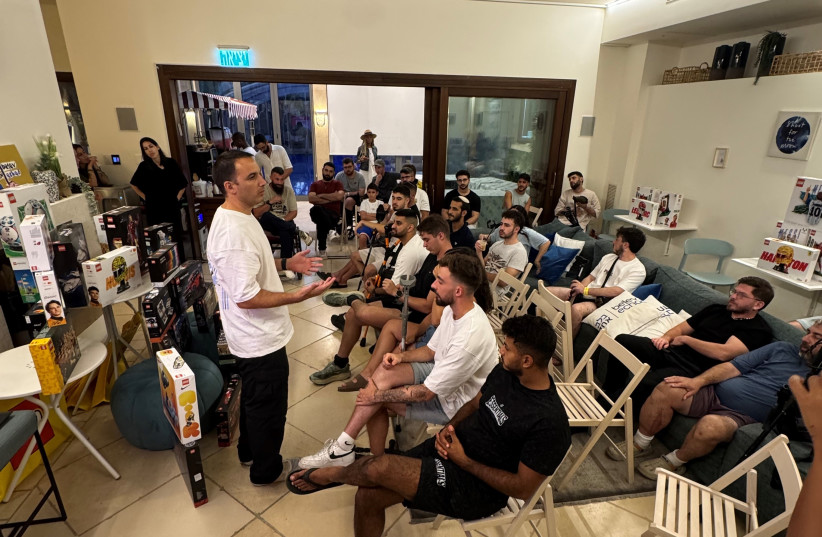
Eizenberg’s experience led him to Belev Echad (“With One Heart”) – an organization that is fundamentally changing how Israel rehabilitates its defenders. Founded in 2010 as the project of a Chabad couple who sent wounded soldiers on rehabilitative vacations to America, the organization still runs these trips, but since 2021 has provided support to wounded soldiers and veterans suffering from PTSD out of its Bayit Cham (literally “warm home” – an informal community center of sorts) in Kiryat Ono.

Spread across three floors and open daily from 10:30 AM to 8:00 PM, the 15,000 square-foot home offers a wide array of rehabilitative services – all completely free of charge – to the soldiers who walk through its doors: home-cooked meals, heated hydrotherapy pools, ice baths, an MMA and fitness gym, and ten specialized treatment rooms offering acupuncture, reflexology, and therapy.
By soldiers, for soldiers
What makes Belev Echad distinct is its peer-led framework. Nearly 99 percent of the organization’s about 60 staff members, including the CEO, are wounded combat veterans themselves. Belev Eched operates on a simple premise: true, long-lasting rehabilitation for wounded soldiers requires the constant presence of a community, whose members can support one another in a myriad of ways.
"Everyone went through the same thing: physical and mental struggles,” explains Eizenberg, who joined the staff in December 2023 and manages external and donor relations for the organization. “Suddenly someone tells you, 'I know what you're going through, let me explain what I did.' That authentic interaction makes you feel understood."
Before October 2023, Belev Echad supported approximately 370 veterans. In the wake of the war, that number ballooned to over 2,500 active members. The Bayit Cham serves 80 to 100 wounded soldiers daily. To meet this overwhelming need, Belev Echad recently opened a second home in Jerusalem, located minutes from Shaare Zedek and Hadassah hospitals.
<br>No stone unturned
Belev Echad’s approach to comprehensive recovery extends beyond physical treatments and amenities. The organization also offers financial management courses, AI and tech workshops, and English fluency classes. It also recognizes the need to ensure that soldiers’ family members are best equipped to support them – and runs programs for specific sub-demographics of soldiers, to ensure no one is left behind.
“We also support their partners and parents,” Eizenberg says. “We even held a workshop for parents: ‘Come, let's give you the tools to cope with your child's trauma.’ At the Jerusalem house, there’s a treatment room exclusively for women. We also organize female-only delegations and retreats to ensure they feel comfortable.”
For veterans who are unable to come to the house due to their injuries, Belev Echad delivers 50-100 care packages monthly, containing food items and household essentials.
“We also get medical second opinions,” adds Eizenberg. “If a wounded soldier needs a specific prosthesis or surgery, the organization’s doctor conducts a second opinion. If a solution can be found, we may send them to America for surgery. We brought in a professor who researched trauma for 30 years, and a psychological team – to continuously study and refine our methods.”
All programs are funded entirely through philanthropic donations.
Miracles on the ground
Dvir Oded is a father of four who survived a sniper attack while serving in the IDF. Bullet fragments in his spine left him paralyzed and in constant pain. Doctors said nothing more could be done.
Belev Echad reviewed his case with in-house experts and flew him to New York for specialized surgery to remove the shrapnel resting against a nerve. Two months later, Oded sent staff a video of himself standing upright and dancing with his four children.
Another veteran, Ohad Cohen, battled severe emotional trauma and wanted to compete in an Ironman Triathlon. Belev Echad paired him with a dedicated trainer through its Step by Step program which trains wounded soldiers to do extreme sports. A year later, Cohen completed an Ironman event in Germany.
A forever-home
Even as the organization’s clientele continues to grow, soldiers are welcome to remain attending the home for as long as they deem necessary. “Moving forward, our main focus is working on the soul. To help wounded soldiers return to life—to see them get married, finish degrees, find jobs, and have children,” emphasizes Eizenberg. "There is no expiration date. You are with us for life.”
This article was written in cooperation with Belev Echad.