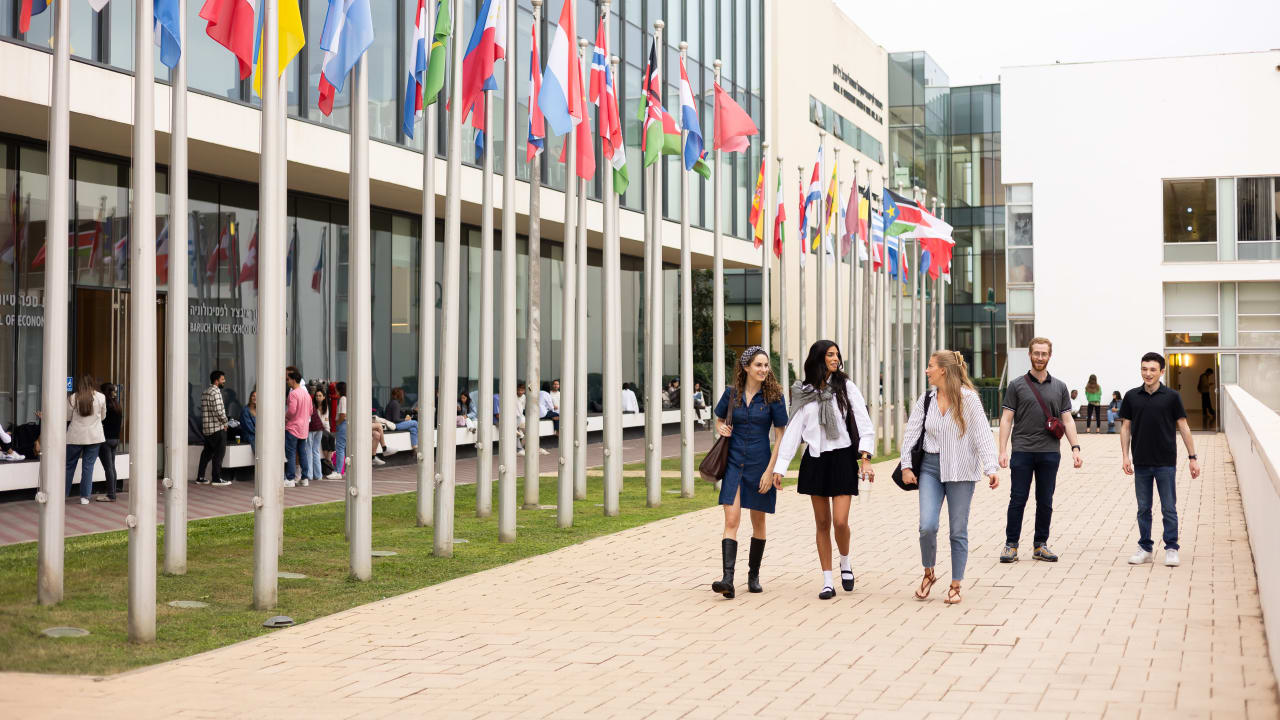
For twenty-five years, Reichman University’s International School has been one of Israel’s most successful international schools, attracting thousands of students from around the world. Sixty percent of its students have made aliyah, many have achieved success in their careers around the world, and all of its graduates – regardless of where they live – are positive ambassadors for Israel. What is the secret of its success?
Jonathan Davis, longtime head of Reichman University’s Raphael Recanati International School, attributes it to a three-word acronym – TLC. “Our success in the International School is based on tender loving care,” he says. “International students need to know that every member of my staff is here to embrace them, and that we’re going to be there for them if there’s the slightest problem.

“Parents know they can send a WhatsApp or an email here, and we'll address it. There’s close contact with parents and students. I personally know hundreds of students here.”
The care and concern for international students at Reichman is best epitomized by an episode that Davis recounts that took place in March 2026, when Iranian missiles were launched daily at Israel. “We held a Kabbalat Shabbat service one Friday, when no one was on campus except the students in the dormitories. Several hours before Shabbat, I brought catered food. Together, with eighty students, we sat on the grass, sang some Zemirot (Shabbat songs), and we recited Kiddush two or three hours earlier, because we didn't want to get into darkness. Under Homefront Command rules, we were permitted to do this because we were within reach of a shelter. I think that was one of the most meaningful Kabbalat Shabbat services I ever experienced.”
Despite the travails that Israel has experienced over the past three years, the international student body has grown at Reichman, and now numbers some 2,400 students from 90 countries around the world.
While the vast majority hails from the US, sizable contingents come from South Africa, Great Britain, France, Italy, Latin America, and even countries with smaller Jewish populations, such as Panama and Guatemala.
The International School has recently introduced several new degree programs, Davis shares. One is a sustainability program that offers innovative, hands-on courses on energy, water, food, and health, alongside advanced technological tools such as artificial intelligence, big data analysis, and circular economy and entrepreneurial thinking. “It’s for people interested in green tech; it’s for people who might want to become entrepreneurs, having to do with the way the world looks with climate change, with water resources, with forestry, with solar energy, with all of those different areas.”
A second program which Reichman recently introduced is a one-year, life sciences preparatory program at the Dina Recanati School of Medicine designed for graduates and students from non-life-science backgrounds. It provides the seven core prerequisites, chemistry prep, and preparation for the Medical Knowledge Exam to qualify for 4-year MD tracks.
“We have 80 new students every year entering the Dina Recanati School of Medicine at Reichman University,” says Davis. “To study there, you need to be an Israeli citizen. We’ve learned from certain universities in the States and elsewhere that some young Jews who are considering making aliyah would like to pursue a career in medicine, and might come and change their status to become Israeli citizens. They would then take this one-year pre-med course that we offer, because our medical school is for people who have already completed their undergraduate degree.”
Davis adds that the International School also has strong demand for entrepreneurial classes. AI is an integral part of all curricula and schools at Reichman. “Every dean is expected to provide us with a work plan on exactly how they're imbuing their students with AI. In every one of those degrees that we teach, there has to be a very, very intensive line of AI.”
The growing interest in entrepreneurship at Reichman dovetails with the results of a recent survey of universities worldwide in the area of entrepreneurship, in which Reichman was ranked fourth in the world, based on the number of unicorns – privately held startup companies with a valuation of over $1 billion – that have come from the school.
Reichman University also recently received the 2026 Minister of Defense Reserve Duty Shield Award, as one of just 20 organizations honored, and stands out as the only university among them for its extensive support of reservists during the Swords of Iron War.
Under the initiative of the university’s president, Boaz Ganor, Reichman created an on-campus physical therapy center for students who were seriously injured in the war. “Instead of having to receive physical therapy at a hospital in Tel Aviv, students can have physical therapy on campus, saving an hour and a half drive in each direction,” says Davis. The university has also established a clinic that treats trauma and PTSD in the School of Psychology. “Their job is to keep their finger on the pulse of students, and to provide workshops to the faculty and staff so that they would know the signs of someone who's going through trauma or suffering from PTSD.”
One of the university's policies, says Davis, is to ensure that students who have served in the IDF reserves are not left behind. Reichman offers private lessons to help these students continue their studies and keep pace with their fellow students.
Finally, Davis shares, this year’s Israeli Presidential Medal of Honor - the country’s highest civilian honor - will be awarded to Prof. Uriel Reichman, Founding President and Chairman of the Board of Directors of Reichman University, in recognition of his extraordinary contributions to the State of Israel, Israeli society, and academia.
Summing up, Davis says, “We are a Zionist university based on the values of Herzl, of Jabotinsky, of Ben-Gurion, and of Menachem Begin, that believes in the Declaration of Independence, in a Jewish and democratic state, and that believes that the ingathering of the exiles should come here, as part of the Zionist movement. We are a Zionist university of the highest order.”
This article was written in cooperation with Reichman University.