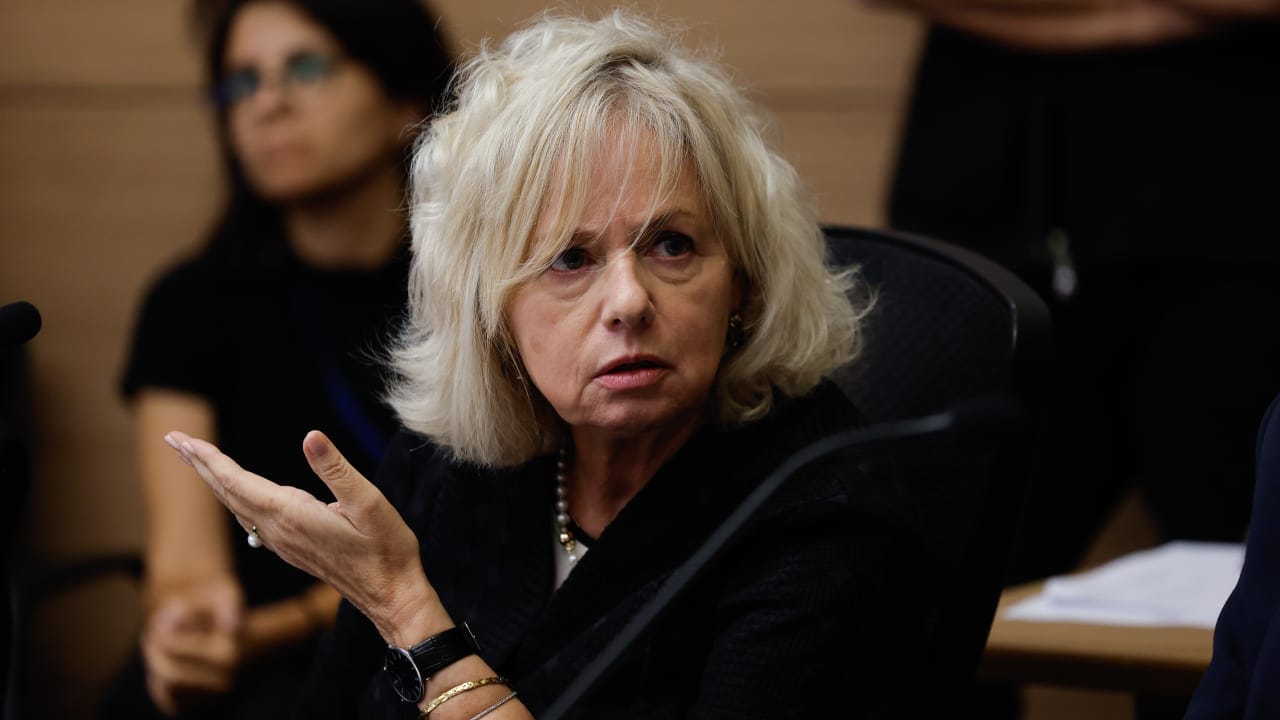
Attorney-General Gali Baharav-Miara warned Monday that Israel has entered “a race to eliminate democratic institutions,” accusing the government of normalizing non-compliance with High Court rulings and advancing legislation that would politicize law enforcement.
Speaking at the Israel Bar Association’s annual conference in Eilat, Baharav-Miara said the judicial overhaul had entered a more extreme “second phase,” accelerated by the approaching end of the current Knesset’s term.
“If, in the past, we spoke about democracies falling in small steps, then because of the proximity to the end of the current Knesset’s term, a race to eliminate democratic institutions has begun,” she said.
The attorney-general’s warning came as the Knesset was already moving toward possible dissolution, amid the coalition crisis over haredi draft legislation.
The coalition’s dissolution bill was set to be brought for its first reading on Monday, after approval by the Knesset House Committee. The committee did not set an election date, agreeing instead to finalize it before the bill’s second and third readings, while lawmakers discussed a possible election window between September 8 and October 20. The bill had already passed its preliminary reading on May 20 with 110 lawmakers in favor and none opposed.

Baharav-Miara pointed to two trends that she said should deeply concern the public, both the normalization of disobedience to court rulings and the political takeover of law enforcement.
Her remarks came as the coalition is advancing legislation to split the attorney-general’s powers and separately change the structure of the Justice Ministry’s Police Investigation Department (PID), known by its Hebrew acronym, MAHASH.
The Knesset Constitution, Law and Justice Committee approved the attorney-general split bill for first reading last month, and a joint Constitution-National Security Committee on Monday rejected a revision request to the MAHASH bill, giving it final committee approval for its second and third readings.
Baharav-Miara said the two bills shared the same logic: “political control over law enforcement bodies and criminal justice,” adding, “With the passage of the split law and the MAHASH law, the law enforcement system in the State of Israel will completely change its character.”
The “split law,” she argued, was misleadingly framed as a technical restructuring of the attorney-general’s office.
In practice, she said, it would “crush” the professional and independent status of both the attorney-general and the chief prosecutor, turning gatekeepers into officials dependent on the political echelon.
Under Israel’s current system, the attorney-general serves as the government’s chief legal adviser, head of the prosecution system, and the official responsible for representing the government in court. Critics of the split bill say that weakening those functions would remove one of the central checks on executive power; supporters say the current model gives unelected legal officials too much authority over elected officials.
'Citizens will feel the change in the street'
Baharav-Miara also warned that the MAHASH bill would remove the barrier between the police oversight body and the political echelon. A politicized MAHASH, she said, would deter police investigators from pursuing cases involving government figures and their associates, while also creating a risk of over-enforcement against groups disliked by the government.
“Citizens will feel the change in the street, at soccer games, and at protest rallies,” she said.
The attorney-general’s sharpest warning, however, centered on what she described as government efforts to undermine the binding force of court rulings.
“In a situation in which the government calls not to obey court rulings, the day is not far off when a court judgment will be seen by the public as non-binding,” Baharav-Miara said. “The waves of impact from the attack on the court are unpredictable.”
She added: “Some will ask, if the government does not obey the court’s decisions, why are other institutions and the public required to do so?”
'The state cannot ignore the law'
As an example, Baharav-Miara pointed to the haredi draft issue, saying that Israeli law is clear that the duty to enlist applies to all. She said that the burden on serving soldiers is “enormous,” and that the IDF chief of staff is “crying out for soldiers.”
“The state cannot ignore the law requiring the enlistment of everyone and the harm to equality,” the A-G said. “It is not possible, legally, to cooperate with a situation in which, with one hand, the government increases the burden on those who serve, and with the other hand, the government enables mass draft evasion – and some would say even encourages it.”
The High Court of Justice ruled in April that the state must take concrete steps to enforce the draft law against haredi draft evaders – including withholding certain state benefits and advancing criminal enforcement – after finding that existing enforcement was inadequate.
The ruling followed the expiration of the legal framework that had allowed blanket exemptions for haredi yeshiva students, leaving the state under a legal duty to enforce the draft law, while the coalition has struggled to pass a new exemption arrangement.
The issue has become increasingly urgent amid the IDF’s wartime manpower shortage.
Baharav-Miara said the government’s distancing from court rulings was directly harming enlistment. “Enforcement could have been much more effective,” she said. “The price is paid by those who serve, not those who evade.”
Before turning to the domestic legal crisis, Baharav-Miara addressed Israel’s legal battle internationally, saying that Israel had recently filed its approximately 1,000-page defense in the genocide case brought by South Africa at the International Court of Justice (ICJ). She called the accusation that Israel intended to harm or destroy Gaza’s civilian population “false,” saying Israel’s objective throughout the war had been to destroy terrorist organizations, remove the threat, and return the hostages.
Baharav-Miara ended by saying that public-sector lawyers would continue helping the government implement its policy but would also continue insisting on the limits of the law.
“We will not lend a hand to the normalization of violations of court rulings, to the politicization of law enforcement systems, or to harm to the mechanisms of democratic government,” she said.
Keshet Neev contributed to this report.