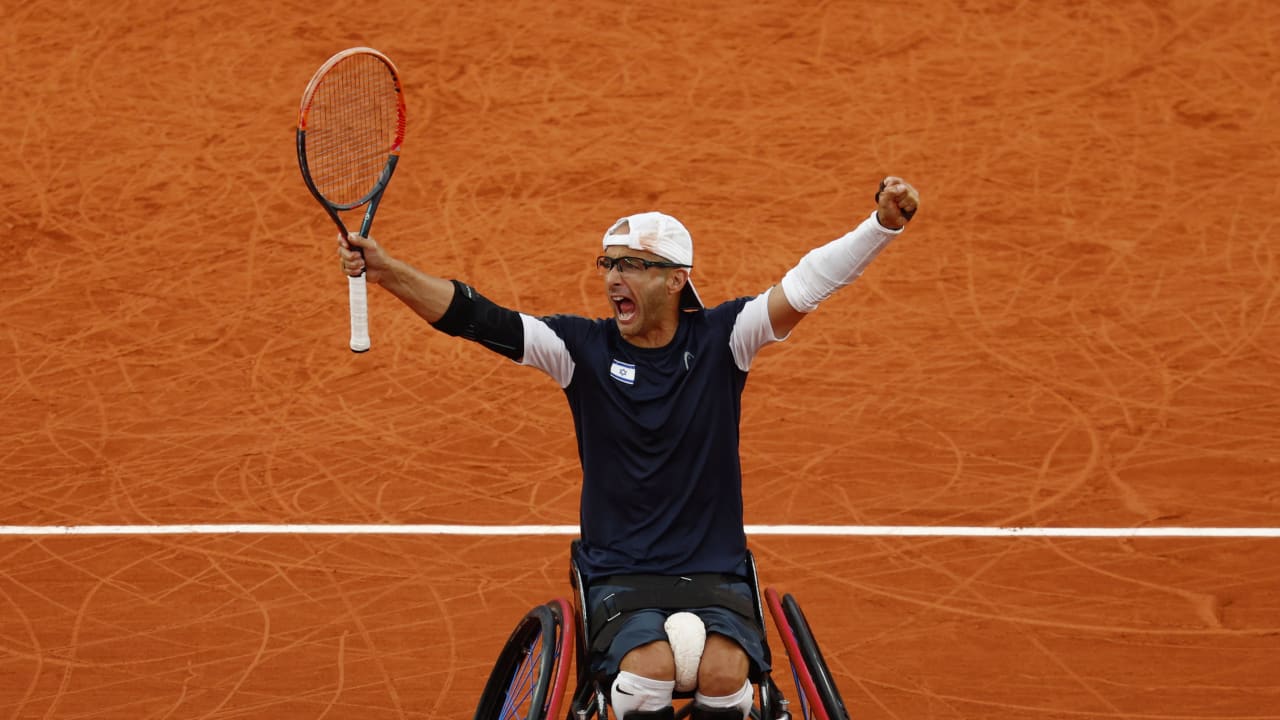
When Guy Sasson and Sergei Lysov rolled onto the tennis courts at the recently completed US Open, they represented the “old” and newer generations of Israeli wheelchair tennis players.
Sasson, 46, has enjoyed a highly successful career competing in the quads division. He won all four Grand Slam doubles tournaments this year and would have completed a calendar-year Grand Slam had he also won the US Open.
Lysov, 22, is an up-and-coming player who competed at the US Open last year and again this year. He won the 2024 Israeli National Wheelchair Tennis Championship and represented Israel at the 2024 Summer Paralympics in Paris.
And several other young Israeli wheelchair tennis players are coming through the ranks.
But with the rise in the number of young, otherwise healthy Israelis who have suffered life-changing injuries in the country’s recent wars, an important question is emerging: Will more newly disabled Israelis discover wheelchair tennis and other wheelchair sports, and could some eventually reach the elite levels achieved by Sasson?

“It is too soon to know – the journey from injury to active sport to competitive sports is a long journey,” says Boaz Kramer, executive director of the Israel ParaSport Center in Ramat Gan and himself a wheelchair user, two-time Paralympian and silver medalist in quad wheelchair tennis at the 2008 Beijing Games.
Still, the numbers suggest more people could participate in wheelchair sports.
Defense Ministry: Over 26,000 war-wounded soldiers sought treatment since start of Gaza war
In July 2026, the Rehabilitation Division at the Defense Ministry reported that approximately 26,200 war-wounded men and women had sought treatment since the war began. It is estimated that there have been 97 amputations since the start of the war.
Some of those injured may discover the world of wheelchair sports and even reach elite levels like Sasson.
Kramer would like to see injured people consider participating.
“I am a big believer in sports as a rehabilitation tool,” he says.
But Kramer also points to an interesting, and perhaps somewhat worrisome, trend: wheelchair sports are becoming “more and more competitive,” something he considers a mixed blessing.
On one hand, Kramer is pleased with how far the sport has come.
“Finally, wheelchair athletes are receiving the recognition, compensation and attention they deserve,” he says. “Paralympic sport is becoming more visible, more attractive and more commercially viable. Athletes are becoming professionals, events are attracting spectators, media are paying attention, fans are following teams and players. After decades of fighting for legitimacy, perhaps Paralympic sport is finally getting there.”
But he also sees a downside.
“But this slow and steady metamorphosis comes with a cost,” Kramer says. “And it raises an important question that has been sitting at the heart of Paralympic sport since its beginning: What is the purpose of Paralympic sport? The competition? The participation?”
Kramer worries that too much focus has gone to competition and that the sport may have “gradually transformed into an elite sport.”
“It rewards talent, it rewards training, it rewards professional support, money, time, access to facilities, coaching, technology and sophisticated sports science,” he explains. “While doing that, it also inevitably leaves people behind.
“So maybe the future of Paralympic sport is not about choosing between participation and excellence. Maybe it is about building a system in which excellence sits at the top without swallowing everything underneath it. While celebrating the jaw-dropping performance of the elite Paralympic sports, we must make sure we never forget why it exists in the first place.”
Kramer, born with arthrogryposis, came to Israel at five years old
Kramer was born with arthrogryposis, a condition characterized by stiff, curved, or locked joints. He came to the Israel ParaSport Center at five and played a variety of wheelchair sports before eventually focusing on tennis.
He became a competitive wheelchair tennis player, played on Israel’s national team for 12 years, and represented the country at the 2008 Beijing Games.
From that experience, Kramer knows that reaching the highest levels of wheelchair tennis can be particularly difficult for athletes who begin using a wheelchair later in life or who did not play tennis as children.
For that reason, he considers Sasson, who has won all four Grand Slam doubles championships in the past, although falling short last week in his quest for a 2026 calendar-year Grand Slam, “an exception in many ways.”
Sasson’s injury, the result of a snowboarding accident, occurred during adulthood. He initially began his competitive career in the open division before later being reclassified for the quads division as the extent of his injury progressed.
The fact that the quads division is smaller has also meant that Sasson has had greater opportunities for success.
Sasson is pleased about the possibility of new wheelchair athletes joining the sport, but he cautions that playing at the elite level is not for everyone.
“If an athlete wants tennis, it is not easy – it cannot be as a side job,” Sasson says.
“If you want to be at the top tier, you need talent, discipline, consistency, and a mindset. You need the physical ability and talent, and you have to do it again and again and again. It is challenging, and it is not easy, but there are rewards.”
Kramer is delighted by Sasson’s tennis success and his potential calendar Grand Slam, but he views what Sasson represents as something much greater.
“It is not just an athletic achievement, not just about tennis – it is also about how he represents Israel, partnering with a Dutch athlete,” Kramer says.
Sasson regularly partners with Niels Vink, 23, of the Netherlands, and together the pair have become one of the most successful wheelchair doubles teams in the world.
Kramer views Sasson’s accomplishments as “a very strong statement on how Israel is more than what people think.”
Perhaps, in time, more newly disabled Israelis will discover wheelchair sports. Some may go on to attain great heights in the competitive sports world. Others may simply find a new source of community, purpose, physical activity, and enjoyment.
Both outcomes, in their own way, could be part of the next chapter of Israeli wheelchair sport.