


For nearly three years, as Israel’s military campaigns in Gaza, Lebanon, and Iran have unfolded, a series of polls has documented a steady erosion of the kind of full-throated support for Israel that once defined much of Diaspora Jewish life.
One recent J Street-commissioned survey found that 24% of American Jews overall – and 44% of those under 35 – support replacing Israel with a binational state in which Jews and Palestinians share equal citizenship, numbers that would have been unthinkable just a generation ago.
As more Diaspora Jews reassess their relationship to Israel, many are rethinking what that means in practice: If they do make the journey, what do they want it to look like when they step off the plane?
For generations, the Israel trip has been a mainstay of Jewish communal life. The itinerary has remained more or less the same: Masada at sunrise, praying at the Western Wall, floating in the Dead Sea, and a night out in Tel Aviv.
But what happens when two weeks of sightseeing and restaurant-hopping no longer feel spiritually – or morally – fulfilling?
Beyond the itinerary
Idit Klein, vice president for public engagement at the New Israel Fund, described their dilemma.
“They do not want to write off Israel completely,” she told The Jerusalem Report, “but they feel like they cannot, in good conscience, continue to travel to Israel the way they always have.
“They want to actually talk with Palestinians,” she continued. “They want to expose themselves to experiences that weren’t a part of their previous trips. They feel a moral mandate to engage in a different way.”
NIF is part of a growing consortium of NGOs, activist groups, and tour companies heeding that call. Zak Witus, NIF’s director of young leadership and education, said demand for these programs has only intensified, with application numbers higher than ever.
It’s a response that caught Witus by surprise.
“I assumed that after October 7, my peers were either going to go more in the right-wing direction or want nothing to do with this place,” he recalled. “And I basically found the exact opposite to be true – that more and more people are leaning in, looking for ways to get involved in the work we do.”
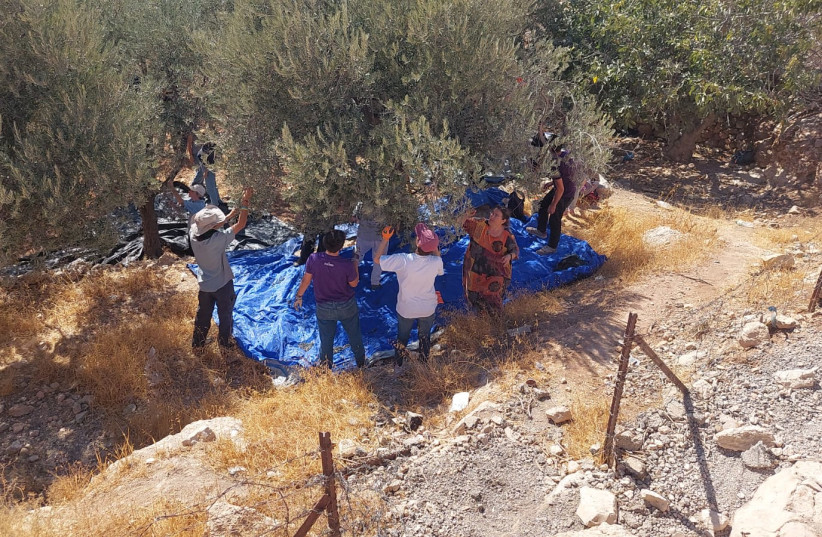
A critical component of NIF’s programming involves protective presence: accompanying Palestinian farmers, shepherds, and families in areas where they face settler violence, which has reached unprecedented levels in recent months.
At the forefront of these efforts is Rabbis for Human Rights, an Israeli NGO founded in 1988. Its acting CEO, Anton Goodman, sees the growing interest in protective presence among Diaspora Jews as part of a seismic shift.
For years, Goodman explained, many Jews related to Israel in almost “mythical” terms.
There was this sort of wishful hope that [Israel] would be the ‘most moral state,’ with ‘the most ethical army,’ pursuing peace and always doing the right thing,” he said.
Now many are waking up to “a very human reality, one that can be painful in a very visceral way.”

“People are shocked when they see the reality on the ground,” Goodman said. “And not just first-timers. I’ve been doing this for a long time, and I am still taken aback by what I see. The impunity. The level of violence. The way that the army supports settler terrorism.”
At the same time, protective presence also gives participants the opportunity to see the humanity in all of us.
“Despite what we are constantly being told, it’s not an either-or proposition,” he said. “We are pro-Israel, and of course, we’re pro-Palestinian. The two are inextricably linked.”
Bearing witness
RHR has been in operation for nearly 40 years, but Goodman says the reality on the ground has changed dramatically in the last decade. What once centered on helping Palestinian farmers access their land during the olive harvest has evolved into near-round-the-clock protection for communities facing what Goodman described as a “direct and extreme threat” of violence.
Activists themselves have also increasingly become targets, and not only of physical violence. International activists have faced arrests, deportations, and, in some cases, lengthy or even lifetime bans from entering the country.
But the risks have not kept volunteers away. During last year’s olive harvest alone, RHR brought roughly 1,400 volunteers into the field, and another 500 participated in tree-planting actions. Most were Israelis, ranging from secular activists to Orthodox and ultra-Orthodox Jews. But the organization has seen a major increase in international Jewish activists.
Given the rise in violence, Goodman said RHR takes every precaution: Volunteers are never sent out without experienced staff and are given strict instructions for how to stay safe.
He does not minimize the risk. “These are dangerous times,” he said.

Molly Hart, who came to volunteer with a Torat Tzedek group in December and January, encountered that danger immediately. Hart grew up in a Modern Orthodox community outside Chicago and first visited Israel on what she described as the standard “greatest hits” itinerary. By college, she had become more critical of Israeli policy and increasingly unsure whether she wanted a relationship with Israel at all.
That changed when a family friend traveled to the West Bank with Torat Tzedek and began sharing updates from the field. For the first time, Hart said, she could picture herself back in Israel.
“I came exclusively to do this program,” Hart recounted. “I don’t think I would have gone back without the context of protective presence.”
On day two in the field, masked settlers attacked the vehicle she was riding in, smashing the rear windows with rocks while she sat in the passenger seat recording.
“In terms of fight or flight, my first instinct was definitely flight,” she said. “I was very shaken up because, you know, I’m a nice Jewish girl from the Chicago suburbs. I’ve never experienced anything like this.”
Finding connections
What stayed with Hart, even more than the violence, were the relationships she formed. Before she arrived, Hart had worried about slipping into a kind of white-savior role – dropping in briefly to help people whose lives she could not fully understand. That concern slipped away as she spent more time with Palestinian families.
In the West Bank Palestinian village of Mukhmas, residents were so on edge after recent attacks that they did not want to be left alone. A father of six living in the village of Duma told Hart his children slept better when activists were staying in the guest house.
Those interactions changed her understanding of Jewish responsibility.
“For some of these kids in rural Palestinian villages, the only encounters that they’re ever going to have with a Jew [are] a settler pointing a gun at them or a soldier kicking them off their land,” she said. “I don’t want that to be the image associated with my identity.
“I do feel like, as a Jew, it’s my responsibility to take that personally,” she added.

Rabbi Sarah Reisman, a congregational rabbi at Temple Emanu-El in New York City, came to protective presence through a similar search. Like Hart, she had visited Israel many times before, but said she had only ever seen “glimpses” of Palestinian life in the territories. After Oct. 7, she wanted to return, but not on a traditional solidarity mission. Any trip she took, she said, would need to include a broader perspective and work that looks toward a shared future.
In November 2025, that search led Reisman to a T’ruah delegation of rabbis doing protective presence in the West Bank. While there, Reisman was particularly struck by the smaller, daily experiences of inequality and vulnerability she witnessed: families living with homes demolished or left half-built under impossible permit regimes, children being woken by settlers in the middle of the night yelling and playing loud music.
During one of their protective presence shifts, a settler attacked the group with a drone and discharged a firearm, injuring one of Reisman’s colleagues. And while much of what Reisman saw and experienced has stayed with her long after her return, the trip did not leave her feeling despair.
“When I’m in Israel, I’m actually more hopeful than when I’m in the States,” she explained. “At home, everything is theoretical – an ideological debate.
“But when I’m in Israel, I’m working alongside people who are on the ground day after day. If they’re investing themselves and their livelihoods and their family’s future, it’s because it’s worth it to them. And if it’s worth it to them, it’s worth it to me.
“If they are staying hopeful, then I am absolutely staying hopeful.”■