


Finding employment after months of serving in the IDF has been a challenge for many veterans, especially for those most affected by continuous months of fighting and operations.
The current employment crisis in Israel’s hi-tech sector has further worsened the situation. With almost 26,000 wounded veterans receiving help from the state through the rehabilitation system, the crisis is not only social but also a financial constraint for the nation.
With this in mind, Oz VeRuach, an initiative created by the Portland Foundation to help wounded IDF veterans find employment, announced that its first program achieved a 100% employment rate in hi-tech companies such as Amdocs, SolarEdge, and Nvidia among its 19 participants.
Now the program aims to expand, with the objective of 500 participants and job placements beyond the hi-tech sector.
“Today’s employment market is more competitive and challenging than ever. Even excellent candidates are struggling to find their first opportunity, and demand for entry-level employees in the hi-tech sector has declined dramatically. Artificial intelligence is changing entire professions and raising the requirements in almost every role.
“It is precisely in this environment that wounded IDF personnel must not be left behind,” said Rami Schwartz, CEO of the Portland Foundation and former president of Amdocs.
“We need to offer them something better than just employment; they need to earn more money than what they receive now through the rehabilitation system for it to be worth it,” Maj.-Gen. (res.) Yoav “Poli” Mordechai, who led the initiative, told The Jerusalem Report.
“During the war, we made a commitment as a society not to leave any wounded behind. That commitment does not end when the fighting subsides or when medical treatment is completed,” he said. “Real rehabilitation is measured at the moment when a person begins to believe in themselves again, reintegrates into society, and builds a future.”
The road back
The project was born when Mordechai approached Sir Ronald Cohen, chairman of the Portland Trust, and explained that while his organization worked mainly with minorities in Israel, a new sector of society needed help: war veterans.
“Even if not technically a minority, they are an important number of people living in the country that need help, and that can’t be forgotten,” he said.
Yehuda Shmulevitz, one of the participants and who currently works at Amdocs, told the Report about his experience:
“Returning to the job market doesn’t mean simply picking up where your career left off. The technology sector moved forward very quickly, particularly with the use of AI.
“Although I studied algorithms and machine learning during my degree, I felt a gap between my academic knowledge and the tools now required in the industry.
“Through Oz VeRuach, I received practical, up-to-date training and support for finding a role, which helped me close some of the professional gap that developed while I was serving in the reserves and going through rehabilitation.”
Shmulevitz, 31, is a software engineer who served as a combat soldier and commander in the Kfir Brigade. He was wounded by shrapnel in his hand during operational activity in the Jabalya area, near the Indonesian Hospital, around two months after October 7. The wound left him with damage to his hand, required rehabilitation, and forced him to balance this with his studies and employment search.
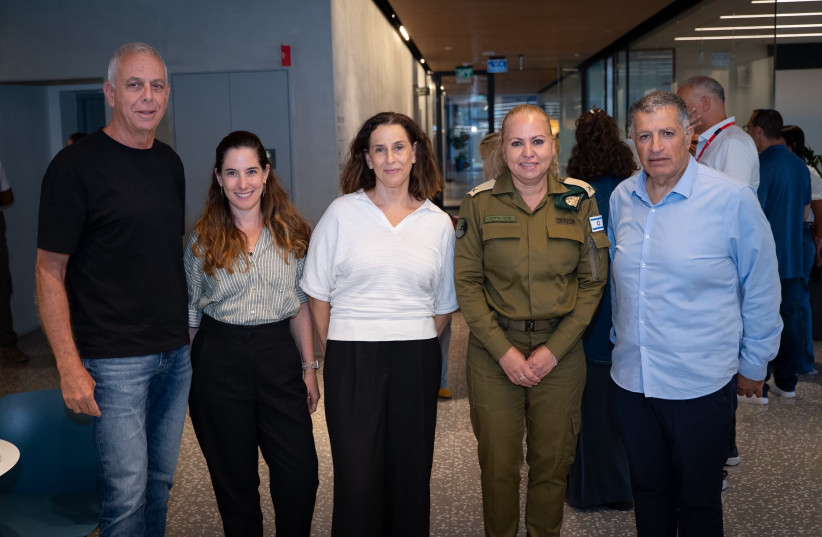
“For me, returning to work is much more than finding a job. My professional path was interrupted by the war and my injury, and work is a significant part of being able to move forward again, build a career in the field I chose, and regain my independence and sense of a future,” he said.
He also explained that October 7 and the call to reserves interrupted not only his studies, but the beginning of his professional career. He recalled preparing to jump into cybersecurity, with a role in a major organization already lined up. But after the war started and he was wounded, the plan got completely scrapped.
“Every wounded soldier has a different experience, and the challenges are not always visible to an employer. There isn’t one solution that fits everyone. Employers need to understand the individual needs of each person and provide the support and adjustments they require,” he pointed out.
“One of the soldiers from the program had post-traumatic stress disorder to a level that, if we didn’t close the door softly enough, he would be jumping. He told us the situation made it impossible to feel at ease in his own home with his children,” Mordechai recalled about one of the participants.
“While in the beginning he explained that he needed to go to quiet places, like libraries, to be able to work in peace, by the end of the course he was able to give a speech in front of everyone, keep composure, and not suffer from a stressful situation.”
Mordechai also explained that this change happened with many of the participants, mainly because the program helped them with finding a duty, a project in life that moves them.
“Many of them even thought about artificial intelligence solutions to problems that they lived with in their daily life, with one of them being a social media app that helps people suffering from mental health conditions and might need someone to talk to in difficult moments,” he explained.
Opening new paths
The initiative is now working to offer more varied job opportunities for people not interested in pursuing a career in the hi-tech sector. Options being considered include drone operators, transport-industry technicians, financial analysts, electricians, and MRI operators.
Mordechai specifically highlighted the first one, saying that many soldiers operated drones during the war and are capable of doing so for noncombat roles in agricultural or delivery services.
The project is in talks with Electra Elevators to offer a training course that would allow graduates to work as technicians in the transportation system.
In the hi-tech sector, Oz VeRuach is working with Matrix to offer system implementation training, while developing additional AI-focused courses for future editions.■