

The prospect that Zionism would deepen rather than resolve the “Jewish Question” would have seemed a cruel irony to its early visionaries.
From 19th-century proto-Zionist rabbis like Judah Alkalai and Zvi Hirsch Kalischer to their political counterpart Theodor Herzl, the Jewish return to Palestine, or the Land of Israel, was seen as a cure for the ills of exile. Perhaps, some believed, it would normalize the Jewish experience.
In many respects, the movement for Jewish self-determination succeeded beyond its founders’ imaginations. In only a few decades, ancient liturgy was transformed into a viable political program. A state was created, and an army; within weeks of independence in May 1948, Jews who had been refugees and partisans were soldiers in uniform, defending their own borders.
Hebrew, revived from the page, became the language of parliament, newspapers, and the street. Jews of every stripe and color immigrated from the “four corners of the Earth,” and biblical prophecies, from Isaiah’s ingathering of the exiles to Ezekiel’s valley of dry bones, seemed fulfilled.
But 125 years after Ephraim Moses Lilien snapped the iconic shot of Herzl gazing out over the Rhine, Zionism is a contested word for Jews. Why?
In part, it always was. Opposition to Zionism is as old as the movement itself. The First Zionist Congress was meant to convene in Munich in 1897; it moved to Basel after the local Jewish community objected.
For some Jews, opposition was theological, an eschatological affront. Redemption would come only with the Messiah, and a return engineered by human hands amounted to “forcing the End.” Others were Bundists, who believed the Jewish future lay not in Palestine but in a socialist Eastern Europe, where Jews would enjoy national-cultural autonomy in Yiddish wherever they already lived.
Still others feared that a Jewish nation abroad would invite the charge of dual loyalty at home. The Reform movement offered one solution. The 1885 Pittsburgh Platform declared that Reform Jews considered themselves “no longer a nation, but a religious community,” and expected no return to Palestine. That position did not hold.

By 1937, the Central Conference of American Rabbis had dramatically reversed course: the Columbus Platform affirmed an obligation to help build Palestine as a Jewish homeland, “a haven of refuge for the oppressed” and a center of Jewish culture.
As the extent of the horrors of World War II came to light, most Jews came to see the need for a Jewish state, if not based on ancient or religious norms, then out of physical necessity. For a while, that understanding extended to the Western world, where support for Israel was largely a consensus issue.
A changing perception
The Six Day War changed things. Diaspora Jewry, which had rallied behind Israel in the anxious weeks before the war, was swept up in euphoria. The reversal was dramatic: during the recession of the mid-1960s, morale was so low that a joke circulated about a sign at Lod airport asking the last one out to turn off the light.
With time, however, the elation gave way to unease. As Israel’s perceived ethos shifted from David to Goliath, tensions developed with a pluralistic, liberal Diaspora, and the Lebanon War of 1982 and the first intifada deepened them.
In the same years, American racial politics and the rise of anticolonialism as an analytic framework cast Israel’s story in a new light. Decolonization had remade the map of Africa and Asia. Zionism was increasingly read not as a national liberation movement or a refuge for a persecuted people, but as a European settler project.
The groundwork had been laid before the war: Fayez Sayegh’s Zionist Colonialism in Palestine, published by the PLO Research Center in Beirut in 1965, framed the conflict in exactly these terms. In 1967, Maxime Rodinson’s essay “Israël, fait colonial?” appeared in Jean-Paul Sartre’s Les Temps modernes.
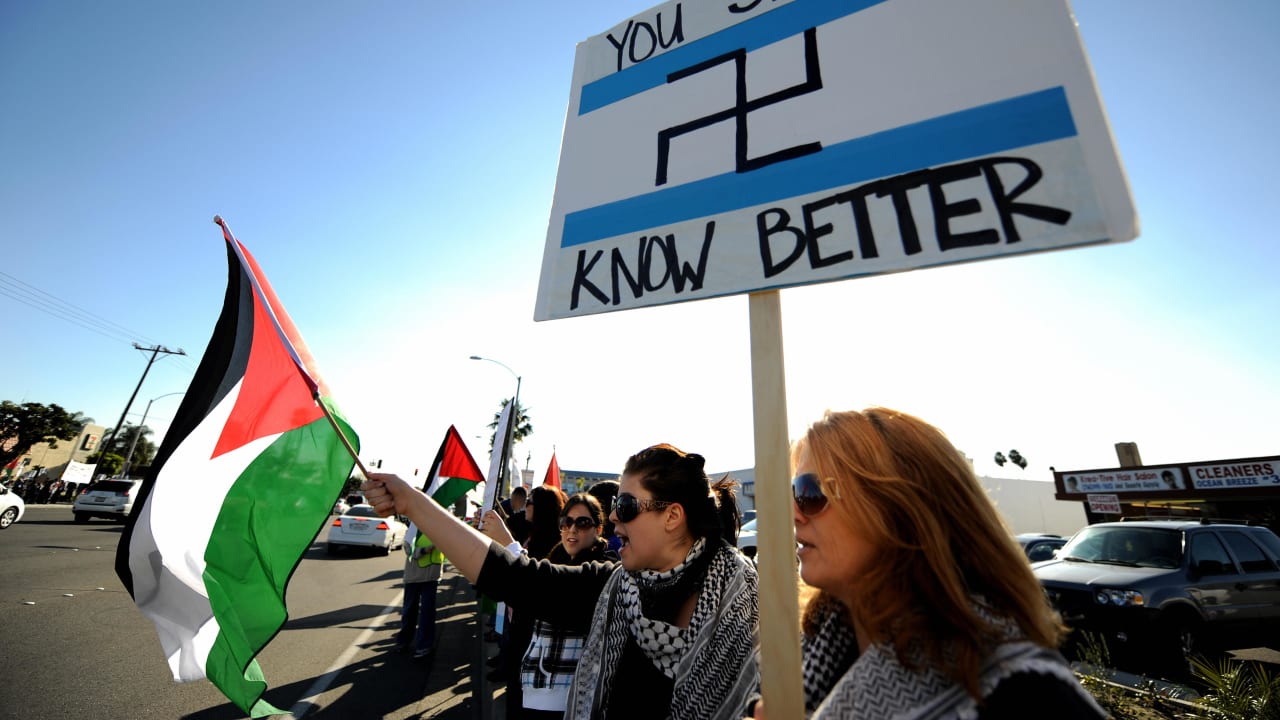
In the United States, the anticolonial frame fused with race. That summer, the newsletter of the Student Nonviolent Coordinating Committee attacked Zionism, marking a rupture in the Black-Jewish alliance of the civil rights years and recasting Jews, and their state, as white and Western. Once Israel was filed alongside French Algeria, Rhodesia, and apartheid South Africa, the question was no longer only what it did, but a return to the pre-state question of whether it should exist at all.
Zionism on trial
Before long, the attack on Zionism as a racialist movement reached the level of states. What began as a Soviet ploy at the United Nations to deflect from its own antisemitic policies was eventually enshrined in General Assembly Resolution 3379, adopted on November 10, 1975, which declared Zionism “a form of racism and racial discrimination.”
The resolution was symbolic, not law. Yet the US ambassador to the UN, Daniel Patrick Moynihan, saw it as so grave that he said it had “granted symbolic amnesty – and more – to the murderers of the six million European Jews.”
Israel’s representative, Chaim Herzog, who noted that the vote fell on the anniversary of Kristallnacht, famously declared that for the Jewish people it was “no more than a piece of paper,” and tore it in half at the rostrum. The resolution was repealed in 1991, but it lived on. Ten years after the repeal, the 2001 NGO Forum at the Durban conference revived its charge, and the BDS movement, founded in 2005, followed in its footsteps.

For Jews coming of age in its wake, particularly on campus, Zionism was now something to be defended or disavowed.
Ideas rarely remain in the realm of the abstract. Jews were reminded of this after October 7, when, within hours of Hamas’s massacre, student groups were justifying it as resistance to settler colonialism and the inherent illegitimacy of Zionism, a vocabulary half a century in the making. At Harvard, more than 30 student organizations signed a statement holding Israel “entirely responsible” for the violence before the dead had been counted.
Zionism today
For many Jews around the world, Zionism is still a position to be reckoned with. But for Israelis, it is less of an idea. It is the condition of being. Hillel Halkin captured this chasm in his 1977 Letters to an American Jewish Friend: “It is not our business to decide whether we deserve to exist or not. It is our business to exist.”
For Jews in Israel, it is precisely the absence of that question, the absence of what the historian Yosef Gorny calls “value trials” that is consequential. If one of the chief goals of Zionism was to make the Jews feel normal, it nearly succeeded.
A posterboard in Jerusalem is plastered with local event advertisements: the Oud festival is back, featuring mostly Jewish singers of Mizrahi descent playing what is known as the pear-shaped “king of instruments.” Another poster advertises biblically infused Hebrew poetry readings at the Confederation House; still another announces a beginners’ Maimonides class at a local Beit Knesset.
Ahad Ha’am got his spiritual renaissance. Herzl got his state. As for the rabbis: the Messiah beckons. And Jews everywhere, like Franz Kafka, hope he won’t arrive when he is no longer needed.■
The writer is a historian of contemporary antisemitism and Jewish political identity. She is a Research Fellow in the INSS-ISGAP Program in Critical Contemporary Antisemitism Studies.