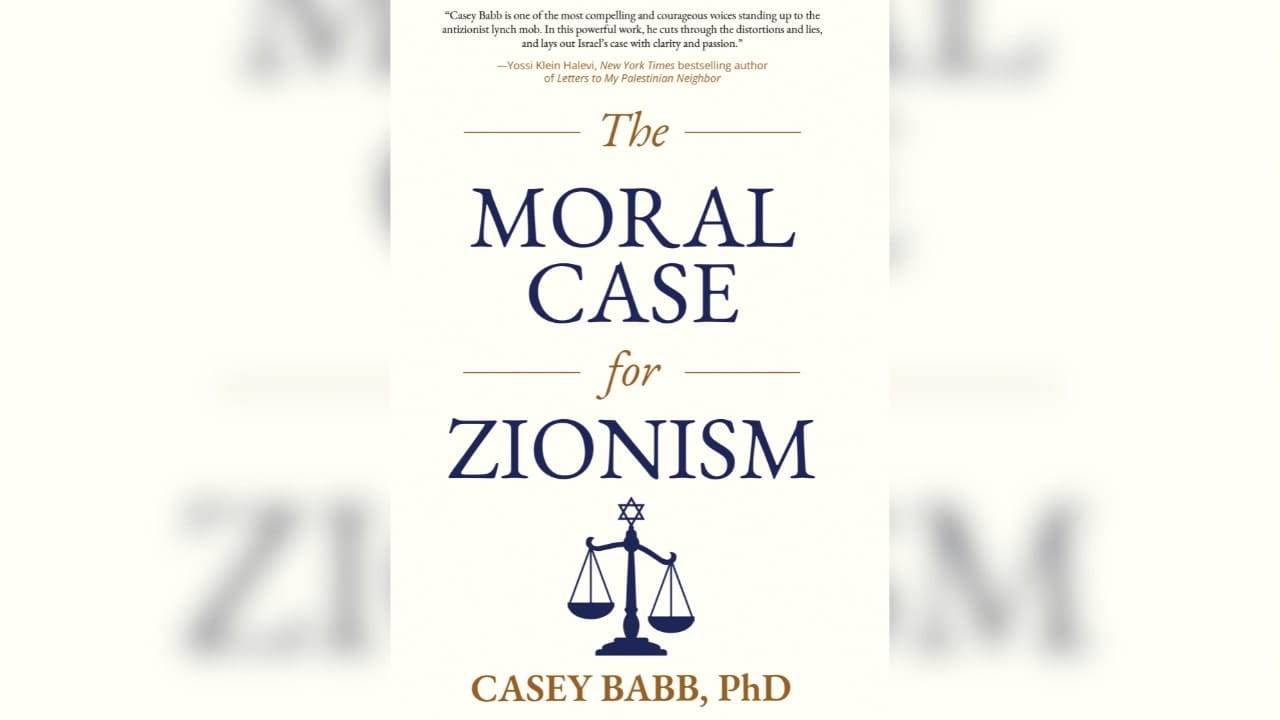
Babb is a Canadian scholar and commentator on international security. Asked what led him to write the book, he explained that, following the Hamas pogroms of October 7, 2023, he had become increasingly alarmed by the rise of anti-Zionism and the normalization of anti-Zionist rhetoric. But he felt that if he wrote a book just on anti-Zionism, he might be putting the cart before the horse.
“If you’re going to talk about anti-Zionism, you first have to talk about Zionism, what it really means, what it represents, and what it has achieved and continues to achieve for the Jewish people,” he says. “I feel like yes, we have to defeat anti-Zionism, but Zionism itself is also worth saving.”
Reclaiming Zionism
Babb contends that Zionism is a positive moral ideal, not merely defense of Israel. Public debate has reduced Zionism to a caricature – “racism” or “colonialism” – while detaching it from Jewish history and the meaning of Jewish national liberation.
He presents Zionism as a movement rooted in a historical relationship between the Jewish people and the land of Israel, and as a project of return, dignity, belonging, and political freedom.
The modern Zionist movement, he argues, does not invent the Jewish attachment to the land of Israel, but endorses it. Meanwhile, much contemporary anti-Zionism repudiates Jewish collective rights, uses antisemitic tropes, and ultimately aims – consciously or not – at destroying “the Jewish story and, in the end, the Jewish people.”
His claim is that Zionism offers something meaningful not only to Jews but “to all people.” By examining the moral principles at the heart of the Zionist spirit, he reveals ways in which both Jews and non-Jews can embrace Zionist ideas in their own lives.
Throughout, Babb addresses his readers in a direct and personal way. “What you will read in this book is said with conviction and with every fiber of my being,” he writes.
The next generation
Early on, he explains who the book is for. Firstly, it is for him, written to reassure himself that the flood of anti-Zionism that followed the Hamas-led assaults of October 7, 2023, was without merit.
Secondly, it is for the next generation.
“It is for my son, Avram,” he writes, “who is five years old as I write this, and who has no idea yet that someday… someone is going to tell him that Zionism is racism. That the homeland his people prayed toward for 2,000 years is a criminal enterprise or an outpost of Western imperialism. That the national liberation movement that gave his people safety, dignity, and the right to determine their own fate is the moral equivalent of apartheid…
“And I want him to know – in his bones, not just in his head – that it isn’t true. That he has a history worth knowing and a story worth telling, and an identity worth defending without apology.”
Beyond defensiveness
The book ends with recommendations. Babb urges Jews and allies not to retreat inward or define Jewish life reactively around opposition and defensiveness. Instead, he calls for courage, “chutzpah,” communal solidarity, and active engagement with Jewish and Zionist culture.
The book reclaims Zionism from hostile framing; grounds it in Jewish history; warns that anti-Zionism can function as a denial of Jewish collective rights and as a vehicle for antisemitism; and calls for a confident, culturally affirmative Zionist renewal rather than purely defensive politics.
He gives readers the language, historical context, and confidence to distinguish legitimate criticism of Israeli governments from denial of Jewish national self-determination.
The Moral Case for Zionism is a
book tailor-made for the times – a guide for anybody seeking arguments to counter the antisemitism suffusing the Western world under the guise of anti-Zionism.■
Neville Teller is a journalist and former senior civil servant. Follow him at: www.a-mid-east-journal.blogspot.com