
Last Thursday evening, my wife and I, having decided to spend Shavuot in Jerusalem, were presented with a bit of a quandary. Should we stroll the streets of Jerusalem that night and sample the numerous Torah classes that were being offered throughout the city, or should we go to sleep at a decent hour, wake before sunrise, and walk to the Western Wall for the morning services?
Ideally, of course, we would have liked to do both, but we have reached the age at which an all-night study session followed by a weary walk to the Western Wall at dawn would probably have left us too exhausted for serious learning or heartfelt prayer.
Torah study or sunrise prayers
Jerusalem is blessed with many distinguished educators and teachers who inspire, educate, and entertain throughout the night at synagogues and community centers. But what to choose? Where to go? One of our children living in Jerusalem was kind enough to print a listing of hundreds of classes, but there were so many lectures packed onto the page, in a minuscule typeface, that it was nearly impossible for us to read.
As for praying at the Western Wall, while I remain inspired by the fact that I can approach the stones of the Western Wall, something that Jews could only dream of for thousands of years, I have frequently found the prayers there to be less than inspiring. On Friday evenings, for example, men can readily find a minyan (prayer quorum) to join. However, the cacophony of competing groups singing and chanting can be somewhat distracting.
Moreover, I could not help but recall my visits to the Western Wall as a youth, when the plaza seemed to represent a broader cross-section of Jewish life. Secular Jews, modern Orthodox Jews, and haredi Jews all appeared to be well-represented there, creating a feeling that Jews from many different backgrounds had come together at Judaism’s holiest site.
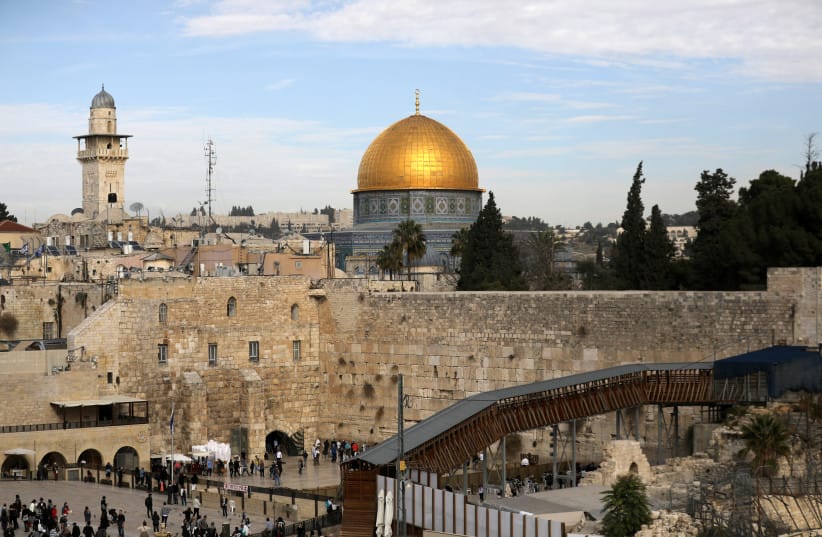
Today, the haredi presence is far more noticeable, and the broader diversity of representation I remember from those earlier visits feels somewhat less visible.
On Shavuot morning, however, many of the prayer groups at the Western Wall are composed of Jews of different stripes and appearances, creating a broader cross-section of Jewish life than is there at other times of the year.
And while the variety of Jews in attendance does not compare to accounts that I have read of the first Shavuot after the June 1967 Six Day War, when the unfinished, muddy area in front of the Wall hosted some 200,000 Jews – secular, religious, and everyone in between – I have found Shavuot at the Western Wall to be a largely positive and inspiring experience that reflects the diversity of the Jewish experience.
The relatively chilly Jerusalem evening and the full feeling in our stomachs as we walked home from our Shavuot evening dinner settled things – it would be sunrise services at the Western Wall. I awoke at 4:30 the next morning, and my wife and I began our walk to the Old City by 5 a.m. The roads were empty of traffic, and there were not many others out and about, as we had left a bit later than we had originally intended.
We wended our way through the upscale Mamilla shopping district – the stores were, of course, closed – and noticed other stragglers walking along with us to the Old City. Entering Jaffa Gate, we realized that the two main routes to the Western Wall we had taken in the past – the Arab shuk and the Armenian quarter entrance – were closed.
We continued walking past the police station as the road sloped downward until we arrived in the Jewish Quarter. Some had already finished their prayers and were heading back from the Western Wall, but most of the traffic was headed to the Kotel.
Shavuot morning at the Kotel
Finally, we arrived at about 5:30 and headed toward the back of the Western Wall plaza, near the first-aid station. In previous years, I have joined a minyan there, largely composed of modern Orthodox men and women. I located the group, managed to stake out a space to stand, and quickly caught up with the minyan in time for the Torah reading.
While finding a place to stand wasn’t that difficult, following the service was another matter. As the Torah reading began, another minyan from a nearby building behind us was joyfully singing the Hallel prayer, making it all but impossible to hear the reader. They eventually completed the prayer, and I was able to follow most of the words after that.
I should add that although there is an official mechitza (partition) that separates the women and men near the front of the Western Wall, most of the prayer services held on Shavuot toward the back of the plaza have no such separation. It is simply too crowded, and while the men and women are separated, they are still standing in very close proximity to one another.
In previous years, some participants in this group were friends and acquaintances. Although I did not locate any of them this year, I was pleased to notice the diminutive figure of Natan Sharansky – the former Prisoner of Zion, former member of Knesset, and government minister – who was praying with our group. He was wearing his trademark olive-green hat, a tallit (prayer shawl) on his back, and a smile on his face.
Sharansky once explained that the reason he wears a nondescript cap is because wearing a kippah – or not wearing one – would identify him more closely with one segment of Israeli society over another. That was precisely the kind of division Sharansky could not abide. Among all the headgear that I witnessed that morning – from shtreimels to fedoras to crocheted kippahs – Sharansky’s was the most meaningful to me.
My wife, who is more vertically challenged than I, was having a less positive experience. She was jostled by people passing near her, and the cigarette smoke coming from some of the participants did not enhance her experience. She went in search of a minyan that would provide her with a more direct view – and ability to hear – the proceedings.
She soon found herself at the southern section of the Western Wall, where the Masorti movement was conducting egalitarian services. She was able to find a seat, had unrestricted access to everything that took place, and found it much more enjoyable – and smoke-free.
After the prayer service had concluded, I made a brief stop at the large restrooms on the left side of the Western Wall plaza. There, I was reminded of my summer visits to Wrigley Field to watch the Chicago Cubs, which were occasionally punctuated by visits to the park’s cavernous lavatories. Both were rather noisy and raucous. The key difference was that most visitors to the Western Wall left their tallit on outdoor shelves before entering, whereas at Cubs baseball games, this was not the case.
My wife and I had arranged to meet at the back of the plaza at 7 a.m., and when we met, we compared our various experiences, both positive and negative.
Several organizations had provided cake and grape juice for visitors, so that they could recite kiddush after they had finished their prayers. Outside of Jaffa Gate, an even more elaborate station had been set up, with ample tables and seating, cake, kugels, grape juice, and popsicles, as well as a flame where those who wanted to smoke could light their cigarettes from pre-existing flames, since creating fires is prohibited on the holiday.
Unfortunately, the large number of people eating, drinking, and smoking left considerable litter, and Arab cleaning crews circulated throughout the area, attempting to keep up with the debris being generated.
Our Shavuot morning, in many ways, mirrored many aspects of our daily life in Israel. There were moments of great spiritual satisfaction.
For me, standing at the back of the Western Wall plaza and watching masses of people engaged in prayer and singing was uplifting. For my wife, participating in a more inclusive type of service was equally so. Yet, these moments were also occasionally accompanied by noise, frustration, pushing, and discomfort.
The long, hot Jerusalem summer will soon begin, with no major holidays on the horizon until Rosh Hashanah, which begins Friday night, September 11.
One can only hope that the next three and a half months will be quiet, uneventful, and calm, both within Israel and from those beyond our borders who threaten us.