
How wonderful to read the numerous press stories featuring the residents of the Gaza border kibbutzim celebrating their first Shavuot together at home since October 7, 2023.
Shavuot is the traditional harvest holiday celebrated by kibbutzniks since the collective settlements were first founded over a century ago. In Kibbutz Nahal Oz, almost 1,000 people showed up to participate in the holiday events.
Over 100 participants sang and danced on stage to the traditional melodies from the past. This group included the founders of the kibbutz, babies born in the past year, and others who had expressed interest in moving there.
The purpose of this article is to tell you about an event that took place on the kibbutz just a couple of nights earlier. At Mechinat Meitarim Nahal Oz, there was a Torah dedication ceremony for a “new” Torah scroll to be used for the future Beit Tefila to be built on the kibbutz. The program was a combination of both new and old.
The “new” was the idea of having a house of prayer in a kibbutz that never had a synagogue in the 70 previous years of its existence. The “old” refers to the Torah Scroll that they were receiving, which was written close to 150 years ago in Germany.
Brought by our family from Nazi Germany to America before the Holocaust, then donated to a shul in New York City, it was rediscovered almost 90 years later. It was then carried to Israel for repair and given to the kibbutz to use in their new Beit Tefila. Here now is the story of that Torah scroll.
The Torah’s origins
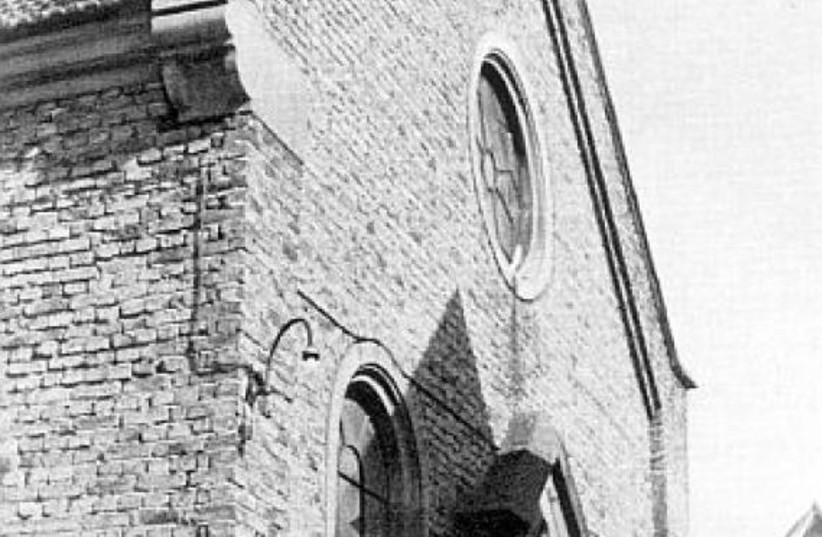
It comes from a synagogue in the town of Eich in south Germany, one of many small agricultural towns surrounding the city of Worms. This is where Ashkenazi Jewry first started, and it has always had a connection to the great Jewish scholar Rashi. He studied at a yeshiva in the first years after his marriage, and to this day, the synagogue located there is known as the Rashi Shul.
As early as the 18th century, Jews began to settle in Eich and in Hamm, an adjacent town. They only built a synagogue there for both communities in 1890.
Relations between Jews and non-Jews were fine for many years. The Eich-Hamm municipality had actually paid for part of the cost of building the shul. When a prominent member of the Jewish community passed away in the early 1900s, they say that church bells rang as the funeral procession departed. Since so many non-Jews wished to attend this funeral, the Protestant minister found it necessary to cancel Sunday morning services.
In 1929, a memorial plaque was put up in the synagogue in memory of two soldiers from the Jewish community who had been killed in World War I. This event was attended by the entire municipal council, including the Protestant and Catholic clergy. In his speech, Jacob Guthmann, a prominent Jew in Eich, praised the harmonious coexistence of all the religious communities in the town.
Now for the more personal part of our story.
My grandfather, Yosef Kahn, married Paula Schott from Eich in 1914 just before the start of World War I. Her grandfather had been one of the founders of the Eich-Hamm synagogue. Yosef was almost immediately drafted to the German army.
After becoming ill with influenza and almost dying, he came back to Eich to live with his wife and her parents. They soon bought their own home where she ran a small general store while he worked as a cattle dealer. My father, Ernst, was born in 1919 and his sister, Gertrude, was born less than two years later.

In 1932, Ernst Kahn and his family celebrated his Bar Mitzvah. However, just a little over two months later, Adolf Hitler and his Nazi party came to power. In my father’s own words, “Then, at the end of January 1933, came the beginning of the end.” The fate of the Jews from Eich-Hamm had been sealed and not for the good.
Once the boycott of Jewish businesses began, it became impossible for Paula Kahn to continue running her store. Her husband, Yosef, was unable to continue working as a cattle dealer. By 1935, things turned even worse when Guthmann, who owned the only automobile in Eich, was tied to the back of it and dragged through the streets of the town.
He would eventually flee to Wiesbaden, taking with him the two Torah scrolls that his family had originally donated to the synagogue almost 50 years earlier.
With no more income to maintain the family, it was clear that the Kahns had to leave Germany. They contacted relatives of my grandmother living in the United States who agreed to sponsor their emigration. In the meantime, my grandfather tried to get some funds owed to him for previous cattle sales to people in the town.

He was told by the one policeman in Eich that these same people were now claiming that it was he who actually owed them money. This “good German” warned Yosef Kahn to take his family and leave Eich as soon as possible.
As a result, in 1936, the Kahns, the last remaining Jewish family in Eich, left the town for good, never to return. Since the shul was now closed and had already been sold, they took with them the last remaining Torah scroll. As their moving van left their hometown, they had clear memories of sitting in the open back of the truck and residents spitting at them as they passed by. Not too soon afterwards, the municipality put up a sign at the entrance to their town, “Eich is now Judenrein” (free of Jews).
After having to spend a few months in Frankfurt waiting for their papers to come from America, the Kahns finally boarded a boat to New York. With them were the few belongings that they were allowed to take with them plus the Torah scroll from Eich. To keep it safe during the ocean voyage, my father actually slept with it in his bed. When the family finally got to their destination, they found a congregation in Washington Heights, a “Yekke Shul,” to which to donate the “Eicher Torah.”
The narrative ended right here for almost 80 years – until family rumors started to circulate about the Kahns having donated a Torah scroll from Eich to a congregation in Washington Heights, just after arriving in the States. I must state that in all the years my father was alive, until 2018, he never once mentioned to me that he had brought a Torah scroll from Germany to America.
Most of the family were not privy to this family lore. Around 2014, a couple of relatives who had heard talk about a donated Torah actually called up various German-Jewish congregations in the Heights looking for the “Kahn Torah.” But they were not successful in their search.

Our luck would change about five years later, when Chana Adler-Leserovits, our very own family “Indiana Jones,” traveled to New York to visit her grandmother, Gertrude Halberstadt, the last living survivor of the Kahns from Eich.
On that visit, Gertrude shared photos and stories about her childhood in Germany and their escape to America. It was at this time that the story of the Eicher Torah came to light. Chana expressed surprise at not having ever heard this story before. For that reason, her grandmother pulled out an original letter in German from 1937 with the logo of “Shaare Hatikvah (Gates of Hope) – a German Jewish Congregation,” thanking Yosef Kahn for donating a Torah scroll to their shul.
It turned out that the rumors were actually true. With the knowledge of where to look for the Torah scroll, the Adler family took it upon themselves to contact the synagogue. The idea was to retrieve the Torah scroll from Shaare Hatikvah and bring it to Israel. Chana “Indiana” had brought us all a bit closer to finding our “Holy Grail.”

Shortly afterwards, a meeting at the shul took place with the participation of Chana and her father, Rabbi Aaron Adler. They showed the letter to the synagogue’s rabbi, and he accepted its validity. However, of the almost 30 Torah scrolls belonging to Shaare Hatikvah, not one could be clearly identified as the one donated by the Kahn family.
Twenty-seven of them either had Torah covers with family names or corresponding paperwork. However, there were three that had absolutely no identification, and so the possibility existed that one of them might actually be the Eicher Torah.
The COVID pandemic broke out shortly afterwards, and that put the investigation on hold for a few years. In 2023, another meeting was held in Shaare Hatikvah. This one was attended again by Rabbi Aaron Adler, his wife Miriam, who was the daughter of Gertrude (Kahn) Halberstadt, and their son Eitan.

The rabbi of the shul explained that the synagogue was no longer functioning and had begun to return the Torah scrolls to the families that had originally donated them. The three whose ownership could not be verified still remained. Eitan had been advised by a Torah scribe from Machon Ot in Jerusalem to photograph certain portions of all three unclaimed Torah scrolls.
The purpose was to identify the script by examining the shapes of the letters plus checking the parchment itself. It was also an opportunity to see whether the Torah scroll was in good enough shape to be restored.
The response from Machon Ot came about a month later. They immediately eliminated two of the Torah scrolls and said that only one had the popular writing style found in Torah scrolls written in southern Germany in the late 19th or early 20th centuries. The feeling was that based on the photographs, it was probable that the Torah scroll could be restored so as to be used again on a regular basis.

The entire family was thrilled to hear the good news. The Adlers then put in a formal request to get the Eicher Torah and bring it to Israel.
After Oct. 7
Sadly, just a few weeks later, October 7 happened, and Israel became embroiled in a war that unfortunately lasted for years.
The distance from Jerusalem to New York became greater, and visits overseas became quite rare. However, in the autumn of 2025, Rabbi Adler, in New York for a family visit, called Shaare Hatikvah, which had become totally inactive. They told him that he should come by to pick up the Torah scroll. A short time later, it was brought to Israel.
The Torah scroll was examined by the experts at Machon Ot, who determined conclusively that it could be saved. Immediately, our family organized to raise the funds from various relatives. This group was led by the five grandchildren of Yosef and Paula Kahn, their great-grandchildren, plus a couple of cousins.

One cousin’s father had actually “celebrated” the last Bar Mitzvah in Eich in November 1933 after the Nazis had already taken power in Germany. There was barely a minyan remaining in the town after so many Jewish families found it necessary to leave.
Now, to Nahal Oz
The next project was to find a new home for the Torah from Eich. We heard about Kibbutz Nahal Oz from another relative whose daughter was studying in Mechinat Meitarim, a pre-army program housed there. Nahal Oz was originally founded more than 70 years ago as a secular Kibbutz without a synagogue.
Today, however, some members have returned in the two years since Oct. 7 and are interested in building a house of prayer. Thus, there was a clear need for a Torah scroll. The “lost and found” Torah from Eich, brought from Germany to the United States and then to Israel, would find a new home in Kibbutz Nahal Oz.
We were told just a few weeks after Passover that the repair of the Torah scroll was complete. Our family decided to schedule the Torah dedication ceremony just a few days before Shavuot, which commemorates the giving of the original Torah.
On May 18, we all gathered at Kibbutz Nahal Oz for the hachnasat sefer Torah (Torah dedication ceremony). First, we marched, sang, and danced throughout the Kibbutz until we reached the small synagogue of Mechinat Meitarim Nahal Oz.
This was to be the temporary home for the “new” Torah scroll.
There we were met by people carrying the two other Torah scrolls used for services in that shul: one in memory of Naftali Fraenkel killed near Hebron in 2014, and the other in memory of Daniel Perez killed on Oct. 7 defending Nahal Oz. Those attending the ceremony that evening included members of the mechina, a few kibbutz members, plus about 50 members of our family.
There were a handful of people who spoke that evening. I told the story of the Torah scroll’s origin in Eich, Germany, and its escape to New York City just before the beginning of World War II. Chana Adler-Laserovits then shared the story of how the Torah scroll had been lost for so many years and was finally rediscovered in New York in 2019. She ended with its arrival in Israel and its recent restoration in Jerusalem.
Rabbi Aaron Adler described the writing that appeared on the cover of the Torah scroll itself. On the front were the names of the family members who originally left Eich, along with the children’s eventual spouses. The Rabbi pointed out that it just so happened that all of the males were Kohanim, and this was why the words of the Priestly Blessing were featured on the mantle.
The center of the cover is decorated with the breastplate that the Kohanim wore in the times of the Temple, with the names of the 12 Tribes of Israel. The text ends with the words, “Together are the Tribes of Israel.” These words were picked specifically to emphasize the unity of the people of Israel from the past to the present and hopefully into the future as well.
On the back of the cover were listed the travels of the Torah scroll from Germany to the United States and finally, Israel.
Representing Kibbutz Nahal Oz was Ronit Goldberg. She spoke about how some of the former residents had returned over the last year to their homes in stages. Several of them were looking for a more Jewish connection, and therefore the timing of this Torah’s arrival was important.
Ronit dreamed of this rebirth or revival, and that it would have some kind of spiritual connection, “a moment of new beginnings.” She told us that today there are members of the kibbutz praying together on Shabbat and holidays in the small synagogue with both the mechina students as well as the soldiers stationed there on the base. Once the building of the House of Prayer is completed on the kibbutz, then the Torah scroll will finally be moved into its new home.
We heard some last words for the evening from Rabbi Adler. He shared with us something he had once learned from his teacher and mentor, Rabbi Joseph B. Soloveitchik: that the Zohar says God created seven worlds before this one.
The Rav said that it was important to know this because each time God destroyed one world, He immediately created another. In Nahal Oz, we are now creating another new world as this Torah scroll makes an eternal connection between our family and the kibbutz.
After some light refreshments were served, our family returned to the shul to take some photos. When the original Kahn family left Eich in 1936, there were just four of them. Today there are over 100 descendants, and more than two-thirds live in Israel. Forty of them, a little more than half, attended the event that evening. The survival and flourishing of our family since their escape from Nazi Germany can be seen as a victory.
Then came what was for me the most emotional part of the evening. German Jews have a custom called a wimpel. This is a piece of linen which is placed under a baby boy at his circumcision. Immediately afterwards, this cloth is cut into strips and sewn together to make one long piece.
On it is painted or embroidered the name of the child, his birth date, and good wishes for his Bar Mitzvah, his marriage, and for all “future good deeds.” When completed, it is used to tie the Torah scroll like a belt and used for that boy’s Bar Mitzvah as well as his Shabbat Chatan, just before his wedding.
I had brought my father’s wimpel with me that evening. It was my intention to physically connect something from that older generation with the events of that evening. I realized that the last time that this wimpel had been used was at his Bar Mitzvah in Eich close to a century ago.
My son lifted the Torah, and after lowering it, I tied my father’s wimpel around this old Sefer Torah. In my mind, I somehow imagined the Torah saying to the wimpel, “You look very familiar to me. Have we ever met before? Maybe it was many years ago in a very different place?” Even if this didn’t actually happen, it will still be a moment that I will cherish forever.
The story of the Eicher Torah is not a sad one. In 1937, our family brought this old Torah scroll to America, where it would be kept safe. It hadn’t been burned because it had been removed from Nazi Germany before Kristallnacht.
More than 90 years later, it was brought back by the descendants of that family to what will be a newly built house of prayer in Kibbutz Nahal Oz. It just missed being destroyed again after having been brought to the kibbutz more than two years after the horrible events of Oct. 7.
In its new home in Israel, may this Torah scroll continue to inspire future generations and bring them hope for a better tomorrow.
The writer lives in Jerusalem with his wife, children, and grandchildren.