
The Book of Samuel pauses, in the middle of a war, to name two rocks. Jonathan is about to climb toward a Philistine garrison above a ravine, with no one beside him but his armor-bearer, and the text stops to record that a crag stood on either side of the pass, one called Botzetz, the other Seneh.
For most readers, that verse is furniture. The Koren Tanakh of the Land of Israel: Samuel treats it as evidence. A short article notes that one name suggests slipperiness and the other thorns, that a pass whose rocks earned names is a pass that killed people. Then it prints an aerial photograph of the cliffs above Wadi Suwenit. You can see exactly what Jonathan looked up at before he began to climb.
It is the right book to receive this treatment, because Samuel is the hinge of the entire biblical story and the most novelistic thing in it. It opens with a childless woman praying so quietly that a priest mistakes her for a drunk, and it closes with a king buying a threshing floor above Jerusalem that will become the Temple Mount.
Between those two scenes, a loose confederation of tribes becomes a kingdom, prophecy rises alongside the throne to keep it honest, King Saul is destroyed by the crown in the manner of a full Greek tragedy, and David – fugitive, poet, warlord, king, and ruined father – becomes the most closely observed human being in ancient literature.
None of it happens in the abstract. It happens on terrain: ascents that could be defended, cities that could outlast a siege. In this book, geography is not backdrop; it is a member of the cast. A volume that restores the terrain is not illustrating Samuel. It is recovering one of Samuel’s own dimensions.
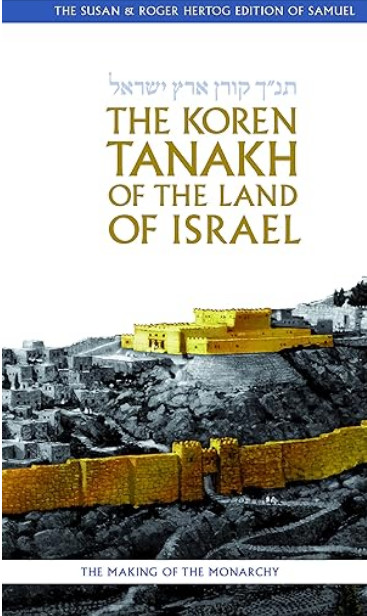
The apparatus built for the recovery is genuinely new, which is why the volume opens with an illustrated manual titled “How to read this book.”
A book plainly built for browsing
Each page sets the fully vocalized Hebrew, cantillation and all, beside a new English translation, rendered for this volume by Sara Daniel from Koren’s Magerman Tanakh, and rings the text with short signed articles keyed by discipline: archaeology, geography, language, the surrounding civilizations, Halacha. The introduction to the Philistines is written by the archaeologist who has led the excavation of their royal city of Gat for 25 years. The pages turn right to left. The editors say plainly that the book is built for browsing.
WHAT A single page delivers is best shown, not described. Take the spread on the aftermath of the David and Bathsheba affair. A son is born and named Solomon, and an article asks a question most of us never thought to ask: Who named him?
The written text of the verse says he did, presumably David. The reading tradition, the way the verse has always been pronounced aloud, says she did. Both of the great codices of the Hebrew Bible, Leningrad and Aleppo, preserve the double reading; the ancient Greek translation uses a verb that cannot decide; and beside the discussion sits a photograph of the Aleppo Codex itself, open on the page.
Inches away on the same spread, a second article follows Joab’s dispatch from the siege of Raba, reporting that he has captured the city’s water supply and the city is therefore finished, into the excavated water systems of Hatzor and Beersheba, shafts cut through bedrock so a besieged town could drink, and the boast of the Moabite king Mesha about the cisterns he built with Israelite prisoners of war.
One page. A newborn future king, a textual mystery a thousand years old, and the engineering that decided which cities in this land survived.
The volume keeps that standard, and it is worth naming what separates it from every other way of learning Samuel in English. The existing editions hand the reader a guide to the words: One anthologizes the classical commentators, another glosses the plain sense, a Hebrew series compresses the physical background into footnotes.
This volume is the first to put the evidence itself on the page, in scale and in color. The reader is not told the pass was treacherous but shown the crags, not told the codices disagree but shown the codex.
What this volume is not deserves saying plainly. It is not a commentary in the classic sense. Rashi, Radak, and Abarbanel are not running beneath the text, and a reader who wants the interpretive tradition should keep the mikraot gedolot, the traditional text ringed by its classical commentaries, open beside it. That is the use the editors intend.
Their introduction models the partnership, opening the question of the book’s authorship with the Talmud’s discussion in Bava Batra and closing it with Abarbanel’s own conclusion that a later prophet gathered and edited the book, before adding what no medieval commentator could have known.
The same candor governs the ground itself: The centerpiece essay on Jerusalem in David’s time lays out the sharpest dispute in biblical archaeology, between scholars who doubt the scale of David’s kingdom and those who defend it. It declines to announce a winner. In a genre that tends to promise certainty, the restraint is itself a mark of seriousness.
A growing range of biblical, religious books
The series now stands at six volumes plus a Haggadah, of a planned 18 meant to cover the entire Tanach, with a volume on the return from the Babylonian exile in preparation.
The object itself is heavy and handsome, printed on stock that lets the photographs, maps, and timelines carry real interpretive weight.
Whether you last read these stories as a child or never opened the book, the offer is the same. The narratives you were handed flat actually took place in three dimensions, most of them within a day’s drive of wherever you are reading this, and this is the book in which the Jewish people acquired a king, a conscience to check him, and a capital. It belongs on the shelf of anyone who has ever passed a brown road sign carrying a name out of the Tanach and wondered, for half a second, what actually happened there.
THE KOREN TANAKH OF THE LAND OF ISRAEL: SAMUEL
Translated by Sara Daniel
Edited by David Arnovitz
Koren Publishers Jerusalem
536 pages; $50