I turned 44 on a summer morning in the Galilee, standing in an alley so narrow I could touch both walls at once.
I had come back to this city before, on various occasions over the years, but this was my first time as a travel photojournalist. I arrived with a new kind of curiosity, ready to listen, explore, and seek. I came carrying the lens I had built over these past two years: an eye trained on the landscape’s opportunities for wellness and healing.
Something is fitting about doing this now, in the weeks preceding Rosh Hashanah, when the Jewish calendar is a reminder of a 500-year enigma of how does a person, or a people, start over again?
Safed does not let you forget that it has done this before. In the 16th century, after the expulsion from Spain, refugees climbed this same mountain carrying anguish that had nowhere else to go, and built the intellectual and spiritual capital of the Jewish world.
Rabbi Yosef Karo wrote the Shulhan Aruch here. Rabbi Yitzhak Luria, Ha’Ari, reshaped Jewish mysticism from a study house a few alleys away from where I stood on my birthday. Rabbi Shlomo Halevi Alkabetz composed the “Lecha Dodi” hymn here, sung to this day in synagogues worldwide as part of Friday night services.

What I found on this trip was a living industry of healing, conceived by people who deliberately chose this mountain, and who have spent decades turning old stone into a place where broken things get put back together.
I made The Way Inn my base for the weekend, and from its stone courtyards I set out to explore the rest of the city’s healing landscape: Livnot U’Lehibanot; the artists who came here and never left; and the kitchens keeping the Old City’s table warm.
I came to this story as a journalist and left it thinking hard about my own restlessness, and about why anyone carrying a hard year should put Safed on their list before the New Year begins.
The Way Inn: A sanctuary of 10 lights
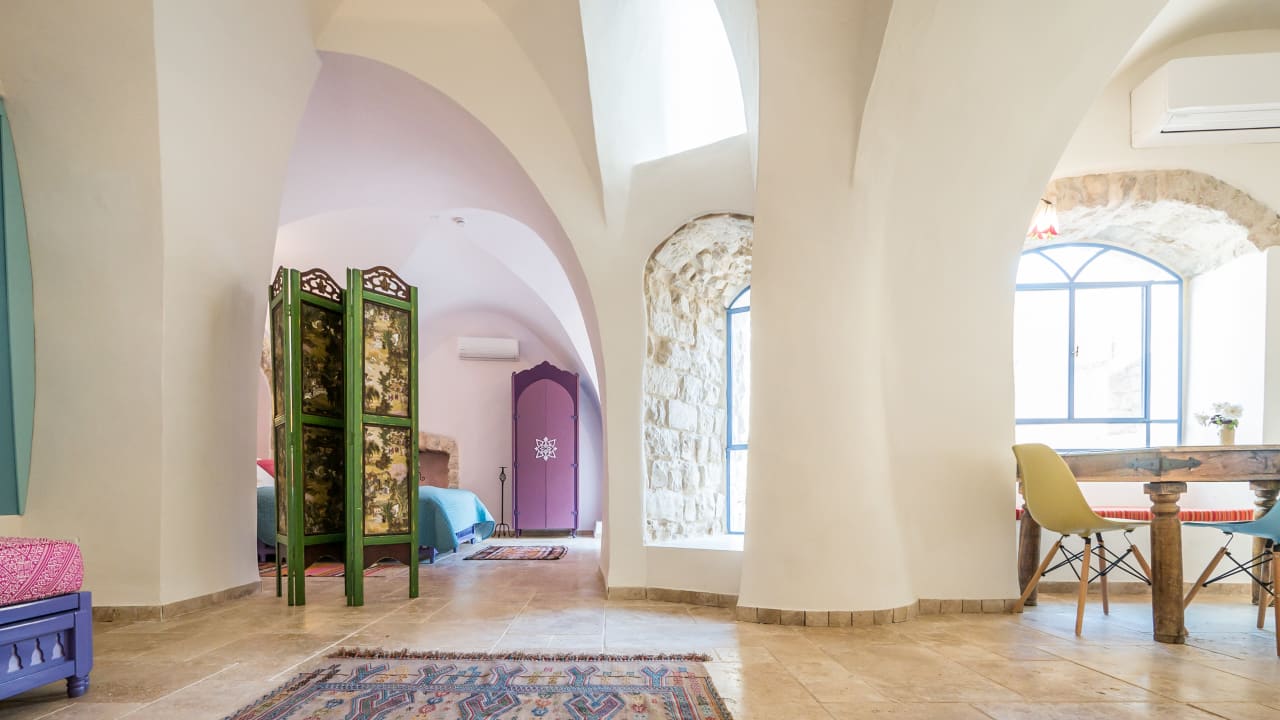
To understand The Way Inn, you must first experience its physical embrace. Stepping off the busy roads of Safed and walking down a quiet stone alleyway, you enter an exquisite, 10-room boutique inn, where beautiful suites are spread out over terraced stone courtyards.
The entire property is crafted with extraordinary attention to detail; everything, from the tiles to the furniture, is handmade by local artists.
On the rooftop, a panoramic view of Mount Meron stretches out before you, offering a front-row seat to the region’s legendary sunsets.
The rooftop is a space designed intentionally to feel like a sanctuary, an idyllic setting for intimate family events, small group gatherings, deep healing, and romantic getaways.
This sanctuary is the creation of Genine Gita Barel and her husband, Rony Barel. Genine, who made aliyah after working at the Israeli Consulate in New York, was on a spiritual journey in India when she met Rony, a professional chef.
Their shared path eventually led them to Safed in 1998, where they bought their first house, which Rony lovingly restored with his own hands.
They began hosting groups for gourmet meals in their home, prepared by chef Rony, and did that for 15 years, cultivating a reputation for exquisite food and warm hosting, before deciding to expand.
To bring their vision to a grander scale, they bought the neighboring properties, spending three years renovating four historic stone buildings into a single hotel structured around the 10 sefirot, the Kabbalistic emanations that map the flow of divine energy.
Each of the 10 rooms is dedicated to a specific sefirah and styled in its corresponding color and energetic character, ensuring that no two rooms feel alike.
The premier double suite, Tiferet (Balance and Beauty), is bathed in warm gold tones and features a private balcony overlooking the majestic mountains.
Netzah (Endurance) is dressed in calming blues, with a headboard hand-painted by a local Safed artist and a deep soaking tub.
Malchut (Kingship), the largest room, was once the Barel family’s own home and now comfortably accommodates families or groups of six to seven guests.
Keter (Crown), representing the highest spiritual level, is decorated with custom glass lamps made by local artist Sheva Chaya.
True to its ethos of mindfulness and healing, there are no televisions anywhere on the property. This deliberate choice is designed to pull guests out of what Genine calls the “autopilot” of modern life, replacing screens with a nightly, 45-minute natural light show as the sun sinks behind the Galilean hills.
Guests gather in the Womb Room, the hotel’s warm, enveloping lobby stocked around the clock with black coffee and herbal tea, which hosts workshops, live acoustic music, and the spontaneous, deep conversations that only happen when phones are put away.
A highlight of the property’s physical healing is its authentic Turkish hammam, and I can attest that this was the most memorable physical treatment I have had on any assignment.
Tucked behind an antique wooden door imported from Indonesia, the steam-filled hammam offers a deeply restorative experience.
The treatment begins with a traditional Kessa scrub on heated stone benches, an intensive, full-body exfoliation that gets the blood moving and lets tense muscles finally breathe.
What follows is a therapeutic swing between hot and cold water, which resets the pulse and dissolves the low-grade stress of modern life. I left feeling, quite literally, lighter than when I had walked in.
This capacity for deep healing extends far beyond individual vacationers. During the war, Genine and Rony turned the inn into a refuge, hosting a fully funded, free-of-charge retreat for bereaved women, mothers, widows, and sisters who lost loved ones in the fighting.
The hotel’s terraced, private courtyards allowed the women to relax in intimate, safe circles and share their grief, supported by sound-healing sessions and astrology readings led by Genine, who has practiced astrology for the past 20 years.
The hotel is built to hold up to 36 guests, providing a holistic infrastructure for larger groups and family events, but for Genine, intimate connection remains the goal. As she describes it, the space succeeded because “people were able to form small, intimate groups in a calm, relaxed way and to share with one another.”

To Build and Be Built: Livnot U’Lehibanot
If The Way Inn taught me what Safed’s healing looks like when it is built by love and patience, Livnot U’Lehibanot taught me what it looks like when it is built by hand.
Fifty-two years ago, a young American Jew named Aharon Botzer arrived in Safed and bought a crumbling ruin in the Old City. He married Miriam, and together they began welcoming strangers for Shabbat meals in their home.
That custom became the foundation of the organization Livnot U’Lehibanot, whose name translates as “to build and to be built.”
As one longtime member of the team put it to me, Aharon is still “stopping people in the alleyway and bringing them in for Shabbat meals. To this day, that is the foundation.”
The idea behind the organization is almost surprisingly simple, and that is exactly why it works: when a person spends the day doing physical labor with their own hands, something in them gets repaired at the same time.
Over the decades, the organization’s work has taken many shapes, from hosting meals on Shabbat to running long-term volunteer programs for young Jews from the Diaspora who experience Israel through rebuilding and community service.
What Livnot’s team eventually uncovered beneath its own building floor was almost unbelievable: an entire buried Jewish neighborhood dating to the city’s 16th-century golden age. Subsequently recognized as a National Heritage site, the team dug the tunnels that now let visitors walk through that hidden quarter.
Inside those excavated passages sits the part of the visit that stopped me cold: a 500-year-old heated mikveh, its waters warmed by an ancient oven built into the floor beneath it.
Local tradition holds that this may be the very mikveh where Ha’Ari himself once immersed, a story anchored to a historical letter from Ha’Ari’s mother to Rabbi Hayim Vital, asking him to watch over her son, who suffered from arthritis. This detail explains why a hot bath would have mattered so much to him.
Standing over that ancient floor, I understood something about this mountain: healing tourism has been its purpose for 500 years, long before anyone gave it that name.
Elsewhere in the tunnels, a sound-and-light installation walks visitors through the four elements of Kabbalah – fire, air, water and earth, closer in spirit to a wellness retreat than a museum tour.
One of its most striking features is a holographic presence that guides visitors through the underground chambers, a presentation designed in part by Aharon’s son Eliezer, who tragically died recently in an accident. Walking through this amazing exhibition, built into the earth his father once dug out by hand, I felt like I was standing near something still breathing.
Young adults coming to Livnot keep discovering that healing experience. Arriving through programs such as Birthright, Masa, and Hillel, Livnot’s volunteers combine hands-on rebuilding work with hiking, touring, music, Jewish learning, and a comprehensive Shabbat experience that staff members describe as one of the most powerful parts of a participant’s time in Israel.
Even meals carry something of the place’s history, with fresh bread baked in an on-site 16th-century oven. As mentioned in his book Jewish Pride, Livnot helped inspire Michael Steinhardt’s vision for Birthright nearly three decades ago, and today Livnot raises funds to continue bringing that experience to a new generation.
Since October 2023, when the Galilee itself became a front line, Livnot’s volunteers have gone out to physically rebuild shelled and evacuated communities such as Menara, Malkiya, Dafna, Avivim and Kiryat Shmona.
But their mission of restoration spans the entire country. Starting in December 2023, Livnot’s teams spent a year and a half on the Gaza border, establishing a continuous healing presence in hard-hit southern communities and kibbutzim.
In Nahal Oz alone, what began as raw, emotional volunteer work, clearing debris, painting, and restoring burned-down bedrooms, evolved into a highly professional reconstruction operation, bringing together teams of professional Israeli builders with volunteer cohorts from across the Diaspora.
Impressed by their efficiency and care, the kibbutzim began employing Livnot’s teams as official project managers and builders.
As one team member recalled, “At a certain point, they started taking us on as project managers, even really paying us... like contractors. Yes, at the lowest possible wage, and we even donated [our own resources], but still, they paid us.”
Ultimately, Livnot repaired about 30 damaged homes in Nahal Oz, before bringing its refined building expertise back to the northern front, where it recently completed the restoration of a home struck by an anti-tank missile in Avivim.
For founder Aharon, this crisis work is the natural extension of the philosophy he established 46 years ago.
“Our core principle is to let Jews be a part of physically building the Land of Israel,” Aharon explains. “It does something to you.... When you do physical labor with your hands, you build up yourself as well.”
The artists who turn sound into light
Safed’s spiritual economy runs on more than hospitality. It runs on artists who came here looking for something else and never left.
Avraham Loewenthal grew up in Michigan and studied art in Chicago. He came to Israel for a six-month artist-in-residence program in Arad, and as it was drawing to a close, he visited Safed for a single Shabbat. He fell in love with the city and never left, and it was here that he met his wife, who is from Baltimore. That Shabbat was 30 years ago.
In his Old City studio, Safed Gallery of Mystical Art, built into a two-level structure, Avraham has spent decades on a project that sounds like science fiction and turns out to be pure Kabbalah: he runs the four traditional shofar blasts – tekiah, shevarim, teruah, and tekiah gedola, representing the four letters of God’s name – through sound-mapping software, then converts the resulting frequency patterns into digital paintings on canvas.
His work leans heavily on triangles, which he explains through the Kabbalistic Tree of Life and its three pillars, right, left and center, standing in for three states of consciousness: joy and gratitude, brokenness and grief, and the integrated, whole heart that understands that both belong to the same person.
In one extraordinary piece, he painted 288 triangles representing the 288 sparks of divine light scattered at the moment of Creation, which every person is tasked with gathering and repairing. His work can be seen at www.kabbalahart.com.
A short walk away, in a stone home purchased in 1980 and restored by hand, David Friedman has lived and taught since 1979. Whereas Avraham works in sound and color, David works in breath and geometry.
He teaches visitors to hear the Hebrew letters alef, mem, and shin as elemental forces – air, water, and fire – and leads a simple breathing meditation built around the two letters that together form the word “shem,” one of God’s names: the exhale forms the sound of the shin, lips open, and the inhale forms the sound of the mem, lips closed.
Breathe the two together, David says, and a person is quite literally calling the divine presence into themselves with every breath. It is a small, physical practice I found myself repeating on the walk back to my room.
A few turns down the cobblestone labyrinth, this connection between breath and Creation reaches its physical limits at Sheva Chaya’s studio, Safed Glass.
Established in 2005 by American-born artist Sheva Chaya, the studio centers on a roaring 2,000-degree flame where solid glass liquefies into a glowing, honey-like substance.
For Sheva Chaya, the intense focus required to manipulate the molten glass is an active practice of mindfulness, but its true soul is the breath.
She points to a midrash comparing God’s creation of Adam, blowing the soul of life (nishmat hayim) into him, to a glassblower.
The breath traveling from deep within the lungs to shape the vessel serves as a stunning physical metaphor for the ongoing miracle of life.
At the core of her work is tikkun, the Kabbalistic repair of brokenness. Taking the fragile, shattered shards of glasses broken under wedding huppahs, Sheva Chaya melts them down in her flame to fuse them into a single, resilient mezuzah.
“When the fire is there,” Sheva smiles, “the brokenness itself becomes part of the beauty.”
This philosophy of finding light in the shards carried her through the Second Lebanon War in 2006, when she painted 20 vibrant canvases under fire to keep her thoughts anchored in goodness.
Today, as the current war silences Safed’s alleyways, she holds fast to that same resilient optimism, believing this difficult quiet is merely setting the stage for a new spiritual growth in the North.
We spent an afternoon with Hana Karo, a 30-year Safed resident who directs the organization Ruach Tsfat, “Spirit of Safed.”
Hana lays out a map of the four holy cities of the Land of Israel, matched to the four elements: Tiberias is water, Hebron is earth, Jerusalem is fire, and Safed, highest in the mountains, is spirit.
Local tradition holds that the air in Safed runs clearer than the air in Jerusalem, and that this clarity is part of what draws people here looking for revelation rather than money.
Hana told us something I haven’t forgotten: people who come to Safed rarely come to make money, and the ones who try usually leave disappointed. What they are looking for, she said, is some internal point that can finally develop from the inside – a retreat, a rest, a stillness, that lets a person shed the noise of work and traffic and finally touch the ground again.
Hana also explained the color that gives Safed’s alleys their signature look. The blue washed over doorframes and synagogue walls carries two explanations locals tell in the same breath:
One explanation ties it to the thread of techelet woven into a prayer shawl, white for purity and blue for holiness and heaven.
The other, older and more folkloric, holds that demons cannot rest in the sky, only on unclean ground, so when they look down and see a town painted the color of the sky, they assume there is nothing there to land on and keep flying.
A table set from the fire: The flavors of the Old City
No healing city runs on spirit alone, and Safed’s kitchens carry as much of its story as its synagogues do.
Our first stop was a small stand in the Old City alleys, across from the historic Beit HaKahal site. The stand, run by Ronen, is known simply as Ronen HaTeimani.
Dressed in traditional Yemenite clothing, Ronen prepares lehuh, a soft Yemenite flatbread, stuffed here with local Safed cheeses and topped with spicy s’hug he grinds in a stone mortar.
It is street food, and it anchors the city’s culinary story to its archaeology, a few steps from history that predates the dish by centuries.
For a fuller meal, Bashert, operating out of the Beit Mendis building, is the city’s hangout for meat lovers.
Kosher lemehadrin, the restaurant is led by chef Yoni Tuvul, was founded by Asher Roth, and its name, meaning a match ordained from above, hints at its pitch: a place where a slow-smoked brisket, cooked for 12 to 18 hours, tastes like something meant to happen. Its parve desserts round out a meal that feels both indulgent and kosher.
Bashert shares its building and kitchen roots with Beit Mendis, a full catering operation that can produce 50 to 1,500 portions across the North and runs a Thursday-and-Friday food fair, with more than 100 salads, 50 meat dishes, cholent and fish spread out for a city getting ready to rest.
And for a smaller, sweeter stop, we kept circling back to Bella and Jacqueline, a bakery tucked into the Old City’s Artists’ Quarter, turning out warm baked goods worth the detour, the kind of stop that rewards no plan beyond walking until the smell pulls you in.
What the mountain remembers
I keep returning, in my notes from this trip, to something Hana said almost in passing: Safed ripens the soul.
I did not fully understand that sentence until we were on our way home, replaying the hammam, the tunnels, the sunset from a hotel balcony named for a Kabbalistic emanation, and the quiet confidence of everyone I met that this particular mountain has been doing this work for 500 years and has no plans to stop.
I was born in this city, and it took me 44 years to come back and actually look at it. That gap gave me a birthday spent in a place built, quite literally, out of the belief that a person or a nation can be broken all the way down and still be built back up, stone by stone, breath by breath, guest by guest.
It is a good idea to carry into a new year, maybe the oldest idea Safed has.■
The writer was a guest of the hotel and restaurant.
Directory of featured businesses and local hosts
Way Inn Hotel – 052-688-1116
Livnot U’Lehibanot, Michael – 054-586-6293
Avraham Loewenthal, Safed Gallery of Mystical Art – 054-728-0612
David Friedman, Kosmic Kabbalah Art – 054-202-7832
Sheva Chaya, Safed Glass Studio – 058-730-1074
Ronen HaTeimani – 050-225-4148
Bashert, meat restaurant – 055-663-0246
Beit Mendi’s, catering for Shabbat – 050-360-9333
Bella and Jacqueline Bakery – 053-794-9304