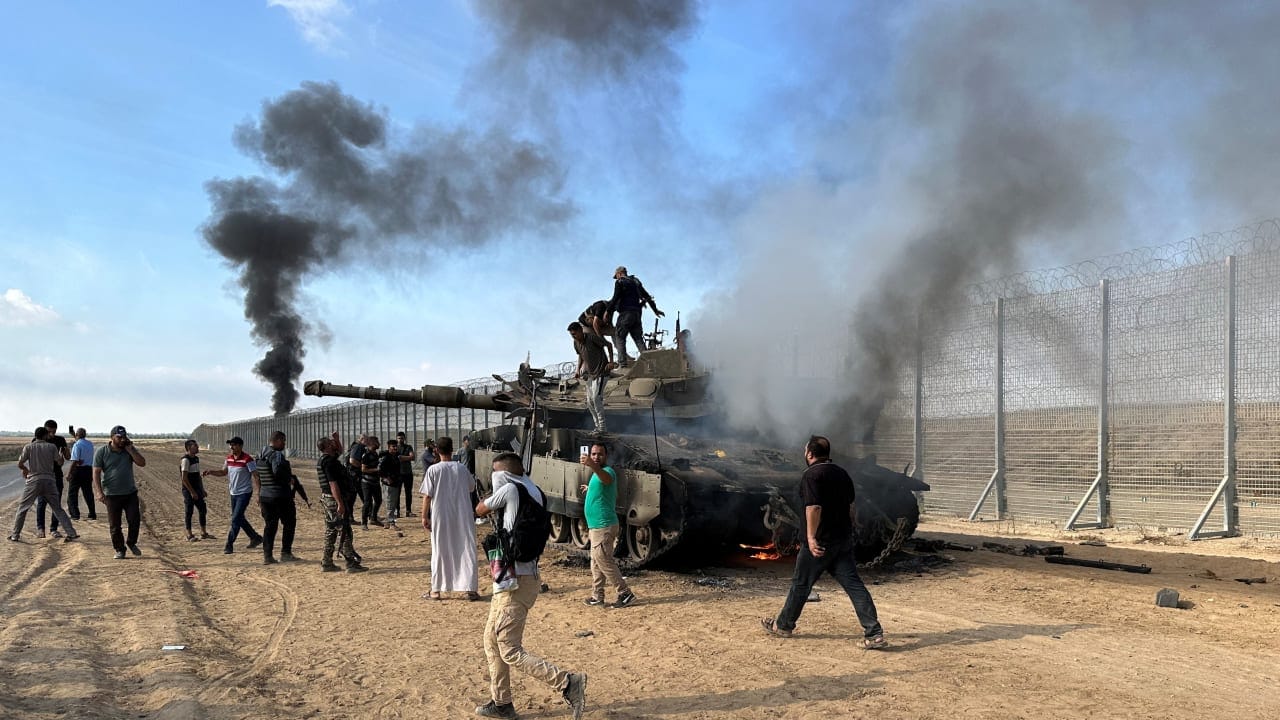
New secret Hamas internal documents have been provided by IDF intelligence to the Amit Terrorism and Intelligence Research Institute, which provided them exclusively to The Jerusalem Post on Thursday.
An analysis by the Amit Center includes six documents viewed by the Post, of which three are covered in this article, showing the progression of Hamas’s secret plans from 2022 to 2023 to systematically deceive Israel into complacency so as to surprise the IDF during the October 7 massacre.
Although much is already known by now about Hamas’s deception, these original documents have not previously been made public and reveal a variety of new pieces of the puzzle of Hamas’s strategy and tactics.
The first document is from September 13, 2022, and is titled Building a Strategic Deception Plan Which Will Be the Basis for a Surprise Attack by Hamas on Israel.
Section 5 of the document emphasized Hamas’s need “to formulate a multi-disciplinary strategic deception plan (diplomatic-military-economic-public relations) which will include advancing the exchange issue [ongoing negotiations at the time to return two living and two deceased Israeli citizens held hostage by Hamas even prior to 2023] with prime minister [Yair] Lapid [Lapid was prime minister from mid-2022 to December 2022].”

Hamas outlines strategy of normalizing border activity ahead of attack
It also highlighted Hamas operatives “building the military [border] positions at a normal pace and continuing drills in a routine manner until the opening of the pressure campaign, which will provide an appropriate excuse for reducing (open military activities).”
Section 6 said that Hamas would “act to summon the Nukhba Force fighters repeatedly and in different ways, and in a manner which would cause ‘the enemy’ [Israel] to lose the ability to identify the moment of the attack.”
According to Section 7, Hamas should put special effort into evaluating specific moments when its forces would be extra ready for an attack and when Israel and the IDF would have a reduced focus on defense.
In Section 8, Hamas recommended increasing the frequency of routine drills involving certain forces moving to and from the border in a way that could confuse the IDF.
It also suggested sending high-level commanders to the border more often and increasing the overall presence of Hamas terrorists there to make it even more difficult for the IDF to notice that anything unusual might happen.
The Amit Center then notes in its own analysis that top Hamas officials later proudly admitted that they had utilized a systematic deception plan to fool Israel and the IDF into a sense of complacency and to believe that the Gaza terror group was too deterred to mount any real threat.
According to the center, this deception plan included Hamas standing down during multiple rounds of conflict between Israel and Palestinian Islamic Jihad, even at the cost of looking weak in the Strip in the short term.

Hamas documents describe effort to mislead Israel into complacency
Top Hamas officials were totally willing to look weaker in the short term in order to fool Israel so that their larger “Big Project” surprise attack plan on Israel would later fully catch the Jewish state off guard.
In the intelligence center report, these officials are quoted as saying they “undertook unprecedented intelligence tactics to confuse Israel, including convincing Israelis that Hamas was afraid to go to war and just wanted to improve its economic situation.”
According to the report, Hamas continued to send deceptive and pro-negotiation messages to Israel even in the days leading up to October 7.
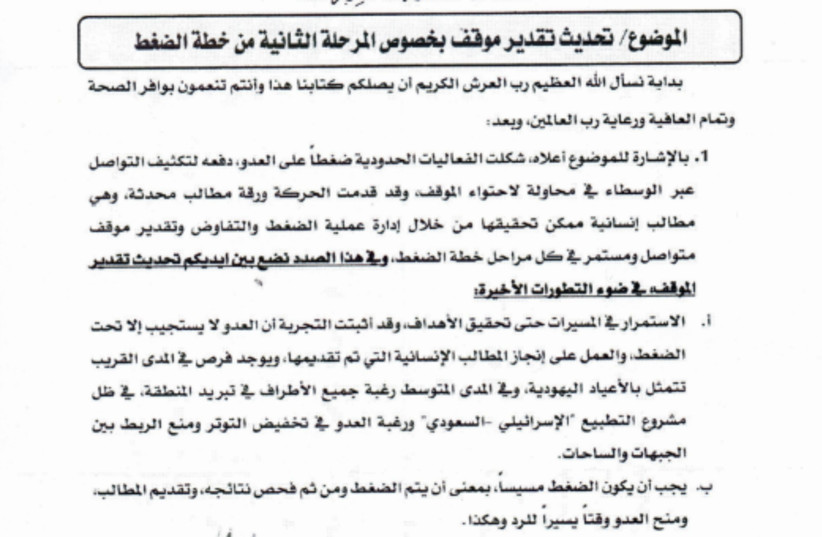
Next, a year later, there is a September 25, 2023, document, Document Five, entitled “Situational Update Regarding the Second Stage of Pressure” from Mohammed Odeh [who later became Hamas’s chief briefly in May 2026 before being assassinated] to Yahya Sinwar.
According to the document, “The additional pressure on ‘the enemy’ caused it to work more intensely with ‘middle-man negotiators’ [such as the Qataris] to calm the situation. ‘The Movement’ [Hamas] presented official updated conditions regarding humanitarian aid.”
Regarding strategy leading up to the invasion, which took place only two weeks later, the document emphasized the importance of continuing the marches until Hamas’s goals were achieved.

“Experience has shown that the enemy only responds to pressure. Jewish holidays represent opportunities in the short term,” and in the medium term, there is a desire to calm matters in order to facilitate normalization with the Saudis and to avoid any connection between the different fronts, said a Hamas analysis of the current situation.
Document details calibrated pressure and negotiation timeline
Next, the document said that pressure must be based on “political motivations and goals, including pressure, clear presentation of demands, and giving the enemy a reasonable time to respond.”
Further, the document stated, “Our humanitarian goals are limited, and we can achieve them through patience and continuous pressure so that the amount of pressure and effort is attuned to the scope of the achievements.”
In addition, the document said that the pressure should continue on September 24 but should be reduced on September 25-27.
“This brief amount of time will allow the enemy time to respond, time to speak to the negotiators, and time to move more personnel and resources toward the border in order to inflame it more [on September 28-29.]”
Moreover, the document said that “the Movement should ensure that other armed groups do not overheat conflict on the border, which could be used to undermine Hamas’s control of the national narrative [and by extension the future of the Big Project].”
The document then issues a list of specific recommendations, such as: “It is critical to push into the public sphere the slogans which will ignite the situation, such as al-Aqsa, security prisoners, enemy aggressiveness against West Bank Palestinians, removing the Gaza sea blockade, the right to work, the right to travel, and the right to medical care without being extorted at the Erez Crossing.”
“These must be inculcated with determination into the national Palestinian consciousness,” added the document.
Next, it recommended that all military forces be kept up-to-date and ready to act and that there be comprehensive efforts with Qatar, Turkey, Algeria, and Kuwait to keep pressure on Israel to improve the humanitarian and unemployment situation.
Curiously, Hamas recommended that a civilian delegation be sent to visit parliaments around the world to rally support for ending the sea blockade of Gaza and to encourage weekly and monthly protests outside American embassies worldwide for the same goal.
Hamas seeks to broaden conflict by linking regional territorial claims
Another strategy of Hamas was to press for tying the Palestinian cause to the cause of restoring territory from Israel to Syria, Lebanon, and Jordan.
Document Six from October 2, 2023, only five days before the invasion, is a “List of Those in Attendance from a Transcript of the Political Bureau of Hamas,” – which was the last major meeting of the specific high committee.
Of the 22 committee members, the transcript noted that seven members were not present, including Khalil al-Hayya, Bassam Naim, and Kamal Abu Oun, with the reason for their absence labeled as “travel.”
Hayya, who was Yahya Sinwar’s top aide at the time, would fly to Qatar and serve as the main negotiator for Hamas over hostages and ceasefires over the course of the war.
He remains one of Hamas’s top officials, although so many have been killed by the IDF that there is currently some ambiguity about exactly who has which authorities.
Since Odeh was killed, Hamas has not announced a new military leader.
The Amit Center is unique because it is run by former top officials from IDF intelligence, the Mossad, and the Shin Bet (Israel Security Agency), in addition to talented outside researchers, and has had special access to Hamas documents seized by IDF intelligence, on top of its high-level open-source research.
Its current head is Col. (res.) Shlomo Mofaz.