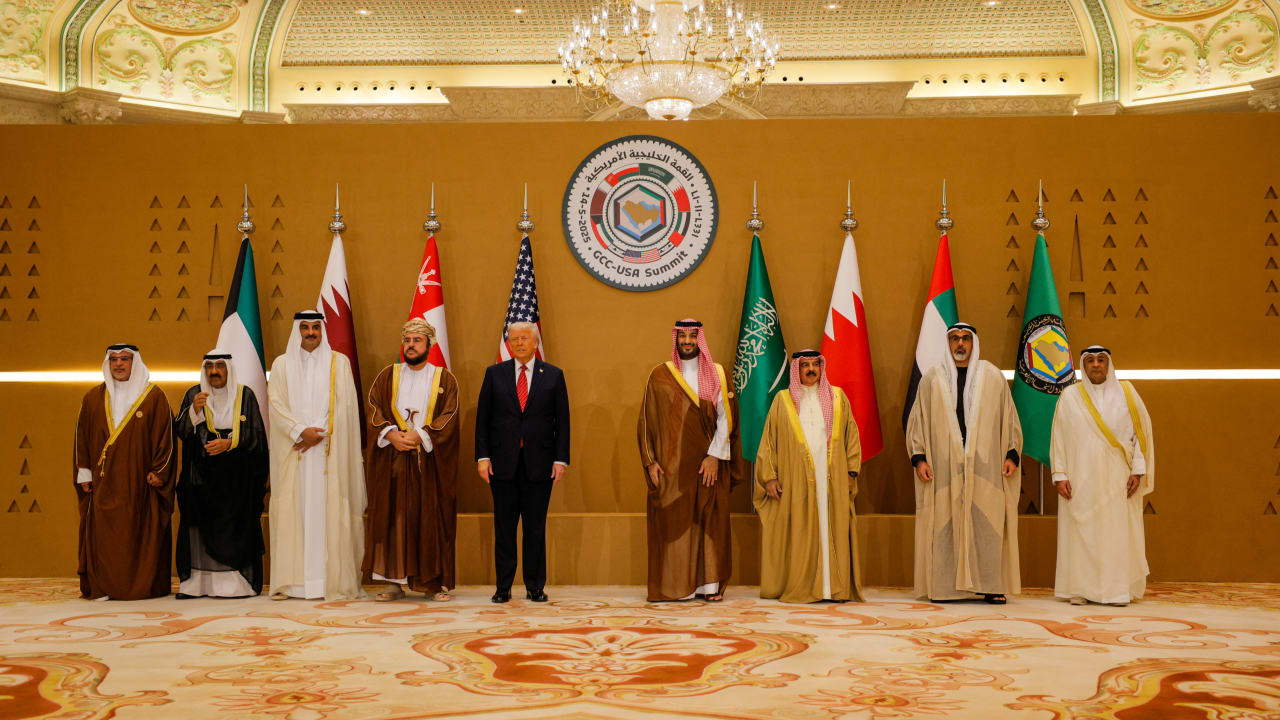
Last week, the Secretary-General of the Gulf Cooperation Council (GCC), Jassim Mohammed Al-Badawi, went to Iraq.
According to Shafaq News in Iraq, he was there to try to get Baghdad to rein in Iranian-backed militias. “Al-Badawi will be in Baghdad to stop attacks targeting the Gulf from Iraq.”
However, it is unclear whether he was able to accomplish his mission.
“A government source reported on Monday that the Secretary-General of the Gulf Cooperation Council will arrive in Baghdad tomorrow to discuss developments in the region and to emphasize that Iraqi territory will not be used to launch attacks on Gulf states,” the Iraqi media said.
The source told Shafaq News Agency that “the Secretary-General of the Gulf Cooperation Council, Jassim Mohammed Al-Badawi, will arrive in the Iraqi capital, Baghdad, on Tuesday afternoon for an official visit.”

Iraq’s Prime Minister Ali al-Zaidi is trying to get militias to hand over their arms; however, Iran is going to be doing a show of influence in Iraq this week in the wake of the funeral of the late supreme leader Ayatollah Ali Khamenei.
Can the Gulf get the Iraqis to listen to their needs?
A source told Shafaq News that “Al-Badiwi will hold meetings with Iraqi officials to discuss the latest developments in the region and to announce the Gulf states’ support for Iraq in various fields,” adding that “the talks will include stressing the need to keep Iraq away from the battlefield and to prevent the use of Iraqi territory to launch any attack on the Gulf states, as happened in the past.”
What we know from official sources in Iraqi state media is that “the President of the Supreme Judicial Council (SJC), Judge Faiq Zidan, discussed on Wednesday with the Secretary-General of the Gulf Cooperation Council (GCC), Jassim Mohammed Al-Badawi, cooperation in judicial fields.”
The report said that the Iraqi News Agency was told: “The President of SJC, Judge Faiq Zidan, received the Secretary-General of GCC, Jassim Mohammed Al-Badawi, and his accompanying delegation.”
Only a general report was issued, stating that “the two sides discussed ways to enhance cooperation between Iraq and the Gulf Cooperation Council (GCC) countries in the judicial and legal fields.” The report in Baghdad said, “the meeting was attended by the Ambassador of the Republic of Iraq to the Kingdom of Saudi Arabia, Safia al-Suhail.”
Iran-backed militias an increasing threat
Iranian-backed militias in Iraq have increasingly become a regional threat, using Iraqi territory as a launchpad for drones and missiles aimed at Gulf states. Recent attacks on Saudi Arabia, the United Arab Emirates, and Kuwait are the problem.
These militias, many of them linked to the Popular Mobilization Forces, have long targeted US forces and the Kurdistan Region. The more recent expansion of attacks toward the Gulf shows a broader Iranian strategy. It shows how Iran made Iraq a front line. Now Iraq is at the center of efforts to rein in the militias. This will be increasingly important after the funeral of the supreme leader in Iran.
The pattern is clear. When Iran faces pressure, it activates multiple fronts. Iraq becomes one of the key arenas because militias there can threaten Saudi Arabia, Kuwait, and the UAE while also pressuring Baghdad and Erbil. The drone threat is especially important because it is cheap, difficult to trace, and can target energy sites, airports, and critical infrastructure.
The mission of the GCC is to use talks to achieve results. The GCC wants quiet in the region and reduced tensions with Iran. It’s unclear if it can achieve it without also having a stick to its numerous carrot-like approaches.