
Syria’s Interior Ministry on Thursday said it intercepted an arms shipment that was likely destined for Hezbollah.
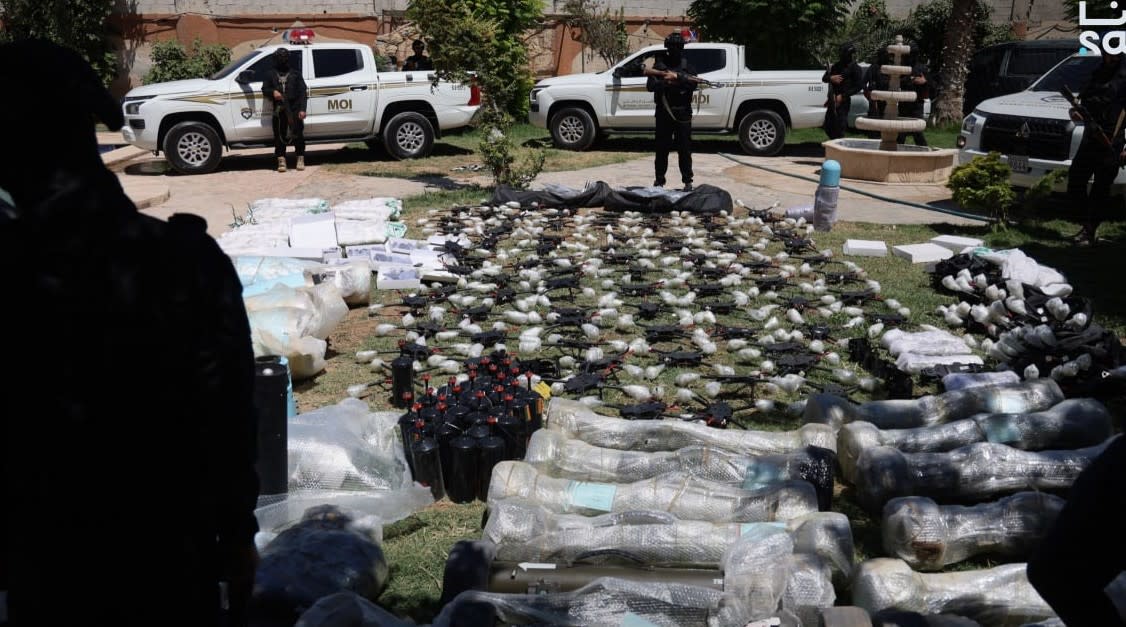
“Specialized security units carried out the operation after detecting a suspicious vehicle parked near the border,” Syrian Arab News Agency (SANA), Syria’s official news agency, reported Thursday. “A search uncovered a cache of weapons that included long-range missiles, guided anti-tank missiles, and drones.”
“The shipment was intended to cross through Syrian territory toward Lebanon for the benefit of the terrorist Hezbollah militia, while investigations are continuing to uncover all the circumstances of the case, identify all those involved, and the networks associated with it,” the Interior Ministry said.
The arms were found in a tanker truck that was seeking to cross the border from Iraq into Syria. It was stopped “before it could be brought into Syrian territory,” North Press Agency, a Syrian news agency, reported.
The truck was in the border-crossing area. A search of the truck revealed a large shipment of weapons, including “long-range missiles, anti-tank guided missiles, and drones,” the report said.
Shipment signals Hezbollah attempt to build up forces, prepare for war
The Syrian authorities released photos of some of the weapons found during the search.
Among the items visible in the photos were “at least 100 UAVs (drones), optical fiber spools, RPG warheads that appear to have been factory-prepared for mounting on UAVs, equipped with dedicated electrical release mechanisms and mounting bolts, rather than improvised adaptations as seen in the past, anti-tank guided missiles (ATGMs) and, most likely, Paveh-family cruise missiles,” the Alma Research and Education Center, which focuses on threats to northern Israel, reported.
“This shipment is consistent with Hezbollah’s current force build-up priorities, particularly the strengthening of Unit 127 (the aerial unit), alongside the Radwan Force and its weapons production, logistics, and supply networks,” it said.
The truck was crossing the Tanf border crossing, which is on the Syria-Iraq border near the Jordanian border. Tanf is also the name of an agricultural station and an outpost garrison that was once used by the US military from 2016-2025.
The US military backed a Syrian rebel group called the Syrian Free Army at the post. The Syrian rebel group was integrated into the new Syrian Security Forces after the fall of the Assad regime.
The US left the Tanf Garrison in February 2026, and the area has been administered by Syria’s new transitional government.
The Tanf border crossing has been used by truckers from Iraq transporting oil to the Port of Baniyas. This has increased since the Iranians began a blockade of the Strait of Hormuz. It is one of the ways that Iraq seeks to move oil for export via Syria.
Iraq provides Syria with oil, smugglers utilize tankers
The other major Iraq-Syria border crossing is at Al-Bukamal in Syria on the Euphrates River.
“A large shipment of weapons, missiles and drones was seized, which was tightly hidden inside one of the oil tankers heading to the city of Baniyas,” the Syrian General Authority for Ports and Customs reported.
After the seizure, the “shipment was handed over to the competent authorities to complete the investigations, follow up on the case, and take the necessary legal measures against those involved,” it said.
The interception of the Hezbollah shipment comes as Syria is stepping up efforts to fight terrorism and drug smuggling. Syrian officials indicated that they are increasing a “nationwide strategy against drug trafficking and addiction,” SANA reported Thursday.
In a meeting chaired by Presidential Secretary-General Abdul Rahman al-Ama, Syrian officials “brought together the ministers of interior, health, religious endowments (Awqaf), and culture, along with representatives from other ministries and government agencies,” the report said.
Syria previously said it had foiled Hezbollah plots this April and May, and that it busted several Hezbollah cells over the past year.