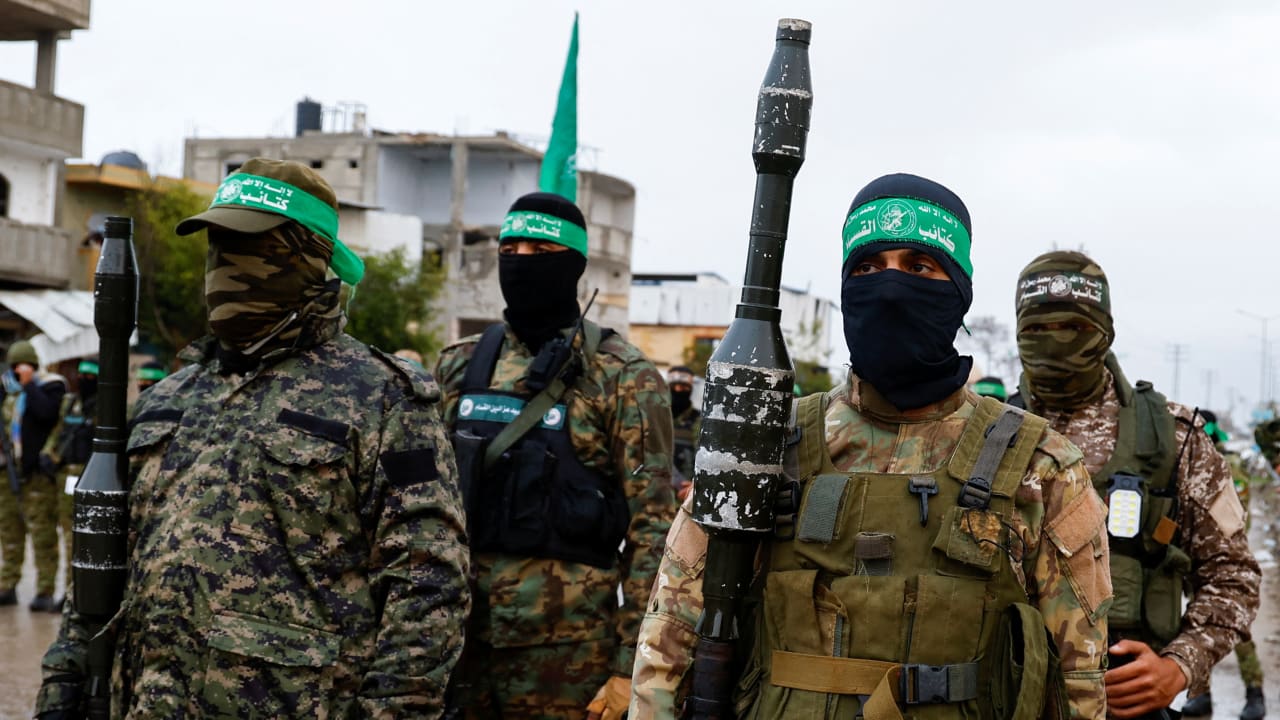
The activity of Gazan militias opposed to Hamas, which took place Tuesday morning deep inside the Gaza Strip, demonstrates not only the area’s volatility but also the deep concern among Hamas’s leadership.
Arab media had initially reported that an Israeli force entered the Gaza Strip to carry out a covert operation against a senior Hamas figure.
After the operation was exposed, a firefight broke out at very close range between the two groups. Members of a Gazan militia led the fighting against the senior official’s guards. The volatile situation forced the IDF to help extract the force, providing cover with ground and aerial strikes, with smoke plumes visible from long distances.
Now that the operation was confirmed to have been carried out by the Gazan militias, it should be noted that former Shin Bet chief Ronen Bar was the one who pushed for supporting the anti-Hamas militias in the Strip, despite criticism from within and outside of the defense establishment.
The operation ended with the arrest of a senior Hamas figure, which could shed light on the organization’s covert activities and its methods of operation in the Gaza Strip.

At the same time, reports indicate that over the past year, members of various militias have carried out operations that directly damaged Hamas’s military capabilities in the Gaza Strip.
Palestinian militias are Hamas’s enemy from within
In recent months, Hamas’s security apparatuses have operated on several fronts in an attempt to confront the militias opposing the organization. The most prominent effort has been the pursuit of collaborators with Israel, informants, and Hamas critics.
Some were warned, while others were taken to interrogation rooms or severely beaten, at times in public, in an attempt to create deterrence and instill fear. Others were killed under "mysterious circumstances."
At the same time, Hamas expanded its intelligence collection and surveillance systems targeting IDF forces along the Yellow Line. As part of these efforts, the organization has carried out operations designed to study the activity patterns of IDF units, identify unusual activity in the area, and detect attempts to breach the new border line between the sides.
Another element involves deliberate friction operations with IDF soldiers along the Yellow Line. Hamas terrorists, some of them children, are sent to the area in exchange for symbolic payments. The goal of these encounters is not only to study the IDF’s response patterns and identify vulnerabilities, but also to place additional pressure on the forces’ operational activities.
Reflecting on IDF's 2018 Operation Tropical Fruit
The events on Tuesday morning raise new questions regarding the IDF's 2018 Operation Tropical Fruit in Khan Yunis. In 2018, an IDF special forces unit operating in the city was exposed by Hamas, leading to an exchange of fire and a complex extraction operation.
During the incident, Lt. Col. Mahmoud Kheir El-Din, a senior officer in the IDF's Intelligence Directorate's Special Operations Division, was killed.
Following Tropical Fruit, Hamas conducted an extensive investigation, strengthened its surveillance and intelligence collection systems along the border with Israel, and tightened security checks at various crossings in order to prevent further infiltrations by undercover Israeli forces into the Gaza Strip.
Security officials described the exposure of the operation’s objective and the technological equipment left behind as "significant damage."
At this stage, it is too early to determine the consequences of Tuesday morning’s operation, both in security and diplomatic terms. The incident comes as the US seeks to ease tensions and advance the reconstruction of parts of the Gaza Strip, without Hamas disarming or losing control over the territory.