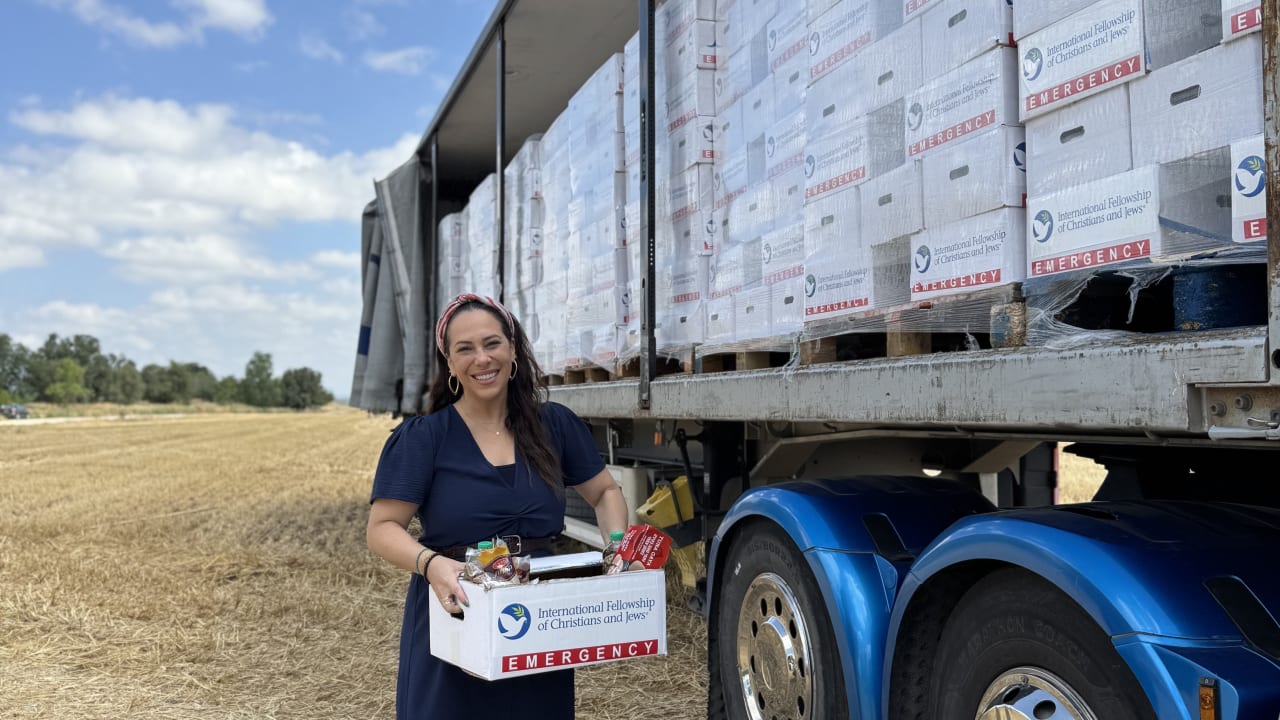
“We don’t sit in boardrooms waiting to make decisions,” says Yael Eckstein, President and Global CEO of the International Fellowship of Christians and Jews (IFCJ). “We’re boots on the ground. We can approve things in a second and identify new opportunities just as quickly. By opportunities, I mean ways to help more people.”
Helping people is the watchword of the IFCJ. Since the organization’s founding in 1983 by her late father, Rabbi Yechiel Eckstein, z”l, The Fellowship has been a leader in Jewish-Christian relations, building bridges of goodwill that have led to greater understanding and cooperation between members of these faiths.
With Rosh Hashanah approaching, Eckstein highlights the IFCJ’s operations in the past year and discusses her plans for the coming one. “The International Fellowship of Christians and Jews, as it says in our name, stands for these values of saving lives, preserving lives, helping people who need us, both in the Jewish community and the Christian community,” she says. To that end, this year, The Fellowship, in partnership with the IDF, provided humanitarian aid to persecuted Christian and Druze communities in Syria, bringing 1,500 food boxes to families living in extreme poverty, and providing medical supplies for villagers. The Fellowship airlifted supplies to the village of Suwayda, located in southern Syria near the Jordanian border, where more than 1,700 people had been killed by Syrian security and military forces. Moreover, The Fellowship decommissioned five Magen David Adom (MDA) ambulances, established two regional medical clinics in villages located in the buffer zone, and delivered shipments of life-saving medical equipment and medications to hospitals in the As-Suwayda region.
Eckstein points out that people must recognize that Israel stands for peace, for helping people in need, and that it stands with persecuted Christians the same way Christians around the world have stood with Israel.
The primary focus of IFCJ’s activities is, of course, in Israel, and Eckstein reports that The Fellowship has identified the need to provide increased assistance to hospitals throughout the country. “As technology advances, as budgets are under more pressure because of the war, with so much money going to security, hospitals are getting less funding, while the needs are getting higher. The Fellowship realized that we wanted to help hospitals in many ways directly connected to the security situation.”

In July, IFCJ donated $1 million to modernize the trauma and emergency medicine department at Nazareth Hospital, which treats approximately 100,000 patients each year. “In Israel, we don't decide who's receiving aid by religion or religious affiliation or even location.” Says Eckstein. “We go according to need.”
Previously, she explains, the trauma and emergency medicine department at Nazareth would first diagnose patients, and only then transport them to specific sections of the hospital for treatment, which often took time and ended in death. “The center there has now been upgraded,” she reports, “so that patients can receive all of their treatment in the trauma center. They can even perform surgery in the emergency room trauma center. You have all the X-rays, all the CTs, all the heart monitors; everything you could need is there. In one place, you get the diagnosis immediately, instead of taking time that costs lives.” In February of this year, the IFCJ upgraded the Fortified Trauma Center at Shaare Zedek Medical Center with the same capabilities.
Discussing the significance of the improvements that The Fellowship sponsored at the Nazareth Hospital EMMS, Eckstein says, “It’s amazing to see the people of Nazareth who have been living here for generations and how much they believe in bridge building, and how they believe in helping anyone who comes through their doors. These are Christian Israeli doctors and workers who were going with full emotion through all the victims of terror that they treated – when a missile struck a house, and they treated those inside. They felt connected from the first second until today, as if they were treating their own children. Many times hospitals in the periphery are neglected and have lower budgets. But in a way, they are even more important because there are fewer hospitals in the periphery than in the center, and they need to be upgraded to save lives.
“To be able to go to Nazareth, a town that is so special and holy to Christians around the world, and to come as a Jewish woman and sit side by side with a Christian man is deeply meaningful to me. My family has lived in Jerusalem for eleven generations, and his family has lived in Nazareth for generations. Coming together to save lives, to stand with the Christian community, and to tell them we are here for them is truly beautiful and powerful. I believe this is how we pave the way for peace – by bringing people together and building bridges between communities, rather than waiting for someone else to make it happen. We, the people, can make it happen.”
Another crucial improvement funded by The Fellowship was directed to Schneider Children’s Hospital in Petah Tikvah, where the center sponsored the creation of a fortified pediatric dialysis unit that ensures that kidney patients can receive necessary treatment, even during rocket and missile attacks. “I was there and saw the incredible reality of children getting dialysis during the attacks and not needing to move and being protected,” says Eckstein.
One of the most innovative medical projects that The Fellowship has sponsored is the Back to Life Center at Sheba Medical Center at Tel HaShomer. The Center, the first facility of its kind in Israel, is dedicated to the rehabilitation, treatment, and long-term support of freed hostages, their families, and the families of those murdered in captivity, in the wake of the events of October 7.
The former hostages and their families, Eckstein explains, have unique needs that can only be provided by a medical center designed for them. “We’re going to do everything we can to make sure that they, their families, their loved ones can heal in the best way possible.”
The Fellowship’s support of the Center, says Eckstein, is a “big hug from Christians and Jews around the world telling them we didn't forget you and we’re going to continue to stand with you. When they were in captivity, The Fellowship was supporting their families. Every single holiday, we gave them grants and cards and stood with them for whatever they needed. When bodies were returned, we helped with setting up food at Shiva houses. Through every stage, we wanted these people to know that we stand with them and that Christians around the world stand with them, and we aren't going to back out now.”
Eckstein says that The Fellowship’s funding of the Center epitomizes its ability to adapt quickly to new realities. “The string that ties all this together is that we go where there's a need. Four years ago, there was no line in our work plan or budget to have a center for hostages.”
The Fellowship has also made a significant impact by supporting eight trauma and resilience centers in the south and one in the north. The project began over a decade ago in the Gaza Envelope, says Eckstein. “There are very unique needs for this population suffering from PTSD who are still living under the threat of terror, still running from the rockets, and still facing the threat of intrusion.”
The Israeli government has set aside funding for these resilience centers, she shares. But, she continues, there are not enough therapists to serve the population, and physically, there is not enough space to treat them. To provide immediate assistance, The Fellowship began constructing yurts, portable, round tents made of a wooden frame covered with felt or animal skins, where sessions are held.
Turning her attention to the Diaspora, Eckstein discusses the rise in antisemitism in recent years, citing one study that says that 46% of adults globally hold antisemitic attitudes. She points out how The Fellowship is uniquely suited to fight this phenomenon. “After October 7, when we saw the rise of antisemitism, we realized that we have a unique angle and a unique understanding of the Christian community. This partnership is based on something spiritual. It's not based on anything besides a deep spiritual belief that this is right. We believe that we have to fight this with spiritual unity, information, engagement, and mobilization. And so we've been working with Christians to educate other Christians.”
In October 2024, a year after anti-Israel riots and protests broke out in the US, The Fellowship initiated the “Flags of Fellowship” project. More than two hundred and twenty churches, seminaries, and synagogues throughout the United States planted 1,200 mini Israeli flags in their front yards, in commemoration of the tragic events of October 7. Many churches, she explains, installed the flags as part of a special ceremony conducted by their youth groups. “It’s very ceremonial as far as passing this message and this partnership on to the next generation,” says Eckstein, who adds that the flag program presents a powerful message both for the Jewish community and the general community at large. “At a time when global antisemitism continues to rise at unprecedented levels, Flags of Fellowship gives people a meaningful way to say: ‘The Jewish people are not alone."
This year, more than 2,500 churches, synagogues, universities, and organizations are participating in the project. The program is expanding to Latin America, South Africa, the UK, India, and more, as a visible show of Christian and Jewish solidarity with Israel, to plant 3 million Israeli flags globally. “These deep relationships and bonds have been formed through this very grassroots movement of planting an Israeli flag and letting the world know, including the Jewish community, that we’re not alone, “ says Eckstein.
Eckstein then shifts the discussion from antisemitism to aliyah. “Aliyah was the first project that The Fellowship had when my father started the organization 43 years ago,” she notes. “Nobody could have ever believed or anticipated that we'd be bringing home lost tribes from India and from Ethiopia and during an intense war, bringing Jews home from the former Soviet Union, when once again we have Jewish refugees and internally displaced people. Unfortunately, we have had to expand the list of countries that we help Jewish people come home from based on threats.”
This year, nearly 600 members of the Bnei Menashe community from India, descendants of one of the Lost Tribes of Israel, arrived in Israel through a major initiative supported by The Fellowship. By the end of 2026, the community is expected to number 1,200, with the rest of the community expected to follow by 2030. The Fellowship is also expanding its aliyah efforts to include South Africa, where many families are facing uncertainty and increasing antisemitism.
Before Rosh Hashanah, The Fellowship has been distributing over $10 million in aid to all the different target markets or populations that they serve – the elderly, the poor, victims of terror, and miluim families who have lost their businesses. “We distribute clothing and food, in the most dignified manner,” says Eckstein, “through digital cards, which enable them to go shopping and choose what they want.”
As our conversation concludes, Eckstein points out that despite the alarming rise in antisemitism around the world, the Jewish people have many friends. “I would encourage everyone to remember that we have hundreds of millions of Christians around the world who stand with Israel and the Jewish people. Instead of trying to change the minds of those who hate us, I want to encourage Jews around the world to invest in the friends we have, nurture those relationships, and continue building bridges. We need to keep standing together and doing what The Fellowship does best – bringing Jews and Christians together to save lives. I believe that if we focus on the good, grow the light, and strengthen this sense of brotherhood, that is what we will see in our future. And I believe that future will be good.”
This article was written in cooperation with the International Fellowship of Christians and Jews.