
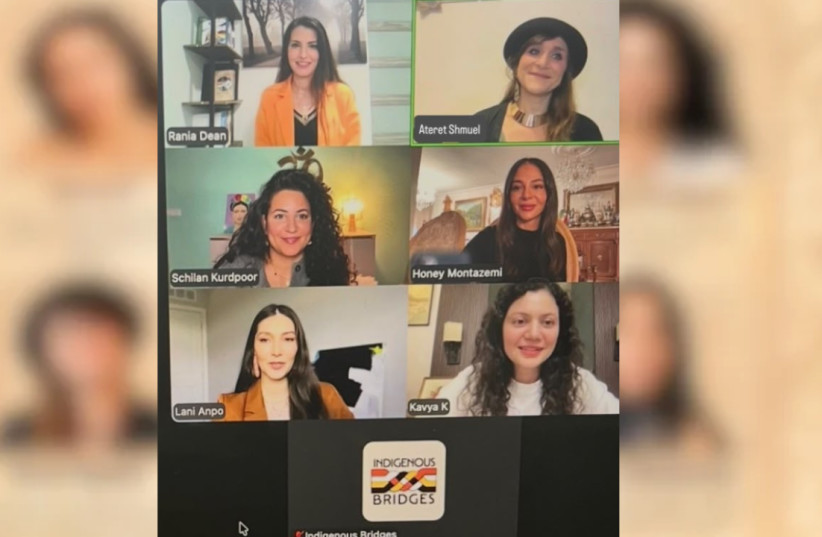
The same radical Islamist forces behind the October 7 attacks, in which more than 1,200 people were killed, are also responsible for attacks on the Druze in Syria and the mass murder and oppression of Iranians and Hindus in India and Kashmir, according to six women from Indigenous communities. They spoke at the panel, Asia & the Middle East: Conversations Across Communities, hosted by Indigenous Bridges on Monday night.
Hindu activist and regional analyst Kavya K, known online as “Kavya Speaks”; Israeli Druze activist Rania Dean; Kurdish speaker and educator Schilan Kurdpoor; Iranian human rights activist Honey Montzemi; and Native American and Jewish Indigenous rights activist Lani Anpo shared their experiences of oppression and silencing by Islamist forces with Ateret Shmuel, the Jewish director of Indigenous Bridges.
Despite hailing from different countries, including Iran, the United States, Israel, and India, the women said they shared experiences of gender-based violence, genocide, forced assimilation, silencing, and intimidation.
Each said she had been accused of Islamophobia and subjected to death threats or doxxing for speaking about her community’s experiences.
They also emphasized the need to build alliances among Indigenous communities to overcome their minority status and more effectively confront what they described as the oppressive forces of political Islam.
Both Kurdpoor and Kavya said radical Islamist forces often target women first because attacks on women also threaten families and the transmission of cultural traditions between generations.
Kavya argued that the targeting of women had led Hindu communities to adopt new gender-based restrictions, keeping women out of public life for their own protection. She contrasted these restrictions with what she described as the historically prominent role of women in Hindu communities.
As an example of women’s power and status in Hindu religious tradition, she cited the Hindu goddess Kali, who defeated the demon Mahishasura when the male gods could not.
Shmuel noted how it was the Kurds who were able to weaponize the misogynistic beliefs of Islamic State against the group. The ISIS fighters believed that being killed by a female combatant would prevent them from entering paradise and receiving the rewards promised to martyrs, including the 72 virgins described in popular accounts of the group’s ideology.
Aware of this, Kurdish fighters in Rojava established the Women’s Protection Units (YPJ), an all-female Kurdish military force operating in northern Syria. Kurdpoor recounted how the women used battle cries to signal their presence, sometimes prompting ISIS fighters to flee. She also described the role of women in the broader Kurdish-led military effort and their acceptance within the Syrian Democratic Forces (SDF).
Kurdpoor discussed the role of ethnic cleansing and the restrictions on indigenous languages. She argued that restricting a community’s language creates a disconnect between individuals and their cultural heritage, citing restrictions in Turkey and limits on Kurdish-language education in Iran. She also highlighted the continuing struggle to learn and preserve the language in Syria, describing it as central to the Kurdish community’s cultural survival.
Dean said that the Druze had historically spoken Aramaic before adopting Arabic, which she described as part of a broader effort to blend in with the surrounding occupying Arab population and protect Druze communities. She noted that the community’s historical efforts to assimilate had failed to ensure its safety, pointing to the July 2025 massacres in Sweida, continued attacks on Druze communities, and the ongoing siege of villages in southern Syria as evidence that conformity had not provided protection.
Dean also welcomed the growing use of Bashan, the biblical name for Sweida and the surrounding area, as it signaled that her community was moving away from what she described as failed attempts to secure peace with its occupiers through assimilation into their society. She condemned the labeling of Druze calling for freedom and self-determination as “separatists,” a term several speakers said had been used to discredit or suppress calls for freedom by Indigenous communities in the region.
Beyond their shared experiences of oppression and Islamist colonial occupation, the speakers also expressed concern about what they saw as a growing trend of Western women supporting regimes that would strip them of the rights and freedoms they currently enjoy.
Secular leftists paved way for Iran’s 1979 Islamic Revolution
Montazemi noted that secular leftists had helped pave the way for Iran’s 1979 Islamic Revolution, only to pay for it with their lives in the years that followed. She expressed concern at seeing women on social media proudly displaying the Islamic Republic’s symbols while wearing tank tops, clothing that would result in their arrest in Iran.
She pointed to Western women who had traveled to Syria to marry ISIS members, arguing that they had surrendered their rights in the process. Montazemi said more needed to be done to understand the appeal these groups held for women.
Explaining the importance of the event to The Jerusalem Post, Shmuel said, “Indigenous nations across Asia, the Middle East, and Africa face the same violent colonialism, yet our stories are routinely spun for Western audiences to portray Islamists as the victims and Indigenous communities as the cause of the conflict. We see this in Western reporting on attacks against Druze, Hindu, Kurdish, Persian, Jewish, Yezidi, Bahá’í, and other Indigenous communities.
Also, there is a sinister reason for this narrative: to manipulate the Western public into sympathizing with Islamist jihadi groups, paving the way for their expansion into the West,” she said.
Shmuel indicated her hope that the panels would provide a greater understanding to the global community of communities too often silenced and an understanding that “the safety and sovereignty of Indigenous communities across Asia, the Middle East, and Africa are deeply intertwined.”
The panel was the first in a series of events addressing the issue of Indigenous solidarity to be hosted by Indigenous Bridges. For more information, visit: https://indigenousbridges.com/