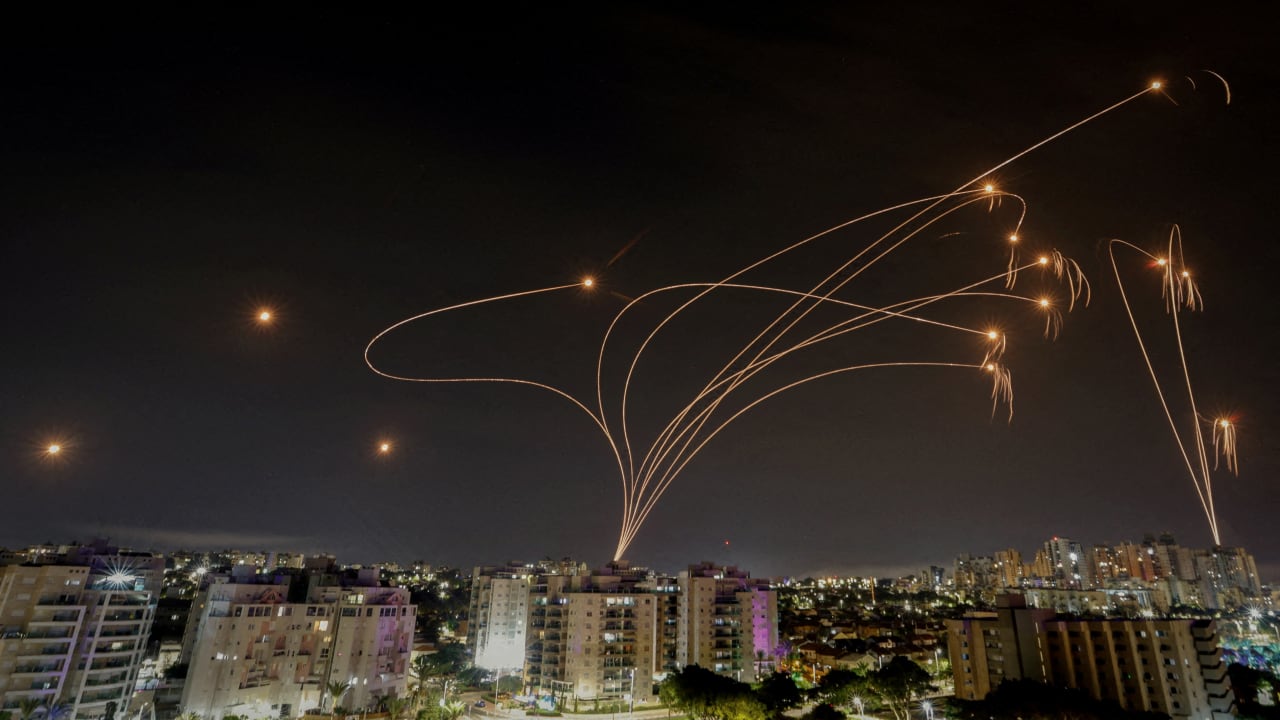
I have been under aerial attack twice this year, once in Kyiv and once in the Gulf. The missile is the part everyone remembers. It is loud and it leaves a crater. But it was never the whole attack. Something quieter runs alongside it, and its target is whether a frightened population still believes what its own government tells it. A forged alert. A rumor that the shelters are full. Panic that travels faster than any correction. In the case of the crater, it gets repaired. But distrust does not.
Israel solved the first half of this problem. When rockets cross the border, a system detects them, picks out the ones that threaten people, and intercepts them before they land. The Iron Dome works because it is layered, automatic, always on, and built at home.
For the second half, the forged alert and the engineered panic, Israel and the United States have nothing of the kind. They have press offices.
And here is where the gap lies. Two of the most targeted democracies on earth are defended overhead and exposed online.
Governments still file hybrid warfare under emerging threats. It is no longer emerging. During this year’s war with Iran, fabricated content was one of the fronts. An AI-generated video of a barrage striking Tel Aviv, of crowds fleeing an airport, of captured American troops, all spread across social media faster than anyone could debunk it. On the Iranian side, the strike and the story are now planned at the same table. A defender who answers the missile from one building and the rumour from another has already lost ground the attacker never had to take.
The numbers are clear. The European Union’s foreign service, reviewing some 43,000 disinformation items from last year, found that 88 percent moved through a single platform, X. The use of AI to manufacture them rose more than 250 percent in a year. During the war with Iran, BBC Verify tracked fabricated war footage drawing hundreds of millions of views, with individual fakes clearing 100 million each within days. The corrections, when they came, reached a fraction of that.
This is the gap a press office is being asked to close with a phone call.
The recommendation is straightforward. The US and Israel should each take information resilience out of the hands of their communications people and stand it up the way they stood up missile defense. As infrastructure. With a budget, a staff, and a place in the chain of command.
Today, when disinformation hits, the only government body that responds is the press office, and the only tool the press office has is to ask a social media platform to take the post down. The platform may act, slowly, or it may not act at all. That is the wrong setup when a hostile influence operation hits during a live missile exchange. It is an attack on command and control. It is built to sever the link between what a government tells its citizens and whether they act on it, at the moment that link decides who reaches a shelter in time.
Some Democracies may find this next part uncomfortable. A hostile state rarely has to invent the panic from scratch. Our own information space hands it the raw material. Engagement merchants and partisan amplifiers repeat almost anything that travels and pay no penalty when it proves false. Some of the fakery is pushed by coordinated networks. Some is simply pushed by creators chasing views. Either way, the adversary does not need to build an audience. It feeds a forged document to the unreliable voices that already have one, and the ecosystem distributes it free.
This is how the confusion reaches an ordinary reader in Ohio or Bavaria. Iranian and Russian state outlets do not stay inside their borders. Their framing is laundered through alternative media and reposted by domestic amplifiers until it surfaces in a Western feed stripped of the label that says this is Tehran’s version, or Moscow’s. The reader who has drifted off mainstream outlets is not foolish. The problem governments are facing is structural. The alternative space has no verification layer. A careful, skeptical person there is still flying without instruments.
Going after those voices is the wrong fight, because in an open society the government cannot silence its own loudest amplifiers and should not try. The answer is to build something faster and more trusted than they are, so that when a forged claim appears, the real source reaches the public first and the amplifiers are left repeating a story the audience has already heard corrected.
The capability cannot be improvised. In the United States, much of the machinery for countering foreign influence, a fair amount of it built during the first Trump administration, has been taken apart over the past year. The coordinating office is gone. Nothing clear has replaced it. A capability with no permanent home, no protected budget, and no command of its own can be dismantled in a single news cycle. Nobody dismantles Iron Dome between conflicts. Neither country should be able to dismantle this either.
Estonia offers a working model. After a coordinated cyberattack hit its government, banks and media in 2007, the Estonians did not respond by convening a committee. They built information resilience into national defense as permanent infrastructure, with the civilian and military sides working together and digital literacy taught from school age. The result is a small, exposed democracy that is genuinely hard to panic. The model scales.
An Iron Dome for the information war has the same architecture as the one overhead. Detection. Interception. A population it protects.
The risk in building this capability is that it drifts inward, because the unreliable domestic voices are a vulnerability to outrun and cannot be treated as a target to silence. Defending against a foreign operation is one thing, and a government deciding what its own citizens may say is another, and the line between them cannot be allowed to blur. Iron Dome points outward, never at the people it protects, and this system has to be built the same way, with a narrow mandate, real oversight, and a single direction of fire.
Israel built an Iron Dome because rockets were getting through and the old answers were not enough. The forged alerts and the engineered panic are getting through now, at a scale and speed the old answers cannot touch on both sides of this alliance. The next attack is already being drafted somewhere. It will not wait for a press office to answer.
David Zaikin is the founder and CEO of Key Elements Group