
Last week, I stood on Avenue M in Flatbush, Brooklyn, in the heart of one of the most established Orthodox Jewish neighborhoods in the United States.
The street looked familiar to anyone who knows Jewish New York: kosher stores, Hebrew signs, families rushing from one place to another, and the dense energy of a community that has carried Jewish life in America for generations.
Inside a nearby venue, the event was supposed to be simple: a real estate fair for American Jews interested in buying homes or investing in property in Israel. It was not a government rally. It was not an official Israeli public diplomacy event. It was not a political convention. It was a business and community gathering about apartments, investments, construction projects, and the bond many Diaspora Jews feel with Israel.
Outside, the scene looked very different.
Hundreds of protesters crowded the sidewalks, waving Palestinian flags and chanting “Allahu Akbar.” The atmosphere was angry and charged. What disturbed me most was the coalition that had gathered there.
There were progressive American activists, religious Muslims, and, standing beside them, members of Neturei Karta, a fringe ultra-Orthodox anti-Zionist sect known for joining anti-Israel demonstrations.
These groups share almost no common worldview. In most other settings, they would reject one another’s values, politics, and way of life. Yet on Avenue M, they stood together because they had found one thing in common: opposition to Israel.
Growing culture of ignorance
That moment forced me to think about something deeper than the Israeli-Palestinian conflict. The larger danger I saw on that sidewalk was the rise of a culture of ignorance.
Many of the people shouting in the street seemed to know very little about the history, geography, politics, or social reality behind the slogans they were chanting. The cause had become a cultural identity marker. It had become a badge of belonging. In the social media age, many people no longer ask whether they understand a conflict. They ask which side their peer group expects them to join.
At one point, I noticed a young American woman wrapped in a Palestinian flag, her face covered, shouting slogans against Israel with total confidence. She looked like a product of liberal Western culture. I asked her calmly whether she understood that the freedoms she enjoyed in Brooklyn, including how she dressed and expressed herself, would place her in danger under Hamas rule in Gaza.
She looked at me blankly. She had no idea what I meant.
For her, Gaza was an abstract symbol, a shorthand for victimhood. It was not a real society with power structures, social codes, coercion, religious control, and authoritarian rule. She had absorbed a narrative while remaining disconnected from facts.
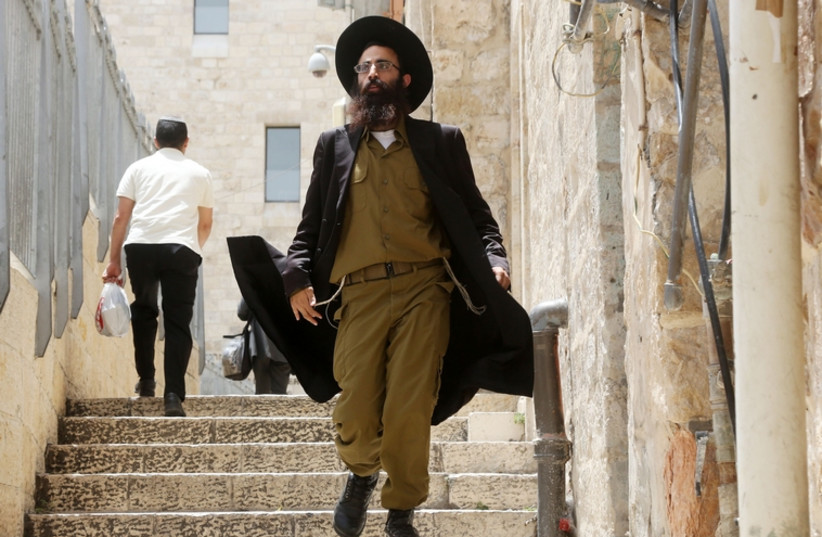
Standing there, thousands of kilometers from Israel, I understood that a version of the same problem is now tearing through Israeli society around one of its most painful issues: the enlistment of haredi (ultra-Orthodox) yeshiva students into the IDF.
For American readers who do not follow the issue closely, the draft debate is one of Israel’s oldest and most explosive domestic conflicts. Most Jewish Israeli citizens are required to serve in the military. For decades, many haredi men, who study full-time in yeshivas, have received exemptions or deferments from service. The arrangement was controversial for years.
After the October 7 massacre and the long war that followed, it has become almost unbearable for large parts of Israeli society.
This anger is justified. It must be said clearly.
The draft issue is not a political invention; it is a real civil and moral crisis. Israel is asking more and more from its soldiers and reservists. Families are being stretched to the breaking point. Small businesses are collapsing because their owners or workers have spent months in reserve duty.
Soldiers have returned from Gaza wounded in body and soul. Many Israelis look at the haredi exemption system and ask a simple question: How can one part of society carry so much while another part remains outside the burden?
That question is fair. It is urgent. It deserves a real answer.
Yet the debate in Israel has moved far beyond serious discussion of military needs, manpower targets, legal formulas, or possible service frameworks. It has become a shouting match between communities that often do not know each other.
Many secular Israelis have never spent real time inside a haredi neighborhood. They have never sat with a yeshiva student and asked what his life looks like, what he believes, what he fears, or why his community views Torah study as central to Jewish survival.
They may strongly reject that worldview, and they have every right to do so. Yet rejection without understanding quickly becomes contempt. In some secular circles, the entire haredi public is described as parasitic, disloyal, or even as an enemy within.
That language is dangerous.
At the same time, many haredim have failed to listen honestly to the other side. They have not listened deeply enough to the mother who has not slept properly since her son entered Gaza. They have not listened to the reservist whose marriage, job, business, and mental health have been damaged by repeated rounds of service.
Too many haredi leaders and spokesmen have framed the draft debate as hatred of religion or persecution of Torah study, rather than grappling with the pain of Israelis who feel abandoned.
That, too, is dangerous.
Into this vacuum step politicians. Many of them are searching for votes rather than solutions. Modern politics feeds on ignorance because ignorance is easy to manipulate. It is easier to inflame a public against a community it does not know than to force both sides into a serious conversation about responsibility, service, identity, and compromise.
The media also plays a role. Outrage performs well on television. Anger drives clicks. Studio shouting is easier to package than a serious discussion about gradual enlistment, civilian service, army needs, educational gaps, religious accommodations, and the future of Israel’s social contract.
The result is a national debate that has stopped being only about draft numbers. Israelis are now arguing over the legitimacy of one another’s lives. Secular Israelis hear haredi refusal as a rejection of shared citizenship. Haredim hear secular anger as an attack on their religious existence.
Each side sees itself as protecting the future of the Jewish people. Each side increasingly sees the other as a threat.
That is where Avenue M and Jerusalem meet.
The strange coalition I saw in Brooklyn was built around a shared enemy. Its members did not need a shared moral vision. They did not need a coherent plan for the future. They only needed a target.
In today’s political culture, shared hostility often creates instant identity.
Israel is now at risk of falling into a similar pattern internally. The haredi draft crisis requires action. It requires fairness. It requires a serious change from the old status quo. Israel cannot ask the same families to sacrifice again and again while leaving the question of haredi service unresolved.
But the path forward cannot be built on ignorance, contempt, or fantasies about the other side disappearing.
A responsible solution will require secular Israelis to understand the haredi world more seriously, even while demanding real participation in the national burden.
It will require haredi leaders to understand that after October 7, Israeli society has changed, and the old answers no longer work. It will require politicians to stop treating both communities as voting blocs. It will require the media to explain more and inflame less.
The greatest danger I saw on Avenue M was not only the hatred toward Israel; it was the confidence of people who had stopped caring whether they understood the truth. They had chosen the comfort of group anger over the harder work of thought.
That same temptation now exists inside Israel.
A society that builds its politics on ignorance begins to lose the ability to solve its real problems. Israel cannot afford that. American Jews cannot afford to misunderstand it either.
The draft crisis is about equality of service. It is about security. It is about the future of haredi society. It is about the limits of an old Israeli compromise that has finally cracked under the weight of war.
Above all, it is about whether Jews with profoundly different lives can still speak to one another before shouting becomes the only language left.
The writer is an anchor and director of news at Radio Kol Barama.